aımnova
DashboardMy LearningCrash CoursesStudy Plan

Aimnova site navigation

Stay in the loop

Get the latest study resources and updates

New features, study tips and exam insights — straight to your inbox.

IB Diploma

  • IB Past Papers
  • IB Study Notes
  • IB Question Bank
  • IB Mock Exams
  • IB Revision

IB Subjects

  • IB Math AA
  • IB Math AI
  • IB Economics
  • IB Business Management
  • IB Physics
  • IB Biology
  • View all IB subjects→

IB Past Papers

  • IB Math AA HL Past Papers
  • IB Math AA SL Past Papers
  • IB Math AI HL Past Papers
  • IB Math AI SL Past Papers
  • IB Economics HL Past Papers
  • IB Economics SL Past Papers
  • IB ESS Past Papers
  • View all past papers→

Study Resources

  • Study Notes
  • Question Bank
  • Mock Exams
  • Crash Courses
  • Flashcards
  • Revision Guide
  • Exam Skills
  • Command Terms
  • Grade Calculator
  • Exam Timetable 2027

Aimnova

  • Features
  • Pricing
  • For Teachers
  • For Schools
  • For Parents
  • About Us
  • Blog
  • Contact
aımnova

IB study, practice and feedback built around the real exam.

TermsPrivacyCookies·© 2026 Aimnova. All rights reserved.d9e1c61

Aimnova is not affiliated with or endorsed by the International Baccalaureate Organization (IB).

NotesSports, Exercise and Health Science HLTopic 10.1
Unit 10 · Stress and coping · Topic 10.1

IB Sports, Exercise and Health Science HL — Arousal and anxiety

Arousal and anxiety

Higher Level students should use this topic hub as a map: start with the shared sub-topics, then follow the HL-only extensions and exam-skill links where this topic asks for deeper analysis.

Exam technique guidePractice questions

Key concepts in Arousal and anxiety

Start here: Most questions on this topic are about anxiety and catastrophe theory, then how anxiety is measured. Separate cognitive from somatic anxiety and label both axes on any sketch.

1. Arousal theories

  • Arousal: physical and psychological activation.
  • Drive theory: performance rises with arousal; best for simple or well-learned skills.
  • Inverted U: best at moderate arousal, a gradual fall either side.
  • IZOF: each athlete has her own best zone.

2. Anxiety

  • Cognitive (worry) and somatic (bodily signs) anxiety.
  • Catastrophe theory: high cognitive anxiety plus high arousal: a sudden, sharp drop.
  • Some anxiety can help: excitement rather than fear.

3. Measuring it

  • Subjective: self-report questionnaires.
  • Objective: heart rate, blood pressure, galvanic skin response.
  • Self-report limits: bias, self-awareness, hard to use mid-competition.

Three athletes, three zones of optimal functioning.
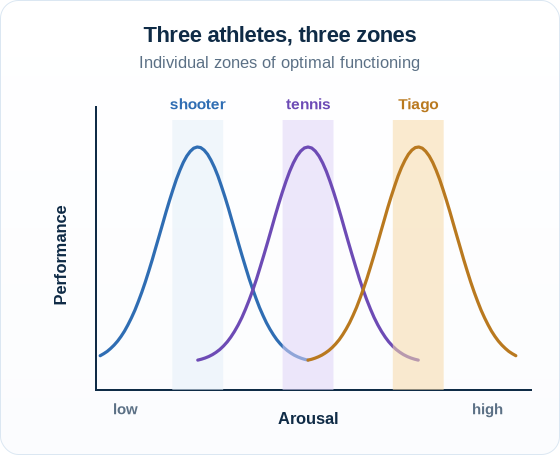
Three inverted U curves with zones at low, moderate and high arousal
Recap: three athletes, three zones.

Catastrophe theory: the sudden drop.
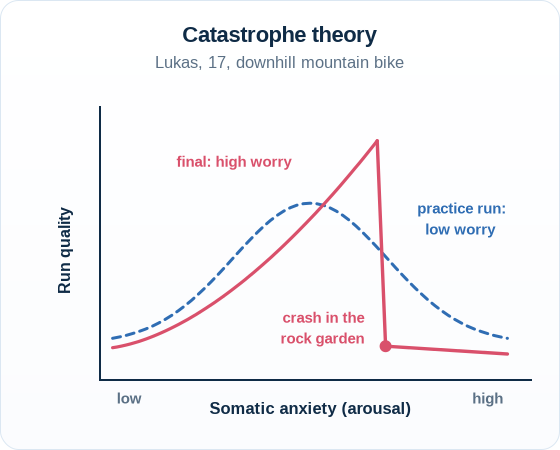
Catastrophe theory: gentle curve with low worry, sudden collapse with high worry
Recap: catastrophe theory.

Inside My Learning

Turn these notes into practice

Try each question, reveal a clear model answer, and learn how to build your response.

  • 1.Describe catastrophe theory. [3]
  • 2.Explain how galvanic skin response measures anxiety. [2]
  • 3.Outline one limitation of measuring anxiety by questionnaire. [1]
Claim your free topic

Key terms, one line each:

TermIn one line
Arousalphysical and psychological activation
Cognitive anxietyworry and negative thoughts
Somatic anxietyphysical signs: heart rate, tension, sweating
IZOFan athlete's individual zone of optimal functioning
Galvanic skin responseskin conductance, rising with sweat

Inside My Learning

Turn these notes into practice

Try each question, reveal a clear model answer, and learn how to build your response.

  • 1.Which theory says more arousal is always better?
  • 2.Racing heart: cognitive or somatic?
  • 3.Is heart rate subjective or objective?
Claim your free topic
IB-style questionDiscuss[4 marks]

Discuss how anxiety could affect a swimmer in an Olympic final.

Model answer plan

See the mark-by-mark plan — for / against / judgement, with marking guidance — in study mode.

Claim your free topic →

Exam tips

  • Catastrophe = high cognitive anxiety and high arousal: a rapid decline.
  • Inverted U: gradual rise, optimum at moderate arousal, gradual fall.
  • GSR chain: anxiety, more sweating, higher skin conductance.
  • In a sketch, label both axes and the optimal point.
  • Self-report limits: subjective, social desirability, hard to use mid-event.

What you'll learn in Topic 10.1

  • 10.1.1 Arousal and performance
  • 10.1.2 Anxiety and performance
Suggested study order: Read the notes for each sub-topic below → test yourself with flashcards → attempt practice questions → review exam technique.

Study resources — 10.1 Arousal and anxiety

10.1.1

Arousal and performance

Notes
10.1.2

Anxiety and performance

Notes

Ready to study Arousal and anxiety?

Get expert practice questions with instant AI feedback, and a study planner tailored to your IB Sports, Exercise and Health Science HL exam date.

Start studying free

Topic 10.1 Arousal and anxiety forms a core part of Unit 10: Stress and coping in IB Sports, Exercise and Health Science HL. Mastering these concepts will strengthen your understanding of connected topics across the syllabus and prepare you for exam questions that require analysis, evaluation, and real-world application.

Previous topic
9.3 Motivational climate
Next topic
10.2 Coping
All Sports, Exercise and Health Science HL topics
Exam technique

Ready to practice?

Get AI-graded practice questions, mock exams, flashcards, and a personalised study plan — all aligned to your IB syllabus.

Start Studying Free

No credit card required · No time limit