What 'der Artikel' is: The article (der Artikel) is a key Paper 1 text type. It is written to inform and entertain a general readership — not one named person. Learn the building blocks below, then use them in reading and writing.
What an article has
- It appears in a magazine, a newspaper or on a website.
- A catchy headline.
- An engaging hook.
- Developed body points.
- A rounded conclusion.
- No greeting and no sign-off.
- der Artikel
- the article
- die Überschrift / der Titel
- the headline / title
- der Einstieg / der Aufhänger
- the hook / opening that grabs the reader
- der Hauptteil
- the body (main part)
- der Schluss / das Fazit
- the conclusion / closing
- die Leserschaft / das Publikum
- the readership / audience
- informieren und unterhalten
- to inform and entertain
- halbformell / sachlich, aber locker
- semi-formal / factual but light
- der Zwischentitel
- the subheading
- das Zitat
- the quotation
- die Zeitschrift / die Zeitung
- the magazine / the newspaper
- kurz gesagt / zusammenfassend
- in short / to sum up
- heutzutage / immer mehr
- these days / more and more
| Useful article phrase (German) | English |
|---|---|
| Was steckt hinter diesem Phänomen? | What is behind this phenomenon? (a hook question) |
| Heutzutage spricht man viel über … | These days people talk a lot about … (a topical opener) |
| Tatsächlich zeigen viele Beispiele … | In fact, many examples show … (developing a point) |
| Hinzu kommt, dass … | On top of that, … (adding a second point) |
| Kurz gesagt, … | In short, … (rounding off the topic) |
Why this matters: An article is judged on conventions (Criterion C): a headline, a hook and a rounded conclusion in a semi-formal, lively register. Greet or sign off like a letter and you lose those marks — an article never says „Hallo!“ or „Mit freundlichen Grüßen“.
Real tasks where it was an option
- Tell your town what you learned at an exhibition on German festivals (SL Nov 2020)
- A cycling club’s bike weekend: inform and convince residents (SL May 2026)
- Encourage classmates to join the new parkrun (SL May 2026)
- How technology is changing our food (HL Nov 2023)
Conventions the examiner checks
- Schlagzeile + Untertitel
- A hook, then paragraphs with facts, examples, quotes
- Name der Autorin / des Autors
Traps that cost Criterion C
- No headline
- Writing to one person as in a letter
- Facts with no structure or no conclusion
Free preview
Reading it is one thing — hearing it is another
You're reading the free notes. Aimnova Pro unlocks the full study experience — and you can try it with your first topic free to keep:
- Audio on every wordTap any vocabulary word or example to hear it read aloud in natural German.
- FlashcardsLock in vocabulary and key terms with spaced repetition.
- Practice questionsAnswer exam-style questions and get instant AI marking.
- Mock exams & past-paper vaultSit full mocks and see exactly how examiners award marks.
- Personalised study planA daily plan built around your exam date and weak areas.
An article argues, it doesn't just list: An article informs the general reader while keeping them entertained. To score Criterion B (Message) you must develop each point — never just assert it.
Develop each point
State a point
Say one clear idea.
Add a connector
Link it to what comes next.
Back it up
Give an example, a figure or a short quotation.
Point → connector → evidence
Phrases to open and develop an article
- Was steckt hinter …? / Stimmt das wirklich? — What is behind …? / Is that really true? (hook questions)
- Heutzutage … / Immer mehr Menschen … — These days … / More and more people … (topical opener)
- Tatsächlich … / In Wirklichkeit … — In fact … / In reality … (developing a point)
- Zum Beispiel … / So berichtet … — For example … / As … reports … (giving evidence)
- Kurz gesagt … / Alles deutet darauf hin, dass … — In short … / Everything suggests that … (closing)
An article (der Artikel)
- Überschrift, Aufhänger, Schluss — kein Gruß, keine Anrede an eine Person.
- Halbformeller, lebendiger Ton für ein breites Publikum.
- Informiert UND unterhält, mit Beispielen und Zitaten.
A letter / an email (zum Vergleich)
- Gruß und Schlussformel: „Hallo Anna!“ … „Liebe Grüße“.
- Richtet sich an EINE Person (du/Sie).
- Persönliches Anliegen, kein breites Publikum.
Link your ideas: Connectors turn a list into an argument: außerdem (besides), hinzu kommt, dass (on top of that), jedoch (however), deshalb (therefore). Use two or three so the article reads as developed prose, not bullet points.
Study smarter, not longer
Most students waste 40% of study time on topics they already know. Our AI tracks your progress and optimizes every minute.
Read like Paper 2: Here is a short article — the kind of media text Paper 2 (Reading) gives you. Read it once just for the gist; don't worry about every word.
How to use this text
- Tap the audio button to hear it.
- Tap Übersetzung anzeigen if you get stuck.
- Then we'll do one exam question together.
Die Jugend liest wieder: Die Jugend liest wieder. Heutzutage spricht man viel über Bildschirme, aber kaum jemand weiß, dass die Bibliotheken voller sind als je zuvor. Was steckt hinter diesem Phänomen?
Die Jugend liest wieder (Fortsetzung)
Immer mehr Jugendliche entdecken das Lesen dank der sozialen Medien, wo Tausende von Nutzern jeden Tag Bücher empfehlen. Eine Schülerin aus Hamburg erzählt: „Früher fand ich Bücher langweilig, doch seit ich Lesetipps online teile, lese ich fast jede Woche einen Roman.“ Kurz gesagt, gilt das Lesen nicht mehr als etwas Altmodisches, sondern als eine moderne Art, Geschichten zu teilen.
- Was steckt dahinter?
- what is behind it?
- etwas empfehlen
- to recommend something
- altmodisch
- old-fashioned
- kurz gesagt
- in short
- Geschichten teilen
- to share stories
IB-style task — eine Frage aus Paper 2
Eine Frage, Schritt für Schritt
- The question — „Welches Mittel benutzt der Artikel im ersten Absatz, um den Leser zu fesseln?“
- Find it in the text. Look at the opening: the headline „Die Jugend liest wieder“ and the question „Was steckt hinter diesem Phänomen?“
- The answer — Die Überschrift nennt das Thema und die Frage „Was steckt hinter diesem Phänomen?“ weckt die Neugier des Lesers.
Reading technique: For a „dem Text zufolge“ (according to the text) question, find the exact line that proves your answer — don't rely on memory or general knowledge.
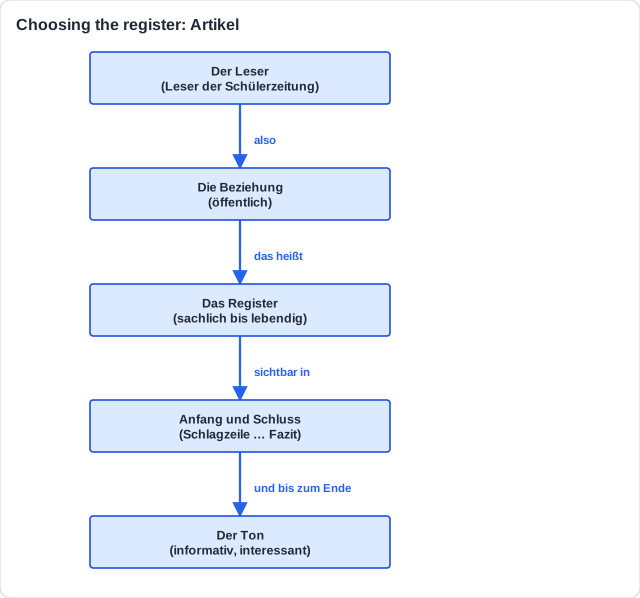
Die Aufgabe — your task: Eure Schülerzeitung sucht Beiträge über die Lesegewohnheiten junger Menschen. Schreibe einen Artikel, in dem du erklärst, warum immer mehr Jugendliche wieder lesen, und ein Beispiel gibst.
Register und Länge — register and length: Halbformelles, lebendiges Register für ein breites Publikum — keine Anrede, kein Gruß. Schreibe zwischen 250 und 400 Wörter.
Article structure — 5 steps
Catchy headline
Short and striking — names the topic. „Die Jugend liest wieder“.
Hook (Aufhänger)
Open with a question or a surprising fact. „Stimmt das wirklich?“
Body point 1 + example
Develop one reason with a concrete example. „In Berlin treffen sich Jugendliche in Lesecafés…“
Body point 2 + connector
Add a second point. „Hinzu kommt, dass soziale Medien das Lesen fördern…“
Rounded conclusion
Close the topic — no sign-off. „Kurz gesagt, ist das Lesen lebendiger denn je.“
Headline → Hook → Body point 1 → Body point 2 → Conclusion
Modell: die 5 Schritte in Aktion
Der fertige Artikel, Schritt für Schritt
- Die Jugend liest wieder
- Heutzutage hört man oft, dass junge Menschen nur noch am Bildschirm hängen. Aber stimmt das wirklich?
- Tatsächlich zeigen viele Beispiele das Gegenteil: In Berlin etwa treffen sich Jugendliche in Lesecafés, um über ihre Lieblingsbücher zu sprechen.
- Hinzu kommt, dass soziale Medien das Lesen sogar fördern, denn dort empfehlen sich die Nutzer ständig neue Romane.
- Kurz gesagt, ist das Lesen lebendiger denn je. Vielleicht ist es Zeit, das alte Vorurteil über die „faule Jugend“ endlich zu vergessen.
Warum es punktet — why it scores: This answer hits all three Paper 1 criteria — here's what earns each one:
A — Language /12
- Connectors: „tatsächlich“, „hinzu kommt, dass“
- Topic vocabulary, used accurately
- A range of structures and tenses
B — Message /12
- Task fully done: explains the reason AND gives an example
- Points developed, not just listed
C — Conceptual /6
- Article conventions: a catchy headline
- A hook and a rounded conclusion
- Semi-formal, lively register — no greeting/sign-off
Practice with exam-style questions
Answer exam-style questions and get AI feedback that shows you exactly what examiners want to see in a full-marks response.
Hörverstehen — ein Radiobeitrag über Repair-Cafés
Paper 2 tests listening (25 marks): you hear short clips, each played twice, and you never see the words. Read the questions first, then listen and reveal the answers.
Du hörst einen kurzen Radiobeitrag, in dem eine Journalistin über einen neuen Trend unter Jugendlichen berichtet.
- Was zeigt die Umfrage aus Graz dem Beitrag zufolge? (What does the Graz survey show?)
- Wie hat sich das Verhalten des Schülers geändert? (How has the pupil's behaviour changed?)
Guten Tag und willkommen. Heute geht es um einen überraschenden Trend: Immer mehr Jugendliche reparieren ihre Sachen selbst. Eine Umfrage aus Graz zeigt, dass jeder dritte Teenager schon einmal ein Repair-Café besucht hat. Dort helfen Freiwillige kostenlos, kaputte Handys, Fahrräder oder Kleidung zu reparieren. Ein Schüler erzählt: „Früher habe ich alles weggeworfen, aber jetzt bin ich stolz, wenn mein altes Rad wieder fährt.“ Kurz gesagt: Reparieren ist das neue Shoppen.
Good afternoon and welcome. Today we're looking at a surprising trend: more and more young people are repairing their things themselves. A survey from Graz shows that one in three teenagers has already visited a repair café. There, volunteers help for free to repair broken phones, bikes or clothes. One pupil says: "I used to throw everything away, but now I'm proud when my old bike runs again." In short: repairing is the new shopping.
- Dass jeder dritte Teenager schon einmal ein Repair-Café besucht hat.
- Früher hat er alles weggeworfen, jetzt repariert er seine Sachen und ist stolz, wenn sein altes Rad wieder fährt.