The blog post: A blog post (der Blog / der Blogeintrag) is a personal article published online for anyone to read.
What you do in it
- You share an experience or an opinion.
- You write in a lively, friendly voice.
- You talk directly to your readers.
When to choose it: In Paper 1 you choose it when the task asks you to write a blog post / an entry for a website. It's part of Unit 2: Text Types, so the marks come from getting its conventions and register right (Criterion C), not just the message.
- der Blog / der Blogeintrag
- the blog / the blog post (entry)
- die Überschrift / der Titel
- the headline / title (often a question)
- die Einleitung / der Einstieg
- the intro / the hook that grabs the reader
- der Leser / die Leserinnen und Leser
- the reader / the readers
- die persönliche Stimme
- the personal, opinionated voice
- die Kommentare
- the comments (readers reply below)
Spot it in the task: The task names the platform and the public. „Schreibe einen Eintrag für deinen Blog…“, „Schreibe einen Text für den Blog deiner Schule…“ → a blog: written for many readers at once, in a personal but public voice. Read where it will be published and who reads it first.
Real tasks where it was an option
- Reflect on a week of hiking in the Swiss Alps (SL Nov 2020)
- Persuade friends to join a sports holiday by the sea (SL Nov 2021)
- Present the environmental initiative you started (SL Nov 2024)
- The pros and cons of AI at school, from a student’s view (HL May 2025)
Conventions the examiner checks
- ein Titel, der neugierig macht + Datum
- First person: your experience and your opinion
- Was meint ihr? Schreibt es in die Kommentare!
Traps that cost Criterion C
- Writing an essay with no personal voice
- No title or no question to the readers
- Forgetting who the readers are
Free preview
Reading it is one thing — hearing it is another
You're reading the free notes. Aimnova Pro unlocks the full study experience — and you can try it with your first topic free to keep:
- Audio on every wordTap any vocabulary word or example to hear it read aloud in natural German.
- FlashcardsLock in vocabulary and key terms with spaced repetition.
- Practice questionsAnswer exam-style questions and get instant AI marking.
- Mock exams & past-paper vaultSit full mocks and see exactly how examiners award marks.
- Personalised study planA daily plan built around your exam date and weak areas.
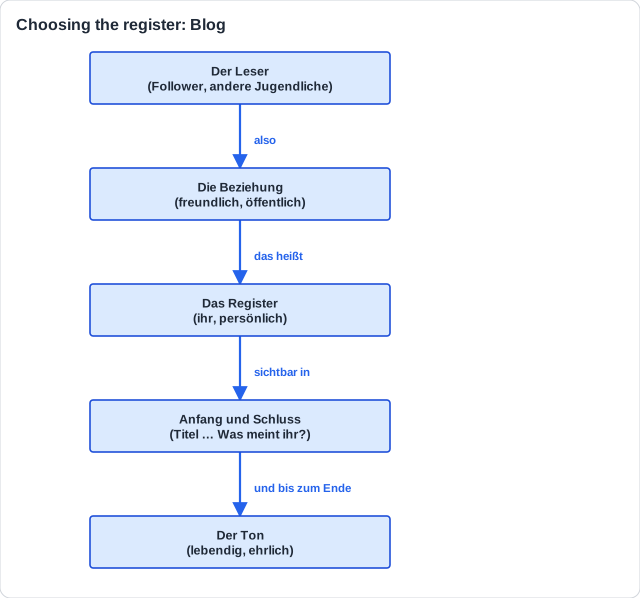
Informal but public: A blog is informal yet public: in German you address many readers at once with the informal plural ihr (and euch / euer).
Keep the blog voice
- Write in a lively, personal voice full of opinion and energy.
- Use exclamations and rhetorical questions.
- Use „ich“ to share your experience.
Consistency matters: Slipping into stiff, neutral or formal „Sie“ kills the lively blog voice and costs you Criterion C.
Blog — do this
- Hallo zusammen! Heute möchte ich euch von … erzählen.
- Ehrlich gesagt, es hat mir riesig gefallen.
- Und ihr, was meint ihr dazu?
Avoid here
- Sehr geehrte Leserinnen und Leser,
- Der vorliegende Text hat zum Ziel, …
- Es wird gebeten, Ihre Kommentare zu hinterlassen.
Talk TO your readers: A blog isn't a private letter and it isn't an essay. Address the crowd directly with ihr (euch, euer), keep the energy up, and let your personal opinion show from start to finish.
See how examiners mark answers
Answer exam-style questions with model answers. Learn exactly what earns marks and what doesn't.
The five parts: Every blog post follows the same shape. Hit all five parts and you've covered the conventions the examiner is looking for.
Blog — 5 parts
Catchy title
A short, eye-catching headline — often a question to the reader. „Einen Monat lang mit dem Rad zur Schule: Könntet ihr das?“
Hook / intro
Greet the readers and introduce your topic with energy. „Hallo zusammen! Heute möchte ich euch von … erzählen.“
Body
Tell your story or argue your opinion in a personal voice — the longest part. „Am Anfang war es richtig hart, aber nach und nach …“
Question to readers
Turn the topic back to your audience to spark a reply. „Und ihr, was meint ihr dazu?“
Upbeat close
Sign off warmly and invite comments. „Bis zum nächsten Mal — hinterlasst mir eure Kommentare!“
Title → Hook → Body → Question → Close
Don't skip the frame: Students lose easy Criterion C marks by forgetting the catchy title or the question to readers — the two features that make a text feel like a real blog. They take seconds and show you know the text type — never leave them out.
A model, part by part: Here's a complete blog post built from the five parts above. Read it once for the message, then tap Übersetzung anzeigen to check the English or the audio button to hear it.
Modell: die 5 Teile in Aktion
Der fertige Blogeintrag, Teil für Teil
- Einen Monat lang mit dem Rad zur Schule: Könntet ihr das?
- Hallo zusammen! Heute möchte ich euch von einer etwas verrückten Herausforderung erzählen, die ich mir im November vorgenommen habe: jeden Tag mit dem Fahrrad zur Schule zu fahren, egal bei welchem Wetter.
- Am Anfang war es richtig hart: Es war dunkel, es regnete oft, und die acht Kilometer kamen mir endlos vor. Aber nach und nach wurde ich fitter, kam wacher im Unterricht an und sparte sogar das Geld für die Busfahrkarte. Ehrlich gesagt habe ich mich selten so gut gefühlt.
- Und ihr, was meint ihr? Würdet ihr es schaffen, einen ganzen Monat lang auf Bus und Auto zu verzichten?
- Ich kann euch nur ermutigen, es auszuprobieren: Vielleicht entdeckt ihr ja etwas, so wie ich. Bis zum nächsten Mal — und hinterlasst mir eure Kommentare unten!
Warum es punktet — why it scores: This short blog post earns marks on all three Paper 1 criteria — here's how:
A — Language /12
- Lively, accurate language; „ihr“ throughout
- Connectors & variety: „am Anfang“, „nach und nach“, „vor allem“, „aber“
- Correct tenses (möchte, war, wurde, habe gefühlt)
B — Message /12
- Clear purpose: shares an experience AND a reflection
- Ideas developed (the challenge, the results)
C — Conceptual /6
- Blog conventions: catchy title + question to readers
- Consistent public-informal register („ihr“)
- Lively, personal, opinionated voice
Study smarter, not longer
Most students waste 40% of study time on topics they already know. Our AI tracks your progress and optimizes every minute.
A toolkit you can reuse: Learn a few ready-made phrases for each part. They make your blog sound natural and save time in the exam. Tap the audio button to hear them.
Für den Einstieg (hook)
- Hallo zusammen! — Hi everyone!
- Heute möchte ich euch von … erzählen. — Today I want to tell you about…
- Habt ihr euch schon einmal gefragt, …? — Have you ever wondered…?
Für den Hauptteil (opinion & story)
- Ich erzähle euch von meiner Erfahrung … — Let me tell you about my experience…
- Ehrlich gesagt … / Meiner Meinung nach … — Honestly… / In my opinion…
- Am Anfang … aber nach und nach … — At first… but little by little…
Für den Schluss (question + close)
- Und ihr, was meint ihr dazu? — And what about you, what do you think?
- Ich kann euch nur ermutigen, es auszuprobieren. — I can only encourage you to try it.
- Bis zum nächsten Mal! Hinterlasst mir eure Kommentare. — See you next time! Leave me your comments.
Use one from each: One hook, one or two opinion phrases in the body, and a question + sign-off at the end is plenty — and instantly makes the text feel like the real blog text type.