What 'Ethik' covers: Ethics (die Ethik) sits in the theme Sharing the Planet. Learn the words below as a deck, then use them in the reading and writing sections.
What you need words for
- Right and wrong
- Moral dilemmas
- Values and duty
- Responsible behaviour
- Arguing both sides of a choice
- die Ethik / ethisch
- ethics / ethical
- die Moral / moralisch
- morality / moral
- das (moralische) Dilemma
- a (moral) dilemma
- der Wert (die Werte)
- value(s)
- die Ehrlichkeit — ehrlich
- honesty — honest
- die Verantwortung — verantwortungsvoll
- responsibility — responsible
- die Pflicht
- duty
- das Gewissen
- conscience
- gerecht / ungerecht
- fair / unfair
- der verantwortungsvolle Konsum
- responsible consumption
- der faire Handel
- fair trade
- die Ausbeutung
- exploitation
- das Richtige tun
- to do the right thing
| Useful expression (German) | English |
|---|---|
| Das ist eine Frage der Ethik. | That's a question of ethics. |
| Es ist nicht leicht zu entscheiden, was richtig ist. | It isn't easy to decide what is right. |
| Ich finde das ungerecht. | I find that unfair. |
| Wir haben alle eine Verantwortung gegenüber den anderen. | We all have a responsibility towards others. |
| Mein Gewissen sagt mir, dass … | My conscience tells me that … |
Why this matters: This vocabulary turns up in every skill — a reading text about consumption, a listening interview about volunteering, a Paper 1 opinion piece, or your oral. Reusing the right topic words is how you score Criterion A (Language).
Free preview
Reading it is one thing — hearing it is another
You're reading the free notes. Aimnova Pro unlocks the full study experience — and you can try it with your first topic free to keep:
- Audio on every wordTap any vocabulary word or example to hear it read aloud in natural German.
- FlashcardsLock in vocabulary and key terms with spaced repetition.
- Practice questionsAnswer exam-style questions and get instant AI marking.
- Mock exams & past-paper vaultSit full mocks and see exactly how examiners award marks.
- Personalised study planA daily plan built around your exam date and weak areas.
Argue both sides: Ethics questions are rarely black and white — examiners reward you for weighing up a choice. Take a position, but show you see the other side too.
The common debates around ethics
- Honesty vs self-interest
- Responsible vs cheap consumption
- How far our individual choices really matter
Opinion & argument phrases
- Meiner Meinung nach… / Aus ethischer Sicht… — In my opinion… / From an ethical point of view…
- Ich finde es (un)gerecht, dass… — I find it (un)fair that…
- Das Richtige wäre, … — The right thing would be to…
- Einerseits… andererseits… — On the one hand… on the other hand…
- Letztendlich kommt es darauf an, … — In the end, what matters is…
Pro: das Richtige tun (the case for acting ethically)
- Mit gutem Gewissen lebt es sich leichter.
- Jede kleine Entscheidung trägt zu einer gerechteren Welt bei.
- Wir tragen Verantwortung gegenüber anderen Menschen.
Contra: die Schwierigkeiten (the obstacles)
- Ethisch zu konsumieren ist oft teurer.
- Manchmal ist nicht klar, was wirklich richtig ist.
- Eine einzelne Person kann nur wenig verändern.
Animals
- Löwen aus einem schlechten Zoo retten
- Tierversuche oder Organchips?
- das Haltungs-Etikett auf dem Fleisch
Everyday choices
- billige Kleidung und Ausbeutung
- eine gefundene Geldbörse abgeben
- ein Handyverbot: Schutz oder Bevormundung?
Big dilemmas
- das Gewissen gegen die Pflicht
- Forschung gegen Tierschutz
- Wildtiere privat halten?
Big questions behind this topic (IB guide, theme Sharing the planet)
- Dürfen Menschen Tiere für ihre Zwecke nutzen?
- Was ist wichtiger: ein günstiger Preis oder faire Bedingungen?
- Woher wissen wir, was richtig und was falsch ist?
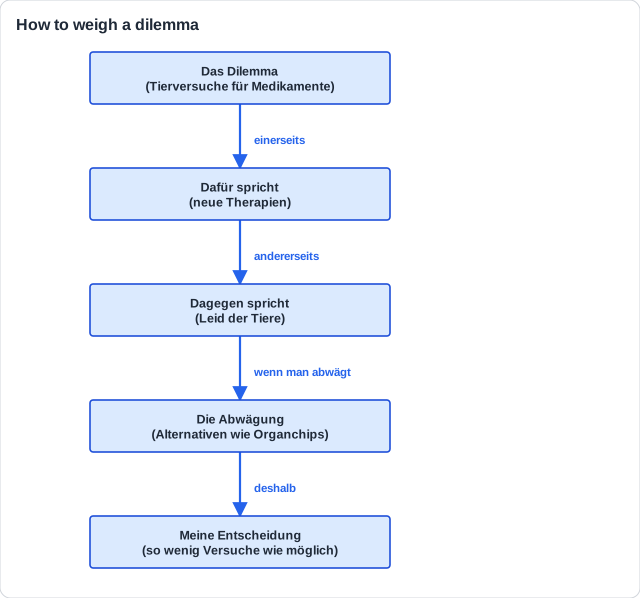
Link your ideas: Connectors turn a list into an argument: außerdem (besides), jedoch / aber (however), deshalb (therefore), obwohl (although). Use at least two or three in any written answer, especially when arguing both sides.
Learn what examiners really want
See exactly what to write to score full marks. Our AI shows you model answers and the key phrases examiners look for.
Read like Paper 2: Here is a short blog — the kind of text Paper 2 (Reading) gives you. Read it once just for the general idea.
How to read it
- Don't worry about every word.
- Tap the audio button to hear it, or Übersetzung anzeigen if you get stuck.
- Then we'll do one exam question together.
Woher kommt meine Kleidung? (1 of 2): Letztes Jahr fing ich an, mich zu fragen, woher meine Kleidung eigentlich kam. Früher kaufte ich sehr billige T-Shirts, ohne weiter darüber nachzudenken.
Eines Tages las ich, dass sich hinter so niedrigen Preisen oft Menschen verbergen, die unter schlechten Bedingungen arbeiten. Das fand ich ungerecht, und ich beschloss, meine Gewohnheiten zu ändern.
Woher kommt meine Kleidung? (2 of 2)
Jetzt kaufe ich weniger, ich wähle verantwortungsvolle Marken und, wenn ich kann, spende ich die Kleidung, die ich nicht mehr trage. Es ist nicht immer leicht und auch nicht billig, aber es lohnt sich. Ich bin überzeugt, dass die kleinen täglichen Entscheidungen auch ethische Entscheidungen sind und dass wir alle zusammen gerechter konsumieren können.
- sich verbergen
- to be hidden / to hide
- unter schlechten Bedingungen
- under bad conditions
- etwas beschließen
- to decide something
- verantwortungsvolle Marken
- responsible brands
- es lohnt sich
- it's worth it
IB-style task — eine Frage aus Paper 2
Eine Frage, Schritt für Schritt
- The question — „Warum beschloss die Person dem Text zufolge, ihre Gewohnheiten zu ändern?“
- Find it in the text. Look for „ändern“: „Das fand ich ungerecht, und ich beschloss, meine Gewohnheiten zu ändern.“ — and just before it: „Menschen, die unter schlechten Bedingungen arbeiten.“
- The answer — Weil sie las, dass hinter den billigen Preisen Menschen unter schlechten Bedingungen arbeiteten, und das ungerecht fand.
Reading technique: For a „dem Text zufolge“ (according to the text) question, find the exact line that proves your answer — don't rely on memory or general knowledge.
Die Aufgabe — your task: Deine Schule veranstaltet eine Woche des verantwortungsvollen Konsums. Schreibe einen Vorschlag an die Schulleitung.
Der Auftrag — what to do
- Beschreibe ein Projekt für ethischeren Konsum an deiner Schule.
- Begründe, warum es sinnvoll ist.
- Schreibe zwischen 250 und 400 Wörtern.
Proposal structure — 3 steps
Addressee + aim
Say who the proposal is for and what it aims to do. „Vorschlag an die Schulleitung: eine Kleidertauschbörse… Ziel ist, …“
The plan
Give a concrete plan: how often, where, who organises. „Einmal im Monat bringen Schülerinnen und Schüler…“
Justification + request
Say why it is worth it, then ask formally. „Eine Tauschbörse spart Geld… Wir bitten Sie deshalb, …“
Aim → Plan → Justification
Modell: die 3 Schritte in ~100 Wörtern
Der fertige Vorschlag, Schritt für Schritt
- Vorschlag an die Schulleitung: eine Kleidertauschbörse im Schulfoyer. Ziel ist, dass weniger Kleidung gekauft und weggeworfen wird.
- Einmal im Monat bringen Schülerinnen und Schüler saubere Kleidung mit, die sie nicht mehr tragen, und tauschen sie gegen andere Stücke. Die Schülervertretung organisiert die Börse; was übrig bleibt, spenden wir an das Rote Kreuz.
- Viele von uns kaufen billige Mode, ohne zu fragen, wer sie hergestellt hat. Eine Tauschbörse spart Geld, schont die Umwelt und zeigt, dass Konsum auch fair sein kann. Wir bitten Sie deshalb, uns das Foyer am ersten Freitag jedes Monats zur Verfügung zu stellen. – Jonas Wagner, Schülervertretung
Warum es funktioniert — what makes it strong: A strong proposal does these things for each of the three Paper 1 criteria:
A — Language /12
- Passive: „gekauft und weggeworfen wird“
- „ohne zu“ + infinitive: „ohne zu fragen“
- Ethics vocabulary: „tauschen“, „die Umwelt schonen“, „fair“
B — Message /12
- Task fully done: describes the project AND justifies it
- Each benefit is concrete (money, environment, fairness)
C — Conceptual /6
- Proposal conventions: the addressee and the aim in the first lines
- A concrete plan: how often, where, who organises
- A justification and a formal request: „Wir bitten Sie deshalb …“
Never wonder what to study next
Get a personalized daily plan based on your exam date, progress, and weak areas. We'll tell you exactly what to review each day.
Hörverstehen — Lauras Ehrenamt
Paper 2 tests listening (25 marks): you hear 3 short clips, each played twice, and you never see the words. Read the questions first, then listen and reveal the answers.
Du hörst Laura darüber, warum sie sich ehrenamtlich engagiert und was ihr dabei wichtig ist.
- Warum begann Laura, sich ehrenamtlich zu engagieren? (Why did she start volunteering?)
- Bekommt Laura Geld für ihre Hilfe? (Does she get paid?)
Hallo, ich heiße Laura. Vor zwei Jahren fing ich an, mich ehrenamtlich zu engagieren, nachdem ich eine ältere Nachbarin gesehen hatte, die allein lebte und niemanden hatte, der ihr half. Ich hatte das Gefühl, es sei meine Pflicht, etwas zu tun. Jetzt mache ich zweimal pro Woche ihre Einkäufe und vor allem leiste ich ihr Gesellschaft. Ich bekomme kein Geld dafür: Für mich ist es ein wichtigerer Wert, anderen zu helfen, als reich zu sein.
Hi, I'm Laura. Two years ago I started volunteering, after I'd seen an elderly neighbour who lived alone and had no one to help her. I felt it was my duty to do something. Now I do her shopping twice a week and, above all, I keep her company. I don't get paid for it: for me, helping others is a more important value than being rich.
- Weil sie eine ältere Nachbarin sah, die allein lebte und niemanden hatte, der ihr half, und sie das Gefühl hatte, es sei ihre Pflicht.
- Nein, sie bekommt kein Geld; für sie ist es ein wichtigerer Wert, anderen zu helfen.