What 'Gleichberechtigung' covers: Equality (die Gleichberechtigung) is part of the theme Sharing the Planet. Learn the words below as a deck, then use them in the reading and writing sections.
What you need words for
- Discrimination
- Diversity
- Rights
- The fight for fair treatment
- Giving your opinion
- die Gleichberechtigung / die Gleichheit
- equality
- die Ungleichheit
- inequality
- die Diskriminierung
- discrimination
- die Vielfalt
- diversity
- die Inklusion
- inclusion
- das Vorurteil
- prejudice
- das Recht (die Rechte)
- the right (rights)
- der Respekt
- respect
- die Lohnlücke
- the pay gap
- jemanden ausgrenzen / ausschließen
- to exclude someone
- gegen etwas kämpfen
- to fight against something
- alle gleich behandeln
- to treat everyone equally
- benachteiligt sein
- to be at a disadvantage / disadvantaged
| Useful expression (German) | English |
|---|---|
| Wir müssen gegen die Diskriminierung kämpfen. | We have to fight against discrimination. |
| Jeder Mensch verdient die gleichen Rechte. | Every person deserves the same rights. |
| Vielfalt ist ein Reichtum, kein Problem. | Diversity is a richness, not a problem. |
| Niemand sollte wegen seiner Herkunft benachteiligt werden. | No one should be disadvantaged because of their background. |
| Wir sollten alle gleich behandeln. | We should treat everyone equally. |
Why this matters: This vocabulary turns up in every skill — a reading text on inclusion, a listening interview about rights, a Paper 1 blog, or your oral. Reusing the right topic words is how you score Criterion A (Language).
Free preview
Reading it is one thing — hearing it is another
You're reading the free notes. Aimnova Pro unlocks the full study experience — and you can try it with your first topic free to keep:
- Audio on every wordTap any vocabulary word or example to hear it read aloud in natural German.
- FlashcardsLock in vocabulary and key terms with spaced repetition.
- Practice questionsAnswer exam-style questions and get instant AI marking.
- Mock exams & past-paper vaultSit full mocks and see exactly how examiners award marks.
- Personalised study planA daily plan built around your exam date and weak areas.
Have something to say: Examiners reward developed ideas, not just vocabulary. Around equality, the common debates are: discrimination and prejudice, the pay gap between men and women, and inclusion of everyone regardless of origin, gender or ability. Take a position and back it up.
Opinion phrases (use these to introduce a view)
- Meiner Meinung nach… / Aus meiner Sicht… — In my opinion… / From my point of view…
- Ich finde es ungerecht, dass… — I find it unfair that…
- Das Wichtigste ist… — The most important thing is…
- Einerseits… andererseits… — On the one hand… on the other hand…
- Ich bin (völlig) davon überzeugt, dass… — I am (completely) convinced that…
Probleme (problems)
- Viele Menschen erleben Diskriminierung wegen ihrer Herkunft oder ihres Geschlechts.
- Frauen verdienen für die gleiche Arbeit oft weniger als Männer.
- Vorurteile und verletzende Kommentare grenzen Menschen aus.
Lösungen (solutions)
- Wir können alle Menschen mit Respekt behandeln.
- Die Schule kann Vielfalt feiern und über Rechte aufklären.
- Transparente Löhne machen die Lohnlücke sichtbar.
Women and men
- immer mehr Mädchen im Kampfsport
- eine Tochter will Handwerkerin werden
- gleicher Lohn für gleiche Arbeit
Inclusion
- die Special Olympics in Berlin
- barrierefreie Posts in sozialen Medien
- ein Musikfestival für Menschen mit und ohne Behinderung
Fair chances
- ein Vermerk zur Legasthenie im Abiturzeugnis
- kostenloses Mittagessen für alle Kinder
- zu alt für den Job?
Big questions behind this topic (IB guide, theme Sharing the planet)
- Haben heute wirklich alle die gleichen Chancen?
- Ist Gleichbehandlung immer gerecht?
- Was muss sich ändern, damit niemand ausgeschlossen wird?
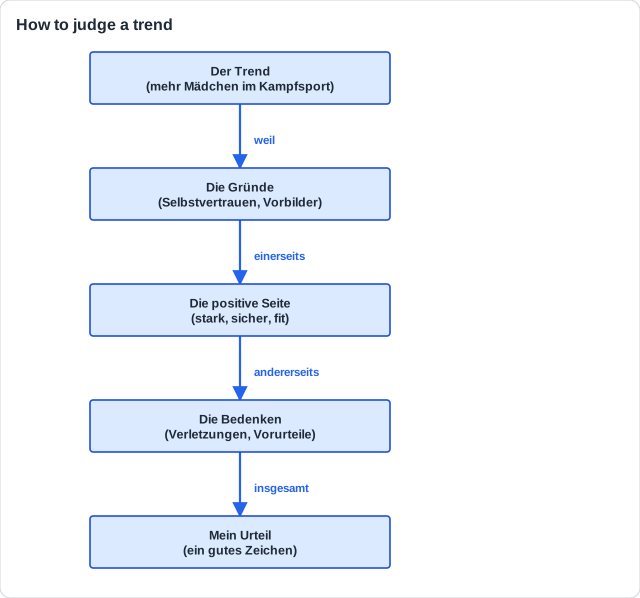
Link your ideas: Connectors lift your answer from a list into an argument: außerdem (besides), jedoch / aber (however), deshalb (therefore), obwohl (although). Use at least two or three in any written answer.
Feeling unprepared for exams?
Get a clear study plan, practice with real questions, and know exactly where you stand before exam day. No more guessing.
Read like Paper 2: Here is a short interview blog — the kind of text Paper 2 (Reading) gives you. Read it once just for the general idea.
How to read it
- Don't worry about every word.
- Tap the audio button to hear it, or Übersetzung anzeigen if you get stuck.
- Then we'll do one exam question together.
Ein Interview über Gleichberechtigung (1 of 3): Für die Schülerzeitung habe ich Lukas interviewt, der in unserer Stadt eine Jugendgruppe für queere Jugendliche leitet. Ich wollte verstehen, warum sein Einsatz für die Gleichberechtigung immer noch nötig ist.
Lukas erzählte mir, dass er sich als Kind anders fühlte und sich niemandem anzuvertrauen wagte.
Ein Interview über Gleichberechtigung (2 of 3)
Deshalb gründete er die Gruppe: einen sicheren Ort, an dem jeder Mensch ohne Angst er selbst sein kann. Er erklärte mir, dass es noch viel Diskriminierung gibt, vor allem verletzende Kommentare in den sozialen Netzwerken. Trotzdem sieht er auch Fortschritte: Heute unterstützen viele Jugendliche die Vielfalt mit Stolz.
Ein Interview über Gleichberechtigung (3 of 3)
Zum Abschied sagte er mir, die Gleichberechtigung werde einem nicht geschenkt, man erkämpfe sie sich Tag für Tag, und es lohne sich, weiterzukämpfen.
- sich jemandem anvertrauen
- to confide in someone
- ein sicherer Ort
- a safe place
- verletzende Kommentare
- hurtful comments
- die Vielfalt unterstützen
- to support diversity
- sich etwas erkämpfen
- to win / fight for something
IB-style task — eine Frage aus Paper 2
Eine Frage, Schritt für Schritt
- The question — „Warum hat Lukas dem Text zufolge die Jugendgruppe gegründet?“
- Find it in the text. Look for „gründete er die Gruppe“: „Deshalb gründete er die Gruppe: einen sicheren Ort, an dem jeder Mensch ohne Angst er selbst sein kann.“
- The answer — Er wollte einen sicheren Ort schaffen, an dem jeder Mensch ohne Angst er selbst sein kann.
Reading technique: For a „dem Text zufolge“ (according to the text) question, find the exact line that proves your answer — don't rely on memory or general knowledge.
Die Aufgabe — your task: Deine Schule organisiert eine Woche für Gleichberechtigung und Vielfalt. Schreibe einen Blog für andere Schülerinnen und Schüler.
Der Auftrag — what to do
- Erzähle, was du über Diskriminierung gelernt hast.
- Gib Tipps, wie man eine gerechtere Gemeinschaft aufbaut.
- Schreibe zwischen 250 und 400 Wörtern.
Blog structure — 5 steps
Catchy title
A title, often a question. „Behandeln wir wirklich alle gleich?“
Greeting + topic
Greet the reader and say what the post is about. „Hallo zusammen! Heute möchte ich mit euch über … sprechen.“
Your experience
Describe what you learned, in the past (Präteritum/Perfekt). „In der Projektwoche habe ich gelernt, dass…“
Two or three tips
Give advice using the imperative. „Hört einander zu“, „sagt etwas, wenn jemand ausgegrenzt wird“, „behandelt alle mit Respekt“.
Motivating close
Finish with an encouraging line. „Macht mit! Gemeinsam wird unsere Schule fairer.“
Title → Greeting → Experience → Tips → Close
Modell: die 5 Schritte in ~120 Wörtern
Der fertige Blog, Schritt für Schritt
- Behandeln wir wirklich alle gleich? Ich habe lange nicht darüber nachgedacht.
- Hallo zusammen! Ich bin Nina, und heute möchte ich mit euch über ein wichtiges Thema sprechen: die Gleichberechtigung an unserer Schule.
- In der Projektwoche habe ich gelernt, dass Diskriminierung oft versteckt ist: ein verletzender Spruch, ein Witz, ein Blick. Mir wurde klar, dass auch kleine Worte jemanden ausgrenzen können.
- Deshalb gebe ich euch drei Tipps: Erstens, hört einander zu; zweitens, sagt etwas, wenn jemand ausgegrenzt wird; und drittens, behandelt alle Menschen mit Respekt, egal woher sie kommen.
- Das Wichtigste ist jedoch, heute anzufangen: Gleichberechtigung wird einem nicht geschenkt, wir bauen sie jeden Tag gemeinsam auf. Macht mit, dann wird unsere Schule ein fairerer Ort für alle!
Warum es funktioniert — what makes it strong: A strong blog does these things for each of the three Paper 1 criteria:
A — Language /12
- Range of tenses: Perfekt „habe gelernt“, Imperativ „hört zu“
- Connectors: „deshalb“, „jedoch“
- Topic vocabulary, used accurately
B — Message /12
- Task fully done: shares a lesson AND gives advice
- Ideas developed with concrete examples
C — Conceptual /6
- Blog conventions: a catchy title
- Direct address: „ich gebe euch“, „macht mit“
- A persuasive, personal tone
Memorize terms 3x faster
Smart flashcards show you cards right before you forget them. Perfect for definitions and key concepts.
Hörverstehen — Mateo und die Inklusion
Paper 2 tests listening (25 marks): you hear 3 short clips, each played twice, and you never see the words. Read the questions first, then listen and reveal the answers.
Du hörst Mateo, der ehrenamtlich für die Rechte von Menschen mit Behinderung arbeitet.
- Was hat Mateos Verein nach und nach erreicht? (What did Mateo's association gradually achieve?)
- Was ist Inklusion für Mateo? (What is inclusion for Mateo?)
Hallo, ich heiße Mateo und ich engagiere mich ehrenamtlich in einem Verein, der die Rechte von Menschen mit Behinderung verteidigt. Früher hatten in meiner Stadt viele öffentliche Gebäude keine Rampen, und deshalb wurden manche Menschen ausgeschlossen. Wir haben mit der Stadtverwaltung gesprochen, und nach und nach haben wir erreicht, dass die Bibliotheken und die Museen für alle zugänglich sind. Für mich ist Inklusion kein Gefallen: Sie ist ein Recht.
Hi, I'm Mateo and I volunteer at an association that defends the rights of people with disabilities. Before, in my city, many public buildings had no ramps, so some people were excluded. We spoke with the town council and, little by little, we got the libraries and museums to be accessible to everyone. For me, inclusion is not a favour: it is a right.
- Dass die Bibliotheken und die Museen für alle zugänglich sind.
- Kein Gefallen, sondern ein Recht.