What 'die Arbeitswelt' covers: The working world (die Arbeitswelt) belongs to the theme Social organisation. Learn the words below as a deck, then use them in the reading and writing sections.
You need words to talk about
- jobs and careers
- work placements and applying for a job
- working conditions and the pay
- your opinion about them
- die Arbeitswelt
- the working world
- der Beruf — die Karriere
- the job / profession — the career
- das Praktikum
- the work placement / internship
- der Ferienjob
- the summer / holiday job
- sich bewerben (um eine Stelle)
- to apply (for a job)
- das Vorstellungsgespräch
- the job interview
- der Lebenslauf
- the CV / résumé
- der Chef / die Chefin
- the boss
- die Kollegin / der Kollege
- the colleague
- das Gehalt / der Lohn
- the salary / pay
- die Arbeitszeiten
- the working hours
- Erfahrung sammeln
- to gain experience
- pünktlich sein
- to be punctual
| Useful expression (German) | English |
|---|---|
| Ich möchte gern Erfahrung sammeln. | I'd like to gain experience. |
| Ich habe mich um ein Praktikum beworben. | I applied for a work placement. |
| Das Gehalt ist nicht hoch, aber die Arbeit gefällt mir. | The pay isn't high, but I like the work. |
| Im Sommer arbeite ich, um mein eigenes Geld zu verdienen. | In summer I work to earn my own money. |
| Mein Traumberuf ist Ärztin. | My dream job is to be a doctor. |
Why this matters: This vocabulary turns up in every skill — a reading text about a first job, a listening interview with a worker, a Paper 1 blog about a placement, or your oral. Reusing the right topic words is how you score Criterion A (Language).
Free preview
Reading it is one thing — hearing it is another
You're reading the free notes. Aimnova Pro unlocks the full study experience — and you can try it with your first topic free to keep:
- Audio on every wordTap any vocabulary word or example to hear it read aloud in natural German.
- FlashcardsLock in vocabulary and key terms with spaced repetition.
- Practice questionsAnswer exam-style questions and get instant AI marking.
- Mock exams & past-paper vaultSit full mocks and see exactly how examiners award marks.
- Personalised study planA daily plan built around your exam date and weak areas.
Have something to say: Examiners reward developed ideas, not just vocabulary. Take a position and back it up.
The common debates around the working world
- whether young people should work during their studies
- doing a placement vs taking a holiday
- what really matters in a job — money or job satisfaction
Opinion phrases (use these to introduce a view)
- Meiner Meinung nach… / Aus meiner Sicht… — In my opinion… / From my point of view…
- Ich finde, dass… / Ich glaube, dass… — I think that… / I believe that…
- Das Wichtigste ist… — The most important thing is…
- Einerseits… andererseits… — On the one hand… on the other hand…
- Ich bin (völlig) der Meinung, dass… — I (completely) think that…
Nachteile eines Ferienjobs (drawbacks)
- Man hat weniger Freizeit in den Ferien.
- Die Arbeitszeiten sind manchmal hart und das Gehalt ist niedrig.
- Man ist oft müde und hat weniger Zeit für Freunde.
Vorteile (benefits)
- Man sammelt Erfahrung und lernt, im Team zu arbeiten.
- Man verdient sein eigenes Geld und wird unabhängiger.
- Ein Praktikum hilft, den richtigen Beruf zu finden.
Summer jobs
- ein Ferienjob in einem Jugendcamp
- ungewöhnliche Studentenjobs
- Skilehrer gesucht: junge Gäste helfen aus
Applying
- sich um ein Praktikum bewerben
- ein Vorstellungsgespräch in einem internationalen Team
- zwei Jobangebote vergleichen
The world of work
- Homeoffice: Vor- und Nachteile
- Mädchen in typischen Männerberufen
- Sprachkenntnisse und Berufschancen
Big questions behind this topic (IB guide, theme Social organization)
- Was ist wichtiger: ein gutes Gehalt oder eine sinnvolle Arbeit?
- Was lernt man in einem Ferienjob, das man in der Schule nicht lernt?
- Gibt es noch typische Männer- und Frauenberufe?
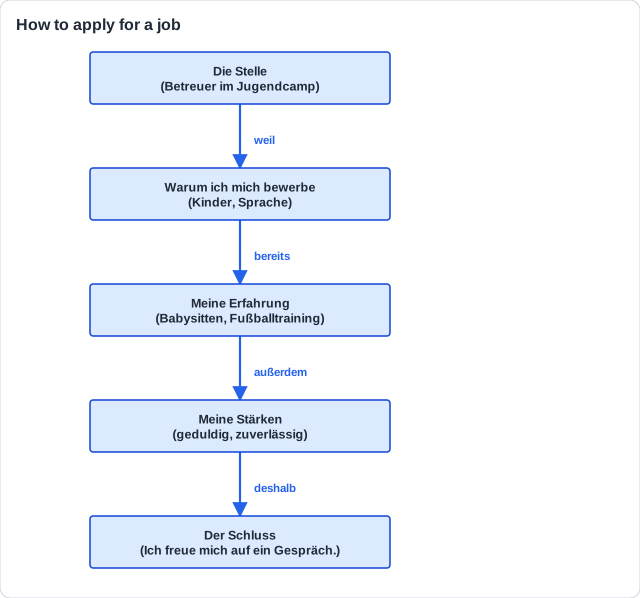
Link your ideas: Connectors lift your answer from a list into an argument: außerdem (besides), jedoch / aber (however), deshalb (therefore), obwohl (although). Use at least two or three in any written answer.
Learn what examiners really want
See exactly what to write to score full marks. Our AI shows you model answers and the key phrases examiners look for.
Read like Paper 2: Here is a short blog — the kind of text Paper 2 (Reading) gives you. Then we'll do one exam question together.
How to read it
- Read it once just for the general idea; don't worry about every word.
- Tap the audio button to hear it.
- Tap Übersetzung anzeigen if you get stuck.
Mein erstes Praktikum (1 von 3): Letzten Sommer habe ich ein Praktikum in einer Tischlerei gemacht. Es war meine erste Arbeitsstelle und am Anfang war ich ziemlich nervös.
Morgens half ich in der Werkstatt und nachmittags durfte ich den Tischlern bei der Arbeit zusehen.
Mein erstes Praktikum (2 von 3)
Ich habe unglaublich viel gelernt: pünktlich zu sein, im Team zu arbeiten und mit ganz verschiedenen Menschen zu sprechen. Am schwersten fiel es mir, mich an die Arbeitszeiten zu gewöhnen, weil ich sehr früh anfangen musste.
Mein erstes Praktikum (3 von 3)
Trotzdem hat es sich gelohnt: Mein eigenes Geld zu verdienen und mich nützlich zu fühlen, war ein tolles Gefühl. Jetzt bin ich sicher, dass ich einen handwerklichen Beruf erlernen möchte, also hat mir dieses Praktikum geholfen, meine Zukunft zu planen.
- die Tischlerei
- the carpentry workshop
- sich an etwas gewöhnen
- to get used to something
- sich lohnen
- to be worth it
- sich nützlich fühlen
- to feel useful
- die Zukunft planen
- to plan the future
IB-style task — eine Frage aus Paper 2
Eine Frage, Schritt für Schritt
- The question — „Was fiel der Person dem Text zufolge am schwersten?“
- Find it in the text. Look for „am schwersten“: „Am schwersten fiel es mir, mich an die Arbeitszeiten zu gewöhnen, weil ich sehr früh anfangen musste.“
- The answer — Sich an die (frühen) Arbeitszeiten zu gewöhnen.
Reading technique: For a „dem Text zufolge“ (according to the text) question, find the exact line that proves your answer — don't rely on memory or general knowledge.
Die Aufgabe — your task: Ein Café in deiner Stadt sucht Aushilfen für die Sommerferien. Schreibe eine formelle E-Mail, um dich zu bewerben.
Der Auftrag — what to do
- Stell dich vor und beschreibe deine bisherige Arbeitserfahrung.
- Erkläre, warum du die Stelle möchtest.
- Schreibe zwischen 250 und 400 Wörtern.
Formal email structure — 6 steps
Subject line
Say plainly what the email is. „Betreff: Bewerbung als Aushilfe für die Sommerferien“
Formal greeting
„Sehr geehrte Frau …,“ / „Sehr geehrter Herr …,“ with a comma. „Sehr geehrte Frau Hartmann,“
Reason for writing
Who you are, your experience and why the job suits you. „Letzten Sommer habe ich ein Praktikum in einer Bäckerei gemacht…“
Request or proposal
Give your availability and ask for an interview. „Ich wäre vom 20. Juli bis 31. August verfügbar…“
Polite close
Thank the reader. „Vielen Dank für Ihre Zeit.“
Sign-off + name
„Mit freundlichen Grüßen“, then your full name.
Subject → Greeting → Reason → Request → Polite close → Signature
Modell: die 6 Schritte in ~100 Wörtern
Die fertige E-Mail, Schritt für Schritt
- Betreff: Bewerbung als Aushilfe für die Sommerferien
- Sehr geehrte Frau Hartmann,
- mit großem Interesse habe ich Ihre Anzeige gelesen. Ich heiße Jonas Berger, bin 17 Jahre alt und besuche die elfte Klasse des Goethe-Gymnasiums. Letzten Sommer habe ich ein Praktikum in einer Bäckerei gemacht. Dort habe ich Kunden bedient und gelernt, auch in stressigen Momenten freundlich zu bleiben. Da ich gern mit Menschen arbeite, passt diese Stelle sehr gut zu mir.
- Ich wäre vom 20. Juli bis 31. August verfügbar und würde mich sehr über ein persönliches Gespräch freuen.
- Vielen Dank für Ihre Zeit.
- Mit freundlichen Grüßen – Jonas Berger
Warum es funktioniert — what makes it strong: A strong formal email does these things for each of the three Paper 1 criteria:
A — Language /12
- Perfekt: „habe gemacht“, „habe gelernt“
- Konjunktiv II: „wäre“, „würde mich freuen“
- Work vocabulary: „die Anzeige“, „Kunden bedienen“, „verfügbar“
B — Message /12
- Task fully done: introduces himself, describes his experience AND says why he wants the job
- Experience linked to the job: friendly under stress
C — Conceptual /6
- Application-email conventions: a clear subject line, „Sehr geehrte Frau Hartmann,“
- The Sie-form all the way through: „Ihre Anzeige“
- Availability, a request for an interview and „Mit freundlichen Grüßen“
Never wonder what to study next
Get a personalized daily plan based on your exam date, progress, and weak areas. We'll tell you exactly what to review each day.
Hörverstehen — Lauras Ferienjob
Paper 2 tests listening (25 marks): you hear 3 short clips, each played twice, and you never see the words. Read the questions first, then listen and reveal the answers.
Du hörst Laura über ihren Ferienjob in einem Café und darüber, was sie dabei gelernt hat.
- Was hat Laura bei ihrem Ferienjob gelernt? (What did Laura learn in her holiday job?)
- Was ist für Laura das Wichtigste? (What matters most to her?)
Hallo, ich heiße Laura. Letzten Sommer hatte ich einen Ferienjob in einem Café in Wien. Ich arbeitete jeden Morgen von acht bis zwei und bediente die Gäste. Am Anfang war ich nervös, aber meine Kolleginnen waren sehr nett und halfen mir. Das Gehalt war nicht hoch, aber ich habe gelernt, im Team zu arbeiten und höflich mit den Gästen zu sprechen. Für mich ist es das Wichtigste, Erfahrung zu sammeln.
Hi, I'm Laura. Last summer I had a holiday job at a café in Vienna. I worked every morning from eight to two and served the guests. At first I was nervous, but my colleagues were very nice and helped me. The pay wasn't high, but I learned to work in a team and to speak politely with the guests. For me, the most important thing is to gain experience.
- Im Team zu arbeiten und höflich mit den Gästen zu sprechen.
- Erfahrung zu sammeln.