What 'die Gemeinschaft' covers: Community (die Gemeinschaft) is part of the theme Social organization. Learn the words below as a deck, then use them in the reading and writing sections.
You need words to talk about
- your neighbourhood and neighbours
- shared spaces and local projects
- helping one another
- your opinion about them
- die Gemeinschaft
- community
- das Viertel / der Stadtteil
- neighbourhood / district
- der Nachbar / die Nachbarin
- neighbour
- der Nachbarschaftsverein
- neighbourhood / residents' association
- der öffentliche Raum
- public space
- der Gemeinschaftsgarten
- community garden
- das Ehrenamt / die Freiwilligenarbeit
- volunteering
- zusammenarbeiten
- to collaborate / to work together
- zusammenleben
- to live together / to coexist
- der Treffpunkt
- meeting place
- (jemandem) helfen / unter die Arme greifen
- to lend a hand
- das Gemeinwohl
- the common good
- sich integrieren / dazugehören
- to fit in / to become part of
| Useful expression (German) | English |
|---|---|
| Ich verstehe mich sehr gut mit meinen Nachbarn. | I get on very well with my neighbours. |
| In meinem Viertel fehlen Orte für junge Leute. | My neighbourhood lacks spaces for young people. |
| Ich engagiere mich ehrenamtlich in einem Stadtteilprojekt. | I volunteer in a local project. |
| Wenn alle zusammenarbeiten, verbessern wir die Gemeinschaft. | If we all work together, we improve the community. |
| Ich versuche immer, denen unter die Arme zu greifen, die es brauchen. | I always try to lend a hand to those who need it. |
Why this matters: This vocabulary turns up in every skill — a reading text about a local project, a listening interview with a neighbour, a Paper 1 blog or letter to the residents' association, or your oral. Reusing the right topic words is how you score Criterion A (Language).
Free preview
Reading it is one thing — hearing it is another
You're reading the free notes. Aimnova Pro unlocks the full study experience — and you can try it with your first topic free to keep:
- Audio on every wordTap any vocabulary word or example to hear it read aloud in natural German.
- FlashcardsLock in vocabulary and key terms with spaced repetition.
- Practice questionsAnswer exam-style questions and get instant AI marking.
- Mock exams & past-paper vaultSit full mocks and see exactly how examiners award marks.
- Personalised study planA daily plan built around your exam date and weak areas.
Have something to say: Examiners reward developed ideas, not just vocabulary. Take a position and back it up.
The common debates around community
- the lack of public spaces for young people
- whether neighbours still help one another today
- how local projects (gardens, volunteering) bring people together
Opinion phrases (use these to introduce a view)
- Meiner Meinung nach… / Aus meiner Sicht… — In my opinion… / From my point of view…
- Mir scheint, dass… / Ich glaube, dass… — It seems to me that… / I think that…
- Das Wichtigste ist… — The most important thing is…
- Einerseits… andererseits… — On the one hand… on the other hand…
- Ich bin (völlig) einverstanden mit… — I (completely) agree with…
Probleme im Viertel (drawbacks)
- Es fehlen öffentliche Orte, an denen sich junge Leute treffen können.
- Manchmal kennen sich die Nachbarn nicht und niemand arbeitet zusammen.
- Einige gemeinsame Orte sind verlassen oder vernachlässigt.
Eine starke Gemeinschaft (benefits)
- Das Ehrenamt hilft uns, uns als Teil von etwas zu fühlen.
- Ein gemeinsames Projekt macht aus einem Viertel einen Treffpunkt.
- Wenn die Nachbarn zusammenarbeiten, leben wir alle besser.
Helping each other
- die freiwillige Feuerwehr im Dorf
- Nachbarschaftshilfe: Einkaufen, Babysitten, Reparieren
- ausleihen statt kaufen
Shaping the town
- Ideen für eine attraktivere Stadt
- ein neuer Treffpunkt für Jugendliche
- eine Musikhalle auf dem Sportplatz?
Living side by side
- Lärm vom Jugendzentrum in der Nacht
- eine Tagesstätte für Obdachlose neben der Schule
- Sprachcafés als Treffpunkt
Big questions behind this topic (IB guide, theme Social organization)
- Was hält eine Gemeinschaft zusammen?
- Wie können junge Menschen ihre Stadt mitgestalten?
- Wer ist verantwortlich für die Schwächsten in einer Gemeinde?
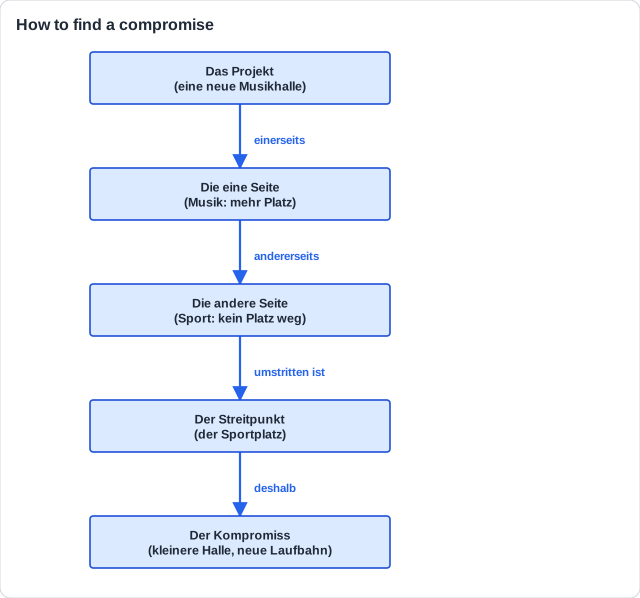
Link your ideas: Connectors lift your answer from a list into an argument: außerdem (besides), jedoch / aber (however), deshalb (therefore), obwohl (although). Use at least two or three in any written answer.
Stop wasting time on topics you know
Our AI identifies your weak areas and focuses your study time where it matters. No more overstudying easy topics.
Read like Paper 2: Here is a short blog — the kind of text Paper 2 (Reading) gives you. Then we'll do one exam question together.
How to read it
- Read it once just for the general idea; don't worry about every word.
- Tap the audio button to hear it.
- Tap Übersetzung anzeigen if you get stuck.
Eine Bibliothek, die das Viertel verbindet (1 von 3): Letztes Jahr haben ein paar Nachbarn und ich beschlossen, die alte Stadtteilbibliothek wiederzubeleben. Am Anfang war ich ziemlich entmutigt, denn in meinem Viertel gibt es kaum Orte für junge Leute.
Doch alles änderte sich, als wir anfingen, zusammenzuarbeiten.
Eine Bibliothek, die das Viertel verbindet (2 von 3)
Jeden Samstag räumten wir die Regale auf, strichen die Wände und organisierten ein Lesecafé für die älteren Nachbarn. Nach und nach wurde die Bibliothek zu einem Treffpunkt, an dem sich die Menschen kennenlernen und einander helfen.
Eine Bibliothek, die das Viertel verbindet (3 von 3)
Ich, die schüchtern angefangen hatte, fühle mich jetzt als Teil einer Gemeinschaft. Ich habe gelernt, dass selbst ein vergessener Ort das ganze Viertel verbinden kann, wenn die Nachbarn zusammenhalten.
- wiederbeleben
- to revive / to bring back to life
- entmutigt
- discouraged / disheartened
- der Treffpunkt
- meeting place
- zusammenhalten
- to stick together
- verbinden
- to bring together / to connect
IB-style task — eine Frage aus Paper 2
Eine Frage, Schritt für Schritt
- The question — „Was haben die Nachbarn dem Text zufolge wiederbelebt?“
- Find it in the text. Look for „wiederbeleben“: „Letztes Jahr haben ein paar Nachbarn und ich beschlossen, die alte Stadtteilbibliothek wiederzubeleben.“
- The answer — Sie haben die alte Stadtteilbibliothek wiederbelebt.
Reading technique: For a „dem Text zufolge“ (according to the text) question, find the exact line that proves your answer — don't rely on memory or general knowledge.
Die Aufgabe — your task: Der Nachbarschaftsverein deines Viertels sucht Ideen, um die Gemeinschaft zu verbessern. Schreibe einen Vorschlag an den Verein.
Der Auftrag — what to do
- Beschreibe ein Projekt für dein Viertel.
- Begründe, warum es sinnvoll ist.
- Schreibe zwischen 250 und 400 Wörtern.
Proposal structure — 3 steps
Addressee + aim
Say who the proposal is for and what it aims to do. „Vorschlag an den Nachbarschaftsverein… Ziel ist ein Treffpunkt, …“
The plan
Give a concrete plan: when, where, who does what. „Wir schlagen vor, sie jeden Samstag von 10 bis 14 Uhr zu öffnen…“
Justification + request
Say why it is worth it, then ask formally. „Das Projekt kostet wenig… Wir bitten Sie daher, …“
Aim → Plan → Justification
Modell: die 3 Schritte in ~100 Wörtern
Der fertige Vorschlag, Schritt für Schritt
- Vorschlag an den Nachbarschaftsverein Weststadt: ein Repair-Café in der alten Bibliothek. Ziel ist ein Treffpunkt, an dem Jung und Alt gemeinsam Dinge reparieren.
- Die verstaubte Bibliothek steht seit zwei Jahren leer. Wir schlagen vor, sie jeden Samstag von 10 bis 14 Uhr zu öffnen. Rentnerinnen und Rentner zeigen, wie man Fahrräder, Lampen oder Kleidung repariert; Jugendliche helfen bei Handys und Computern. Das Werkzeug könnten Geschäfte aus dem Viertel spenden.
- Das Projekt kostet wenig, spart Müll und bringt Generationen zusammen, die sich sonst kaum begegnen. Wir bitten Sie daher, uns den Raum zur Verfügung zu stellen. – Marta Klein, im Namen der Jugendgruppe
Warum es funktioniert — what makes it strong: A strong proposal does these things for each of the three Paper 1 criteria:
A — Language /12
- Konjunktiv II: „könnten spenden“
- Relative clauses: „an dem“, „die sich … begegnen“
- Community vocabulary: „der Treffpunkt“, „spenden“, „die Generation“
B — Message /12
- Task fully done: describes the project AND justifies it
- Each benefit is concrete (cost, waste, generations)
C — Conceptual /6
- Proposal conventions: the addressee and the aim in the first lines
- A concrete plan: when, where, who does what
- A justification and a formal request: „Wir bitten Sie daher …“
See how examiners mark answers
Answer exam-style questions with model answers. Learn exactly what earns marks and what doesn't.
Hörverstehen — Hugos Rede
Paper 2 tests listening (25 marks): you hear short clips, each played twice, and you never see the words. Read the question first, then listen and reveal the answer.
Du hörst Hugo bei einer Versammlung des Nachbarschaftsvereins sprechen.
- Was werden die Schüler dem Audio zufolge jeden Samstag machen? (What will the students do every Saturday?)
- Was werden die älteren Nachbarn lernen? (What will the older neighbours learn?)
Guten Abend, liebe Nachbarn. Ich heiße Hugo und bin Schüler hier im Viertel. Wie ihr seht, wissen viele Ältere nicht, wie man das Handy für die alltäglichen Erledigungen benutzt. Deshalb schlage ich euch eine Idee vor: Jeden Samstag geben einige Schüler im Stadtteilzentrum kostenlose Technikkurse. So lernen die Älteren, Videoanrufe zu machen, und wir fühlen uns nützlich. Wenn wir alle zusammenarbeiten, wird das Viertel ein echter Treffpunkt. Vielen Dank.
Good evening, dear neighbours. My name is Hugo and I'm a student here in the district. As you can see, many older people don't know how to use their phones for everyday tasks. So I'd like to suggest an idea: every Saturday some students give free technology classes at the community centre. That way the older people learn to make video calls and we feel useful. If we all work together, the district becomes a real meeting place. Thank you very much.
- Sie geben den Nachbarn im Stadtteilzentrum kostenlose Technikkurse.
- Sie lernen, das Handy zu benutzen, zum Beispiel Videoanrufe zu machen.