What 'Lebensgeschichten' covers: Life stories (die Lebensgeschichten) is part of the theme Experiences. Learn the words below as a deck, then use them in the reading and writing sections.
You need vocabulary to talk about
- childhood
- memorable moments
- turning points
- what you learned
- your opinion about these experiences
- die Lebensgeschichte
- life story
- eine Erfahrung / ein Erlebnis
- an experience
- eine Erinnerung
- a memory
- die Kindheit
- childhood
- ein Lebensabschnitt
- a stage of life
- ein unvergesslicher Moment
- an unforgettable moment
- eine Erfahrung, die mein Leben geprägt hat
- an experience that shaped my life
- ein Wendepunkt
- a turning point
- eine Schwierigkeit überwinden
- to overcome a difficulty
- eine Lektion lernen
- to learn a lesson
- etwas/jemanden vermissen
- to miss (someone/something)
- erwachsen werden / reifen
- to grow up / to mature
- stolz sein auf
- to be proud of
| Useful expression (German) | English |
|---|---|
| Diesen Tag werde ich nie vergessen. | I'll never forget that day. |
| Es war eine Erfahrung, die mich geprägt hat. | It was an experience that shaped me. |
| Aus jenem Lebensabschnitt habe ich viel gelernt. | I learned a lot from that stage of life. |
| Am Anfang war es schwer, aber am Ende hat es sich gelohnt. | At first it was hard, but in the end it was worth it. |
| Jener Moment veränderte meine Sicht auf das Leben. | That moment changed the way I see life. |
Why this matters: This vocabulary turns up in every skill — a reading text telling someone's story, a listening interview about a memory, a Paper 1 diary or blog about an experience, or your oral. Reusing the right topic words is how you score Criterion A (Language).
Free preview
Reading it is one thing — hearing it is another
You're reading the free notes. Aimnova Pro unlocks the full study experience — and you can try it with your first topic free to keep:
- Audio on every wordTap any vocabulary word or example to hear it read aloud in natural German.
- FlashcardsLock in vocabulary and key terms with spaced repetition.
- Practice questionsAnswer exam-style questions and get instant AI marking.
- Mock exams & past-paper vaultSit full mocks and see exactly how examiners award marks.
- Personalised study planA daily plan built around your exam date and weak areas.
Have something to say: Examiners reward developed ideas, not just vocabulary. Around life stories, the common debates are: whether difficult experiences make us stronger, how travel and time away change us, and what childhood memories teach us. Take a position and back it up.
Opinion phrases (use these to introduce a view)
- Meiner Meinung nach… / Aus meiner Sicht… — In my opinion… / From my point of view…
- Mir scheint, dass… / Ich glaube, dass… — It seems to me that… / I think that…
- Das Wichtigste ist… — The most important thing is…
- Einerseits… andererseits… — On the one hand… on the other hand…
- Ich bin (völlig) einverstanden mit… — I (completely) agree with…
Das Schwierige an einer Erfahrung (drawbacks)
- Am Anfang vermisst man sein Zuhause und seine Familie.
- In einer anderen Sprache Fehler zu machen, ist peinlich.
- Die eigene Komfortzone zu verlassen, kostet viel Mut.
Was man gewinnt (benefits)
- Eine Schwierigkeit zu überwinden, macht dich stärker.
- Man lernt andere Kulturen kennen und schließt neue Freundschaften.
- Man kommt selbstbewusster nach Hause.
Inspiring people
- eine Eiskletterin: vom schüchternen Kind zur Weltmeisterin
- Margarete Steiff: trotz Krankheit eine Firma gründen
- junge Frauen, die etwas verändern
Family stories
- das alte Tagebuch der Großmutter
- ein Familienbetrieb in der dritten Generation
- Erinnerungen beim Sonntagskaffee
Turning points
- ein Musikstar, der an deiner Schule war
- ein Beruf, der ein ganzes Leben prägt
- eine Erfindung aus dem Alltag
Big questions behind this topic (IB guide, theme Experiences)
- Wie prägt unsere Vergangenheit unsere Gegenwart und Zukunft?
- Was macht einen Menschen zum Vorbild?
- Was können wir aus den Geschichten unserer Großeltern lernen?
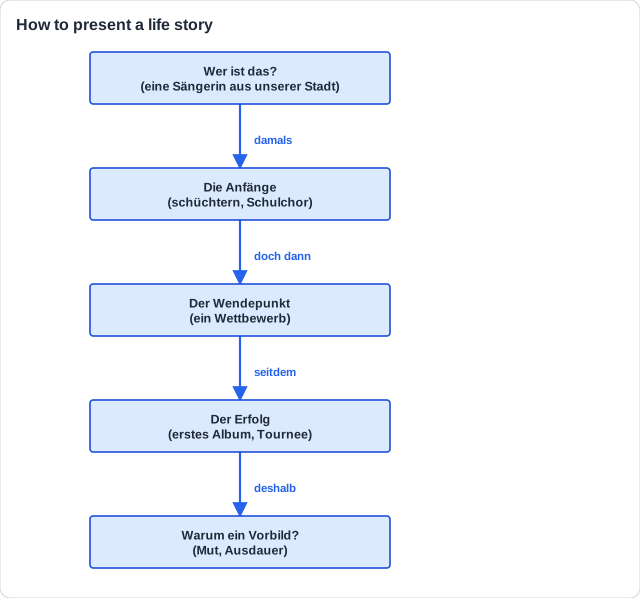
Link your ideas: Connectors lift your answer from a list into an argument: außerdem (besides), jedoch / aber (however), deshalb (therefore), obwohl (although). Use at least two or three in any written answer.
Stop wasting time on topics you know
Our AI identifies your weak areas and focuses your study time where it matters. No more overstudying easy topics.
Read like Paper 2: Here is a short blog — the kind of text Paper 2 (Reading) gives you.
How to read it
- Read it once just for the general idea; don't worry about every word.
- Tap the audio button to hear it.
- Tap Übersetzung anzeigen if you get stuck.
- Then we'll do one exam question together.
Ein Sommer, der mein Leben veränderte: Als ich sechzehn war, verbrachte ich einen Sommer bei einer Gastfamilie in Wien. Am ersten Tag fühlte ich mich sehr allein und verloren, weil ich den Wiener Dialekt kaum verstand.
Ein Sommer, der mein Leben veränderte (Fortsetzung)
Eines Nachmittags stieg ich in die falsche Straßenbahn und landete in einem Viertel, das ich nicht kannte. Ich wusste nicht, wie ich zurückkommen sollte, und der Akku meines Handys war leer.
Ein Sommer, der mein Leben veränderte (Fortsetzung)
Da half mir eine ältere Dame: Sie lud mich auf einen Kaffee ein und rief von ihrem Telefon aus meine Gastfamilie an. Diese kleine Geste veränderte alles. In jenem Sommer lernte ich, dass aus einem Fehler die schönste Erinnerung werden kann, und ich kam selbstbewusster und sehr dankbar nach Hause.
- die Gastfamilie
- host family
- verloren
- lost
- in die falsche Straßenbahn steigen
- to get on the wrong tram
- eine Geste
- a gesture
- dankbar
- grateful
IB-style task — eine Frage aus Paper 2
Eine Frage, Schritt für Schritt
- The question — „Was tat die ältere Dame dem Text zufolge, um der Person zu helfen?“
- Find it in the text. Look for „eine ältere Dame“: „Da half mir eine ältere Dame: Sie lud mich auf einen Kaffee ein und rief … meine Gastfamilie an.“
- The answer — Sie lud sie auf einen Kaffee ein und rief von ihrem Telefon aus ihre Gastfamilie an.
Reading technique: For a „dem Text zufolge“ (according to the text) question, find the exact line that proves your answer — don't rely on memory or general knowledge.
Die Aufgabe — your task: Du bist gerade bei einem Austausch in Österreich, und heute lief nicht alles glatt. Schreibe einen Tagebucheintrag.
Der Auftrag — what to do
- Erzähle, was an diesem Tag passiert ist.
- Beschreibe, wie du dich gefühlt hast und was du daraus gelernt hast.
- Schreibe zwischen 250 und 400 Wörtern.
Diary entry structure — 4 steps
Place, date + „Liebes Tagebuch“
Start with place, date and „Liebes Tagebuch,“. „Graz, Freitag, 14. März – Liebes Tagebuch,“
What happened (past tense)
Tell the event in the past (Perfekt/Präteritum). „Ich habe den falschen Zug genommen…“
Your feelings
Say how you felt, and how that changed. „Zuerst hatte ich furchtbare Angst… Später war ich erleichtert.“
Reflection: what you learned
Think about what the day taught you. „Was ich gelernt habe? …“
Date + Liebes Tagebuch → What happened → Feelings → Reflection
Modell: die 4 Schritte in ~90 Wörtern
Der fertige Tagebucheintrag, Schritt für Schritt
- Graz, Freitag, 14. März – Liebes Tagebuch,
- heute war der schlimmste und zugleich der beste Tag meines Austauschs. Ich habe den falschen Zug genommen und bin in Leoben gelandet. Mein Handy war leer, und ich verstand fast nichts. Trotzdem half mir eine Dame am Bahnhof: Sie rief sogar meine Gastfamilie an.
- Zuerst hatte ich furchtbare Angst und habe fast geweint. Später war ich einfach nur erleichtert und dankbar.
- Was ich gelernt habe? Man muss keine Sprache perfekt sprechen, um Hilfe zu bitten. Morgen frage ich einfach öfter nach – versprochen!
Warum es funktioniert — what makes it strong: A strong diary entry does these things for each of the three Paper 1 criteria:
A — Language /12
- Perfekt and Präteritum together: „habe genommen“, „half“
- Connectors: „trotzdem“, „zuerst“, „später“
- Feeling vocabulary: „erleichtert“, „dankbar“
B — Message /12
- Task fully done: tells the difficult day AND what she learned
- Developed with concrete details (the train, the lady)
C — Conceptual /6
- Diary conventions: place, date and „Liebes Tagebuch“
- The event in the past, the feelings, then a reflection
- Written for herself: no tips for readers, no sign-off
See how examiners mark answers
Answer exam-style questions with model answers. Learn exactly what earns marks and what doesn't.
Höre wie in Paper 2: Paper 2 also tests listening (25 marks): you hear short clips and answer questions — but you never see the words. Here's one, simplified. Play it, answer, then reveal the transcript to check.
Hörverstehen — die Geschichte von Hugo
Listen to Hugo tell the story of an experience that changed him. Try to answer before you reveal the transcript — that's how Paper 2 Listening works.
- Was fing Hugo im Krankenhaus an, und warum? (What did Hugo start doing in hospital, and why?)
Hallo, ich heiße Hugo. Mit fünfzehn habe ich mir zwei Wochen vor dem wichtigsten Fußballspiel der Saison das Bein gebrochen. Ich war am Boden zerstört, weil ich sechs Wochen lang nicht laufen durfte. Aus Langeweile fing ich an, im Krankenhaus Comics zu zeichnen. Eine Pflegerin fand sie so lustig, dass sie sie den anderen Patienten zeigte. Heute spiele ich wieder Fußball, aber das Zeichnen ist meine größte Leidenschaft geworden. Für mich war dieser Unfall die Erfahrung, die mich am meisten geprägt hat.
Hi, I'm Hugo. When I was fifteen, I broke my leg two weeks before the most important football match of the season. I was devastated, because I wasn't allowed to walk for six weeks. Out of boredom I started drawing comics in hospital. A nurse found them so funny that she showed them to the other patients. Today I play football again, but drawing has become my greatest passion. For me, that accident was the experience that has shaped me the most.
- Er fing an, Comics zu zeichnen, weil ihm langweilig war.
Listening technique: Read the question first, then listen for that one detail — you don't need to catch every word. In the real exam you hear each clip twice.