What 'Freizeit' covers: Leisure and free time (die Freizeit) is part of the theme Experiences. Learn the words below as a deck, then use them in the reading and writing sections.
You need vocabulary to talk about
- hobbies and sports
- music and going out
- screen time
- how you use your spare time
- your opinion about them
- die Freizeit
- leisure / free time
- das Hobby / der Zeitvertreib
- hobby / pastime
- die Zeit (sinnvoll) nutzen
- to make good use of your time
- sich für (einen Kurs / einen Verein) anmelden
- to sign up for (a course / a club)
- sich mit Freunden treffen
- to meet up with friends
- Sport treiben
- to play / do a sport
- ein Instrument spielen
- to play an instrument
- die Videospiele
- video games
- im Internet surfen
- to browse the internet
- lesen / das Lesen
- to read / reading
- sich entspannen / abschalten
- to relax / to switch off
- sich amüsieren / Spaß haben
- to have fun / to have a good time
- eine kreative Aktivität
- a creative activity
| Useful expression (German) | English |
|---|---|
| In meiner Freizeit spiele ich Gitarre. | In my free time I play the guitar. |
| Ich habe mich für einen Kochkurs angemeldet. | I signed up for a cookery course. |
| Am Wochenende treffe ich mich meistens mit meinen Freunden. | At weekends I usually meet up with my friends. |
| Ich verbringe zu viel Zeit mit Videospielen. | I spend too much time on video games. |
| Lesen ist meine Lieblingsart, mich zu entspannen. | Reading is my favourite way to relax. |
Why this matters: This vocabulary turns up in every skill — a reading text about hobbies, a listening interview about a weekend, a Paper 1 blog about free time, or your oral. Reusing the right topic words is how you score Criterion A (Language).
Free preview
Reading it is one thing — hearing it is another
You're reading the free notes. Aimnova Pro unlocks the full study experience — and you can try it with your first topic free to keep:
- Audio on every wordTap any vocabulary word or example to hear it read aloud in natural German.
- FlashcardsLock in vocabulary and key terms with spaced repetition.
- Practice questionsAnswer exam-style questions and get instant AI marking.
- Mock exams & past-paper vaultSit full mocks and see exactly how examiners award marks.
- Personalised study planA daily plan built around your exam date and weak areas.
Have something to say: Examiners reward developed ideas, not just vocabulary. Take a position and back it up.
The common debates (leisure)
- active hobbies vs too much screen time
- doing things alone vs with others
- whether free time should be productive or just for resting
Opinion phrases (use these to introduce a view)
- Meiner Meinung nach… / Aus meiner Sicht… — In my opinion… / From my point of view…
- Mir scheint, dass… / Ich glaube, dass… — It seems to me that… / I think that…
- Das Wichtigste ist… — The most important thing is…
- Einerseits… andererseits… — On the one hand… on the other hand…
- Ich bin (völlig) einverstanden mit… — I (completely) agree with…
Zu viel Bildschirmzeit (drawbacks)
- Viele Jugendliche verbringen ihre Freizeit vor einem Bildschirm.
- Videospiele können uns Stunden Schlaf rauben.
- Wenn wir nicht ausgehen, finden wir weniger Freunde.
Aktive Hobbys (benefits)
- Ein kreatives Hobby hilft uns abzuschalten.
- Sich für einen Verein anzumelden ist eine Art, Leute kennenzulernen.
- Sport und Musik bauen Stress ab.
Sport and adventure
- mit Freunden in ein Sportcamp am Meer
- Extremsport: Wie bereitet man sich vor?
- nachts auf Inlineskates durch die Stadt
Fun and games
- die besten Freizeitparks im Vergleich
- Brettspiele und Spielecafés
- Virtual Reality in der Freizeit
Clubs and courses
- ein Zirkuskurs: Akrobatik lernen
- im Chor oder im Jugendtheater mitmachen
- ein Wochenendfestival mit Sport, Musik und Film
Big questions behind this topic (IB guide, theme Experiences)
- Was lernen wir in der Freizeit, das uns keine Schule beibringt?
- Wie viel freie Zeit brauchen Jugendliche?
- Macht uns Freizeit vor dem Bildschirm einsamer?
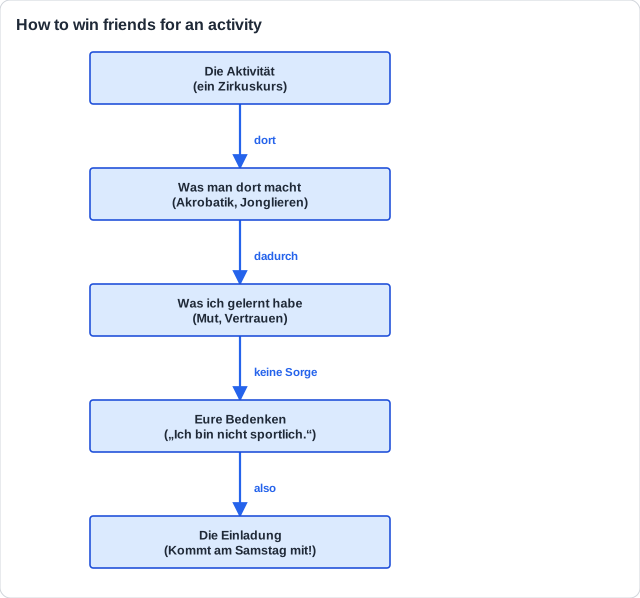
Link your ideas: Connectors lift your answer from a list into an argument: außerdem (besides), jedoch / aber (however), deshalb (therefore), obwohl (although). Use at least two or three in any written answer.
Stop wasting time on topics you know
Our AI identifies your weak areas and focuses your study time where it matters. No more overstudying easy topics.
Read like Paper 2: Here is a short blog — the kind of text Paper 2 (Reading) gives you.
How to work through it
- Read it once just for the general idea; don't worry about every word.
- Tap the audio button to hear it.
- Tap Übersetzung anzeigen if you get stuck.
- Then we'll do one exam question together.
Ein Sommer in der Küche (1/3): Letzten Sommer habe ich mich für einen internationalen Kochkurs in Österreich angemeldet, wo ich zwei Wochen mit Jugendlichen aus verschiedenen Ländern verbracht habe.
Ein Sommer in der Küche (2/3)
Am Anfang war ich etwas nervös, weil ich niemanden kannte und kaum Deutsch sprach. In der Küche war die Sprache jedoch egal: Wir schnitten, mischten und lachten zusammen.
Ein Sommer in der Küche (3/3)
Ich lernte, frische Nudeln zuzubereiten, und entdeckte, dass Kochen eine wunderbare Art ist, vom Handy abzuschalten und Freundschaften zu schließen. Ich kam mit neuen Rezepten nach Hause, mit mehr Selbstvertrauen und mit der Lust, meine Freizeit weiterhin für etwas Kreatives zu nutzen.
- sich anmelden für
- to sign up for
- kaum
- barely / hardly
- mischen
- to mix
- das Rezept
- the recipe
- Lust haben auf / zu
- to feel like / to be eager to
IB-style task — eine Frage aus Paper 2
Eine Frage, Schritt für Schritt
- The question — „Was hat die Person dem Text zufolge im Kurs zubereiten gelernt?“
- Find it in the text. Look for „lernte … zuzubereiten“: „Ich lernte, frische Nudeln zuzubereiten, und entdeckte, dass Kochen eine wunderbare Art ist, vom Handy abzuschalten.“
- The answer — Sie lernte, frische Nudeln zuzubereiten.
Reading technique: For a „dem Text zufolge“ (according to the text) question, find the exact line that proves your answer — don't rely on memory or general knowledge.
Die Aufgabe — your task: Deine Schule organisiert eine Woche der Hobbys und Aktivitäten. Schreibe für die Schülerzeitung eine Rezension über einen Kurs oder eine Freizeitaktivität, die du ausprobiert hast.
Der Auftrag — what to do
- Beschreibe die Aktivität und was man dort macht.
- Sag, ob du sie empfiehlst, und begründe deine Meinung.
- Schreibe zwischen 250 und 400 Wörtern.
Review structure — 4 steps
Present it: what, where, when
Give the facts first: what, where, when, how much. „Kochen für Anfänger – Volkshochschule Mitte, donnerstags…“
Describe it
Say briefly what happens there (Präsens). „In dem Kurs lernt man einfache Gerichte…“
Strengths and weaknesses
Judge it: one strength and one weakness. „Besonders gut gefällt mir… Leider ist die Küche ziemlich eng.“
Recommendation + rating
Say who should try it and give a rating. „Trotzdem empfehle ich den Kurs allen, die… Vier von fünf Sternen.“
Presentation → Description → Strengths & weaknesses → Recommendation
Modell: die 4 Schritte in ~100 Wörtern
Die fertige Rezension, Schritt für Schritt
- Kochen für Anfänger – Volkshochschule Mitte, donnerstags von 17 bis 19 Uhr, 40 Euro für sechs Abende.
- In dem Kurs lernt man einfache Gerichte aus verschiedenen Ländern. Jede Woche kochen wir zu viert an einem Tisch, und am Ende essen alle zusammen.
- Besonders gut gefällt mir die Kursleiterin: Sie erklärt alles geduldig und mit viel Humor. Ich habe dort sogar neue Freunde gefunden. Leider ist die Küche ziemlich eng, und zwei Stunden sind manchmal zu kurz.
- Trotzdem empfehle ich den Kurs allen, die weniger Zeit am Handy verbringen und etwas Praktisches lernen wollen. Meine Bewertung: vier von fünf Sternen.
Warum es funktioniert — what makes it strong: A strong review does these things for each of the three Paper 1 criteria:
A — Language /12
- Relative clause: „allen, die … wollen“
- Connectors: „leider“, „trotzdem“, „am Ende“
- Leisure vocabulary: „der Kurs“, „die Kursleiterin“, „die Bewertung“
B — Message /12
- Task fully done: describes the course AND recommends it
- The opinion is backed with concrete details
C — Conceptual /6
- Review conventions: the key facts first (place, time, price)
- Strengths AND weaknesses: „besonders gut“ … „leider“
- A clear recommendation and a rating
See how examiners mark answers
Answer exam-style questions with model answers. Learn exactly what earns marks and what doesn't.
Hör zu wie in Paper 2: Paper 2 also tests listening (25 marks): you hear short clips and answer questions — but you never see the words. Here's one, simplified. Play it, answer, then reveal the transcript to check.
Hörverstehen — Hugos Freizeit
Listen to Hugo describe what he does in his free time. Try to answer before you reveal the transcript — that's how Paper 2 Listening works.
- Was macht Hugo am Wochenende? (What does Hugo do at weekends?)
Hallo, ich heiße Hugo. In meiner Freizeit habe ich mehrere Hobbys. Unter der Woche spiele ich eine Stunde Gitarre und, wenn ich kann, lese ich Abenteuerromane. Am Wochenende treffe ich mich meistens mit meinen Freunden, um im Park Basketball zu spielen. Früher verbrachte ich zu viel Zeit mit Videospielen, aber jetzt versuche ich, Aktivitäten im Freien zu machen. Für mich ist das Beste an der Freizeit, abzuschalten und mit den Menschen, die man mag, Spaß zu haben.
Hi, I'm Hugo. In my free time I have several hobbies. During the week I play the guitar for an hour and, when I can, I read adventure novels. At weekends I usually meet up with my friends to play basketball in the park. I used to spend too much time on video games, but now I try to do outdoor activities. For me, the best thing about free time is switching off and having fun with the people you like.
- Er trifft sich meistens mit seinen Freunden, um im Park Basketball zu spielen.
Listening technique: Read the question first, then listen for that one detail — you don't need to catch every word. In the real exam you hear each clip twice.