What 'Stadt & Land' covers: Urban & rural (Stadt und Land) is part of the theme Sharing the planet. Learn the words below as a deck, then use them in the reading and writing sections.
What you need words for
- Comparing city and country life
- The neighbourhood
- Services
- The pace of life
- Problems like Landflucht (rural depopulation)
- die Stadt — das Land
- the city — the countryside
- das Dorf
- the village
- das Viertel / der Stadtteil
- the neighbourhood / district
- der Einwohner / die Einwohnerin
- the inhabitant / resident
- die Landflucht
- rural depopulation (people leaving the countryside)
- umziehen (nach / aufs Land)
- to move (house) to a place
- die öffentlichen Verkehrsmittel
- public transport
- die Dienstleistungen / die Versorgung
- services / provision (shops, doctor…)
- die Grünfläche / der Park
- the green space / the park
- die Ruhe — der Lärm
- the peace and quiet — the noise
- der Stau
- the traffic jam
- die Luftverschmutzung
- air pollution
- die Lebensqualität
- quality of life
| Useful expression (German) | English |
|---|---|
| Ich wohne in einem ruhigen Viertel. | I live in a quiet neighbourhood. |
| Auf dem Land atmet man saubere Luft. | In the countryside you breathe clean air. |
| In der Stadt gibt es mehr Dienstleistungen. | In the city there are more services. |
| Im Dorf fehlen oft öffentliche Verkehrsmittel. | In the village public transport is often missing. |
| Viele Jugendliche ziehen in die Stadt. | Many young people move to the city. |
Why this matters: This vocabulary turns up in every skill — a reading text on village life, a listening interview about a house move, a Paper 1 blog about your neighbourhood, or your oral. Reusing the right topic words is how you score Criterion A (Language).
Free preview
Reading it is one thing — hearing it is another
You're reading the free notes. Aimnova Pro unlocks the full study experience — and you can try it with your first topic free to keep:
- Audio on every wordTap any vocabulary word or example to hear it read aloud in natural German.
- FlashcardsLock in vocabulary and key terms with spaced repetition.
- Practice questionsAnswer exam-style questions and get instant AI marking.
- Mock exams & past-paper vaultSit full mocks and see exactly how examiners award marks.
- Personalised study planA daily plan built around your exam date and weak areas.
Have something to say: Examiners reward developed ideas, not just vocabulary. Take a position and back it up.
The common debates around city vs country
- The convenience and services of the city vs the calm and clean air of the countryside
- Rural depopulation (Landflucht)
- How to make a neighbourhood liveable
Opinion phrases (use these to introduce a view)
- Meiner Meinung nach… / Aus meiner Sicht… — In my opinion… / From my point of view…
- Mir scheint, dass… / Ich glaube, dass… — It seems to me that… / I think that…
- Das Wichtigste ist… — The most important thing is…
- Einerseits… andererseits… — On the one hand… on the other hand…
- Ich bin (völlig) einverstanden mit… — I (completely) agree with…
Leben auf dem Land (countryside)
- Man lebt ruhiger und atmet saubere Luft.
- Die Menschen kennen sich und helfen einander.
- Oft fehlen aber Dienstleistungen und Verkehrsmittel.
Leben in der Stadt (city)
- Es gibt mehr Arbeit, Geschäfte und Kultur.
- Die öffentlichen Verkehrsmittel sind besser.
- Es gibt aber mehr Lärm, Staus und Luftverschmutzung.
City life
- eine autofreie Innenstadt
- die 15-Minuten-Stadt
- teure Mieten: ein Zimmer für 700 Euro
Country life
- eine Stunde Busfahrt bis zur Schule
- aus der Großstadt in ein Dorf ziehen
- ohne Auto auf dem Land leben?
Between the two
- jeden Tag aus dem Umland pendeln
- Läden und Ärzte, die im Viertel fehlen
- Wohnen für Hilfe bei älteren Menschen
Big questions behind this topic (IB guide, theme Sharing the planet)
- Wo lebt es sich besser: in der Stadt oder auf dem Land?
- Wem gehört die Straße: Autos oder Menschen?
- Wie können Dörfer für junge Menschen attraktiv bleiben?
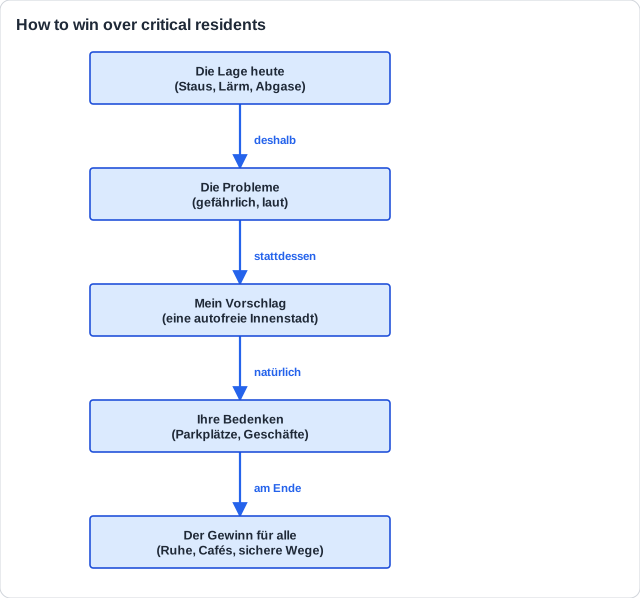
Link your ideas: Connectors lift your answer from a list into an argument: außerdem (besides), jedoch / aber (however), deshalb (therefore), obwohl (although). Use at least two or three in any written answer.
Stop wasting time on topics you know
Our AI identifies your weak areas and focuses your study time where it matters. No more overstudying easy topics.
Read like Paper 2: Here is a short blog — the kind of text Paper 2 (Reading) gives you. Read it once just for the general idea.
How to read it
- Don't worry about every word.
- Tap the audio button to hear it, or Übersetzung anzeigen if you get stuck.
- Then we'll do one exam question together.
Mein Schulweg zwischen Dorf und Stadt (1 of 3): Ich wohne in einem kleinen Dorf in Mecklenburg mit nur dreihundert Einwohnern. Jeden Morgen stehe ich um sechs Uhr auf, weil der Bus zum Gymnasium in der Stadt fast eine Stunde braucht.
In der Stadt ist alles anders: Es gibt Kinos, Cafés und Geschäfte, aber auch viel Verkehr und Lärm.
Mein Schulweg zwischen Dorf und Stadt (2 of 3)
Nach der Schule fahre ich zurück aufs Land, wo es still ist und man nachts die Sterne sieht. Leider fährt der letzte Bus schon um sechs Uhr abends, deshalb kann ich selten mit meinen Freunden ins Kino gehen. Viele junge Leute ziehen weg, und vor Kurzem hat sogar unser Dorfladen zugemacht.
Mein Schulweg zwischen Dorf und Stadt (3 of 3)
Trotzdem möchte ich später zurückkommen, denn auf dem Land habe ich gelernt, was echte Ruhe bedeutet.
- der Einwohner / die Einwohnerin
- inhabitant
- das Gymnasium
- academic secondary school
- der Verkehr
- the traffic
- wegziehen
- to move away
- der Dorfladen
- the village shop
IB-style task — eine Frage aus Paper 2
Eine Frage, Schritt für Schritt
- The question — „Warum kann die Person dem Text zufolge selten mit ihren Freunden ins Kino gehen?“
- Find it in the text. Look for „Leider“: „Leider fährt der letzte Bus schon um sechs Uhr abends, deshalb kann ich selten mit meinen Freunden ins Kino gehen.“
- The answer — Weil der letzte Bus schon um sechs Uhr abends fährt.
Reading technique: For a „dem Text zufolge“ (according to the text) question, find the exact line that proves your answer — don't rely on memory or general knowledge.
Die Aufgabe — your task: Deine Schule veranstaltet eine Projektwoche zum Thema Stadt und Land. Führe für die Schülerzeitung ein Interview mit jemandem, der von der Stadt aufs Land gezogen ist.
| Teil | Auf Deutsch | English |
|---|---|---|
| Inhalt 1 | Frag nach den Vor- und Nachteilen des Lebens auf dem Land. | Ask about the advantages and disadvantages of country life. |
| Inhalt 2 | Frag nach Tipps, wie man das Beste aus seinem Wohnort macht. | Ask for tips on making the most of where you live. |
| Länge | Schreibe zwischen 450 und 600 Wörtern. | Write 450–600 words. |
Interview structure — 3 steps
Introduction: who and why
Introduce the guest and say why she is interesting. „Vor einem Jahr ist Lena Hofmann von Berlin in ein kleines Dorf gezogen.“
Questions and answers
Mark each turn with a name; let the answers carry the ideas. „Schülerzeitung: Was vermisst du an der Stadt? Lena: …“
Close: thanks
Thank the guest. „Danke, Lena, und viel Glück in deinem neuen Zuhause!“
Introduction → Questions and answers → Close
Modell: die 3 Schritte in ~100 Wörtern
Das fertige Interview, Schritt für Schritt
- Vor einem Jahr ist Lena Hofmann (16) mit ihrer Familie von Berlin in ein kleines Dorf in Brandenburg gezogen. Wir haben sie gefragt, wie das Leben dort ist.
- Schülerzeitung: Was vermisst du an der Stadt? Lena: Am meisten die Freiheit. In Berlin konnte ich überall mit der U-Bahn hinfahren; hier fährt der Bus nur dreimal am Tag. Schülerzeitung: Und was ist auf dem Land besser? Lena: Die Ruhe und die Natur. Außerdem kennt hier jeder jeden. Schülerzeitung: Dein Tipp? Lena: Engagiert euch im Sportverein oder bei der Feuerwehr – so findet man schnell Freunde.
- Danke, Lena, und viel Glück in deinem neuen Zuhause!
Warum es funktioniert — what makes it strong: A strong interview does these things for each of the three Paper 1 criteria:
A — Language /12
- Präteritum vs Präsens: „konnte“ / „fährt“
- Connectors: „außerdem“, „so“
- City/country vocabulary: „das Dorf“, „die Ruhe“, „die U-Bahn“
B — Message /12
- Task fully done: asks about pros, cons AND tips
- The answers give examples
C — Conceptual /6
- Interview conventions: an introduction that presents the guest
- Clear question-and-answer turns, each marked with a name
- A short thank-you close
See how examiners mark answers
Answer exam-style questions with model answers. Learn exactly what earns marks and what doesn't.
Hörverstehen — Marta zieht aufs Land
Paper 2 tests listening (25 marks): you hear 3 short clips, each played twice, and you never see the words. Read the questions first, then listen and reveal the answers.
Du hörst Marta darüber, warum sie von der Stadt aufs Land gezogen ist.
- Warum ist Marta aus der Stadt weggezogen? (Why did she leave the city?)
- Was ist am schwierigsten am Leben im Dorf? (What is the hardest thing about village life?)
Hallo, ich heiße Marta. Vor drei Jahren bin ich von München in ein kleines Dorf in Bayern gezogen. Ich war den Lärm, die Staus und die Luftverschmutzung der Stadt leid. Jetzt lebe ich viel ruhiger: Ich arbeite von zu Hause über das Internet, und am Wochenende gehe ich auf dem Land spazieren. Am meisten gefällt mir, dass sich alle Nachbarn kennen und einander helfen. Am schwierigsten ist, dass Dienstleistungen fehlen: Der nächste Arzt ist dreißig Kilometer entfernt, und es gibt keine öffentlichen Verkehrsmittel, deshalb bin ich für alles auf das Auto angewiesen.
Hi, I'm Marta. Three years ago I moved from Munich to a small village in Bavaria. I was tired of the noise, the traffic jams and the air pollution of the city. Now I live much more calmly: I work from home over the internet, and at weekends I go walking in the countryside. What I like most is that all the neighbours know and help one another. The hardest thing is that services are missing: the nearest doctor is thirty kilometres away and there is no public transport, so I depend on the car for everything.
- Sie war den Lärm, die Staus und die Luftverschmutzung leid.
- Dass Dienstleistungen fehlen: Der Arzt ist weit weg und es gibt keine öffentlichen Verkehrsmittel.