What 'Reisen und Ferien' covers: Travel and holidays (Reisen und Ferien) is part of the theme Experiences. Learn the words below as a deck, then use them in the reading and writing sections.
You need vocabulary to talk about
- types of trip
- transport and accommodation
- planning a holiday
- what you do there
- your opinion about them
- die Reise
- the trip / journey
- die Ferien / der Urlaub
- the holidays / vacation
- das Reiseziel / das Ziel
- the destination
- die Unterkunft — die Jugendherberge
- accommodation — youth hostel
- buchen (ein Hotel / eine Fahrkarte)
- to book (a hotel / a ticket)
- den Koffer packen — das Gepäck
- to pack the suitcase — luggage
- das Verkehrsmittel
- means of transport
- der Massentourismus
- mass tourism
- die Pauschalreise
- a package / organised trip
- individuell / auf eigene Faust reisen
- to travel independently
- Sehenswürdigkeiten besichtigen — der/die Tourist(in)
- to go sightseeing — tourist
- die Landschaft
- the landscape / scenery
- der Schüleraustausch
- a school exchange
| Useful expression (German) | English |
|---|---|
| Ich reise lieber auf eigene Faust als mit einer Pauschalreise. | I prefer travelling independently to a package trip. |
| Wir haben in einer günstigen Jugendherberge übernachtet. | We stayed in a cheap youth hostel. |
| Der Massentourismus schadet den schönsten Orten. | Mass tourism damages the most beautiful places. |
| Am liebsten entdecke ich die Landschaft. | What I like most is discovering the scenery. |
| Ich mache einen Schüleraustausch mit einer Familie aus Wien. | I'm doing an exchange with a family from Vienna. |
Why this matters: This vocabulary turns up in every skill — a reading text about a trip, a listening interview about a holiday, a Paper 1 blog or postcard, or your oral. Reusing the right topic words is how you score Criterion A (Language).
Free preview
Reading it is one thing — hearing it is another
You're reading the free notes. Aimnova Pro unlocks the full study experience — and you can try it with your first topic free to keep:
- Audio on every wordTap any vocabulary word or example to hear it read aloud in natural German.
- FlashcardsLock in vocabulary and key terms with spaced repetition.
- Practice questionsAnswer exam-style questions and get instant AI marking.
- Mock exams & past-paper vaultSit full mocks and see exactly how examiners award marks.
- Personalised study planA daily plan built around your exam date and weak areas.
Have something to say: Examiners reward developed ideas, not just vocabulary. Take a position and back it up.
The common debates (travel)
- package holidays vs travelling independently
- the impact of mass tourism on places and landmarks
- what we really gain from travelling
Opinion phrases (use these to introduce a view)
- Meiner Meinung nach… / Aus meiner Sicht… — In my opinion… / From my point of view…
- Mir scheint, dass… / Ich glaube, dass… — It seems to me that… / I think that…
- Das Wichtigste ist… — The most important thing is…
- Einerseits… andererseits… — On the one hand… on the other hand…
- Ich bin (völlig) einverstanden mit… — I (completely) agree with…
Nachteile des Massentourismus (drawbacks)
- Der Massentourismus schadet den Sehenswürdigkeiten und der Umwelt.
- Die schönsten Orte sind überfüllt.
- Die Preise steigen und die Einheimischen ziehen weg.
Vorteile des Reisens (benefits)
- Reisen öffnet den Horizont und macht uns toleranter.
- Wir lernen andere Kulturen kennen und üben Sprachen.
- Sanfter Tourismus unterstützt die lokale Wirtschaft.
Trips and destinations
- ein Ziel für die Klassenfahrt vorschlagen
- eine Woche Wandern in den Alpen
- Urlaub zu Hause statt Fernreise
When things go wrong
- eingeschneit in einem Bergdorf
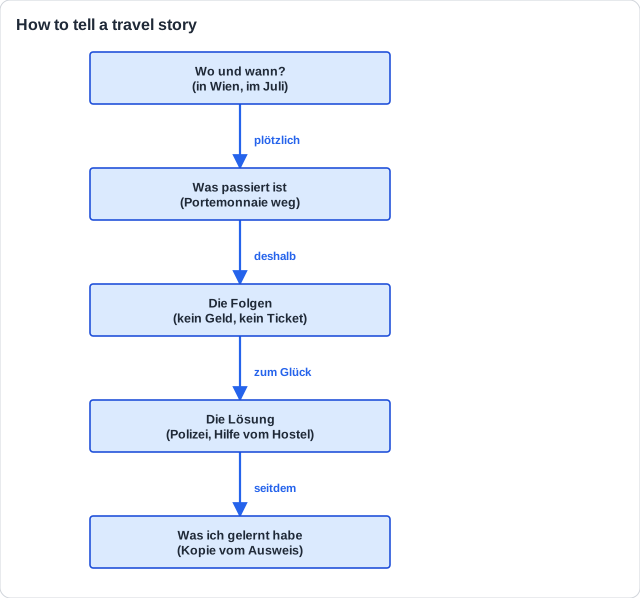
- Das Portemonnaie wurde gestohlen.
- Streit in der Warteschlange am Flughafen
Travelling responsibly
- sanfter Tourismus in den Bergen
- die Regeln in einer Berghütte
- mit dem Zug statt mit dem Flugzeug
Big questions behind this topic (IB guide, theme Experiences)
- Wie erweitert Reisen unseren Horizont?
- Was macht eine Reise unvergesslich: die Orte oder die Menschen?
- Können wir reisen, ohne der Umwelt zu schaden?
Link your ideas: Connectors lift your answer from a list into an argument: außerdem (besides), jedoch / aber (however), deshalb (therefore), obwohl (although). Use at least two or three in any written answer.
See how examiners mark answers
Answer exam-style questions with model answers. Learn exactly what earns marks and what doesn't.
Read like Paper 2: Here is a short blog — the kind of text Paper 2 (Reading) gives you.
How to work through it
- Read it once just for the general idea; don't worry about every word.
- Tap the audio button to hear it.
- Tap Übersetzung anzeigen if you get stuck.
- Then we'll do one exam question together.
Ein Sommer ohne Buchungen (1/4): Letzten Sommer habe ich mit meinem Bruder eine Zugreise durch die Schweiz und Österreich gemacht. Wir hatten kein Hotel gebucht: Wir übernachteten in günstigen Jugendherbergen und kauften die Fahrkarte jeden Morgen neu.
Ein Sommer ohne Buchungen (2/4)
Am Anfang war es ein bisschen chaotisch. Am ersten Tag verpassten wir den Zug, und erschöpft nach Stunden am Bahnhof dachte ich, es sei eine schlechte Idee gewesen.
Ein Sommer ohne Buchungen (3/4)
Diese Freiheit wurde jedoch das Beste an der Reise: Wir lernten andere Reisende kennen, änderten unsere Pläne ohne Stress und entdeckten wunderschöne Dörfer, die in keinem Reiseführer stehen.
Ein Sommer ohne Buchungen (4/4)
Deshalb möchte ich nächsten Sommer dasselbe noch einmal machen, aber diesmal mit dem Fahrrad. So zu reisen, ohne Eile, hat mich gelehrt, den Weg zu genießen und nicht nur das Ziel.
- die Jugendherberge
- youth hostel
- die Fahrkarte
- ticket
- erschöpft
- exhausted
- der Reiseführer
- guidebook
- das Reiseziel
- destination
IB-style task — eine Frage aus Paper 2
Eine Frage, Schritt für Schritt
- The question — „Wo haben die beiden dem Text zufolge während der Reise übernachtet?“
- Find it in the text. Look for „übernachteten“: „Wir hatten kein Hotel gebucht: Wir übernachteten in günstigen Jugendherbergen und kauften die Fahrkarte jeden Morgen neu.“
- The answer — Sie übernachteten in günstigen Jugendherbergen.
Reading technique: For a „dem Text zufolge“ (according to the text) question, find the exact line that proves your answer — don't rely on memory or general knowledge.
Die Aufgabe — your task: Deine Klasse plant eine Klassenfahrt und möchte nachhaltig reisen. Schreibe eine Broschüre für deine Mitschülerinnen und Mitschüler.
| Teil | Auf Deutsch | English |
|---|---|---|
| Inhalt 1 | Stelle das Reiseziel vor. | Present the destination. |
| Inhalt 2 | Gib Tipps, wie man verantwortungsvoll reist. | Give advice on how to travel responsibly. |
| Länge | Schreibe zwischen 450 und 600 Wörtern. | Write 450–600 words. |
Brochure structure — 4 steps
Eye-catching title
A title that catches the eye. „Sanft reisen: Unsere Klassenfahrt nach Rügen“
Sections with subheadings
Short sections, each with a subheading, often a question. „Was erwartet euch?“
Bullet points
List the tips as short bullet points with the ihr-imperative. „• Fahrt mit dem Zug • Nehmt eine Trinkflasche mit“
Practical info + call to action
End with the practical details and a call to action. „Abfahrt: 12. Mai… Packt leicht!“
Title → Sections → Bullet points → Info + call to action
Modell: die 4 Schritte in ~80 Wörtern
Die fertige Broschüre, Schritt für Schritt
- Sanft reisen: Unsere Klassenfahrt nach Rügen
- Was erwartet euch? Fünf Tage an der Ostsee, Kreidefelsen, Radtouren und Nächte in der Jugendherberge direkt am Strand.
- So reist ihr verantwortungsvoll: • Fahrt mit dem Zug statt mit dem Flugzeug. • Nehmt eine Trinkflasche mit, keine Plastikflaschen. • Kauft Souvenirs in kleinen Läden vor Ort. • Bleibt auf den Wegen, damit die Natur geschützt bleibt.
- Abfahrt: 12. Mai, 8 Uhr, Hauptbahnhof. Kosten: 180 Euro. Fragen? Schreibt an Herrn Wolf. Packt leicht – und entdeckt Rügen mit offenen Augen!
Warum es funktioniert — what makes it strong: A strong brochure does these things for each of the three Paper 1 criteria:
A — Language /12
- Imperative ihr: „fahrt“, „nehmt“, „bleibt“
- „statt“ and „damit“: „statt mit dem Flugzeug“, „damit die Natur geschützt bleibt“
- Travel vocabulary: „die Jugendherberge“, „die Abfahrt“
B — Message /12
- Task fully done: presents the destination AND gives tips for responsible travel
- Practical details are complete (date, time, cost, contact)
C — Conceptual /6
- Brochure conventions: an eye-catching title
- Subheadings as questions and bullet points
- Practical info and a call to action at the end
Study smarter, not longer
Most students waste 40% of study time on topics they already know. Our AI tracks your progress and optimizes every minute.
Höre wie in Paper 2: Paper 2 also tests listening (25 marks): you hear short clips and answer questions — but you never see the words. Here's one, simplified. Play it, answer, then reveal the transcript to check.
Hörverstehen — Lenas Sommerferien
Listen to Lena describe her summer holiday. Try to answer before you reveal the transcript — that's how Paper 2 Listening works.
Du hörst Lena über ihre Ferien an der Ostsee erzählen.
- Wie sind Lena und ihre Freundinnen gereist und wo haben sie übernachtet? (How did Lena and her friends travel and stay?)
Hallo, ich heiße Lena. Letzten Sommer bin ich mit meinen Freundinnen an die Ostsee gefahren. Wir haben keine Pauschalreise gebucht: Wir sind auf eigene Faust mit dem Bus gereist und haben in einer Jugendherberge übernachtet. Vormittags haben wir die Altstadt besichtigt und nachmittags waren wir am Strand. Für mich war das Beste an der Reise, die Menschen vor Ort kennenzulernen und die regionalen Spezialitäten zu probieren. Wir haben außerdem versucht, verantwortungsvoll zu reisen und die Orte, die wir besucht haben, immer zu respektieren.
Hi, I'm Lena. Last summer I went to the Baltic coast with my friends. We didn't book a package trip: we travelled independently by bus and stayed in a youth hostel. In the mornings we visited the old town and in the afternoons we were at the beach. For me the best part of the trip was getting to know the local people and trying the regional specialities. We also tried to travel responsibly and always respect the places we visited.
- Sie sind auf eigene Faust mit dem Bus gereist und haben in einer Jugendherberge übernachtet.
Listening technique: Read the question first, then listen for that one detail — you don't need to catch every word. In the real exam you hear each clip twice.