Bury it: A landfill is the cheapest and most common way to get rid of waste. An open dump causes the most harm.
Landfill: for and against
- Good: cheap and simple; takes mixed waste; methane can be captured for electricity.
- Leachate can pollute soil, rivers and groundwater.
- Rotting waste gives off methane and CO2: global warming, and fires and explosions.
- Uses land that could be farms, homes or habitat; that land is lost for decades.
- Vermin, disease, litter, smells and an eyesore lower nearby house prices.
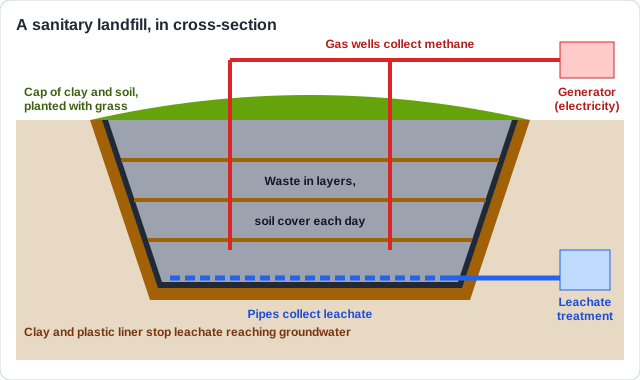
- A sanitary landfill (liner, leachate pipes, gas wells, daily cover) cuts most of these risks.
Real example: Delhi's Ghazipur landfill opened in 1984 with no liner. By 2019 it was about 65 m high. In 2017 part of it collapsed onto a road, killing two people, and fires have spread smoke over nearby homes.
Stick to the waste and the site: Link each problem to the waste or the site in the question: 'paper rots and gives off methane', not a general landfill point. Pollution from the lorries driving to the site may not be credited.
Free preview
This is the free notes preview
You're reading the free notes. Aimnova Pro unlocks the full study experience — and you can try it with your first topic free to keep:
- FlashcardsLock in vocabulary and key terms with spaced repetition.
- Practice questionsAnswer exam-style questions and get instant AI marking.
- Mock exams & past-paper vaultSit full mocks and see exactly how examiners award marks.
- Personalised study planA daily plan built around your exam date and weak areas.
Incineration shrinks waste. With waste to energy, the heat is put to use.
Incineration and waste to energy
- Burning at 850-1,100 C cuts waste volume by about 90%, so far less land is needed.
- It destroys germs and, with waste to energy, makes electricity and heat.
- It makes less methane than landfill (CO2 is a weaker greenhouse gas).
- But it releases CO2 and air pollutants (dioxins, particulates) unless filtered.
- It leaves toxic ash for landfill, is costly to build and run, and needs experts.
- It can weaken the push to reduce waste: the plant needs a steady supply to burn.
Remember it as: Less land, more air pollution.
Incineration instead of landfill: gains
- About 90% less volume
- Energy recovered
- Less methane
Costs
- Air pollution and CO2
- Toxic ash still to landfill
- Expensive; may slow reduction
Real example: Sweden sends less than 1% of its household waste to landfill. About half is burned in waste-to-energy plants that heat homes, and Sweden even imports waste from other countries to keep the plants running.
Feeling unprepared for exams?
Get a clear study plan, practice with real questions, and know exactly where you stand before exam day. No more guessing.
Some countries ship waste abroad instead of dealing with it at home. This moves the impacts to another place, often a poorer one.
Exporting waste
- Rich countries ship waste, often plastic and e-waste, to poorer countries.
- Good for the exporter: cheaper than treating it at home; materials may be reused.
- Bad for the receiver: dumping, open burning, polluted air, water and soil.
- Poor communities bear the harm of others' waste: environmental injustice.
- Shipping uses fuel, and waste can be lost at sea; it moves the problem, not solve it.
Real example: for years China took in about half the world's plastic waste for recycling. In January 2018 its National Sword policy banned most imports. Waste piled up in exporting countries or was sent to Malaysia, Vietnam and Turkey instead.
Both sides: For the exporter, export is cheap and easy. For the receiver, it brings pollution and health risks. Say whose side each point is on.
Recycling turns waste back into a resource, but it is not free of costs.
Recycling: for and against
- Good: less extraction of new resources; less waste to landfill or incineration.
- It usually saves energy: recycled aluminium uses about 95% less than new.
- It creates jobs and can make people more aware of waste.
- But many items cannot be recycled; mixed materials are hard to separate.
- Sorting, transport and reprocessing use energy and can pollute.
- Food contamination spoils a load; quality falls each time (downcycling).
Recycles well
- Aluminium and steel
- Glass
- Clean paper and card
Recycles badly
- Mixed plastics and films
- Clothes with mixed fibres
- Anything dirty with food
Real example: an aluminium drinks can can be recycled again and again without losing quality, and recycling it uses about 95% less energy than making new aluminium from bauxite.
Not 'lower quality' for metal: For metal, 'the recycled metal is lower quality' is not accepted. Use: some metals are hard to separate, recycling still needs a lot of energy, or reuse would save more.
Memorize terms 3x faster
Smart flashcards show you cards right before you forget them. Perfect for definitions and key concepts.
Food and garden waste can be turned back into soil. This closes the nutrient cycle and keeps rotting waste out of landfill.
Composting and anaerobic digestion
- Composting: microbes break down food and garden waste with oxygen into compost.
- Anaerobic digestion: microbes break it down without oxygen, making biogas and fertiliser.
- Both keep food out of landfill, so less methane and leachate.
- Compost and digestate replace artificial fertiliser and improve soil.
- But only for biodegradable waste: not meat, dairy or plastic in a home heap.
- Smells and pests if badly run; digesters are costly and need expertise.
Real example: since 2014 Milan, Italy, has collected food waste separately from every home. It is turned into compost and biogas, and Milan is one of Europe's leading big cities for food waste collection.
Food waste is not recycled: For food waste, use composting, anaerobic digestion, landfill with methane capture or incineration. 'Recycling' is not a valid method for food.
No option is best for everything. Judge each one by its impact on ecosystems and on societies, and by the material it is used for.
Comparing the options
- Impact on ecosystems: pollution of land, water and air; habitat lost; greenhouse gases.
- Impact on societies: health, jobs, cost, land, smells, house prices, fairness.
- Match the method to the material: compost food; recycle metal and glass; burn what is left.
- Climate: recycling, composting, waste to energy and landfill gas capture all mitigate.
- Ocean life: recycling, safe landfill and littering laws keep plastic out of rivers and the sea.
| Option | Advantages | Disadvantages |
|---|---|---|
| Landfill | Cheap; takes mixed waste; gas for energy | Leachate, methane, land lost, pests |
| Incineration | 90% less volume; kills germs | Air pollution, CO2, toxic ash, cost |
| Waste to energy | Electricity and heat; replaces coal | Needs waste to burn; costly |
| Exporting | Cheap for the exporter | Pollution and injustice for the receiver |
| Recycling | Saves resources and energy; jobs | Not all recyclable; energy; contamination |
| Composting | Fertiliser; less methane | Food and garden waste only; smells, pests |
Real example: in Delhi the same waste could be composted, burned or dumped. Composting suits the large share of food waste, while burning wet food waste gives little energy.
A two-sided answer: In a 'discuss' question, give a benefit and a 'but' for each option, then a conclusion. With no 'but' and no conclusion, you cannot get full marks.
Know your predicted grade
Take timed mock exams and get detailed feedback on every answer. See exactly where you're losing marks.
How this comes up: Paper 2, Section A: a chart of the carbon impacts of household waste, then disadvantages of one disposal option for one material [2].
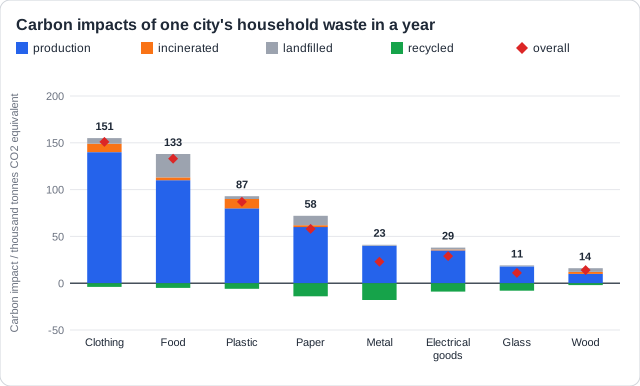
Figure 1 shows the carbon impacts of one city's household waste in a year.
Outline two disadvantages of using landfill to dispose of food waste, as shown in Figure 1.
Model answer plan
See the mark-by-mark plan — for / against / judgement, with marking guidance — in study mode.