Live on the interest: Sustainable resource management follows two rules: take no more than nature replaces, and dump no more than nature can break down.
The two rules
- Use renewable resources no faster than they regenerate: live on the natural income, keep the capital.
- Release wastes no faster than they can be transformed (broken down or absorbed) by nature.
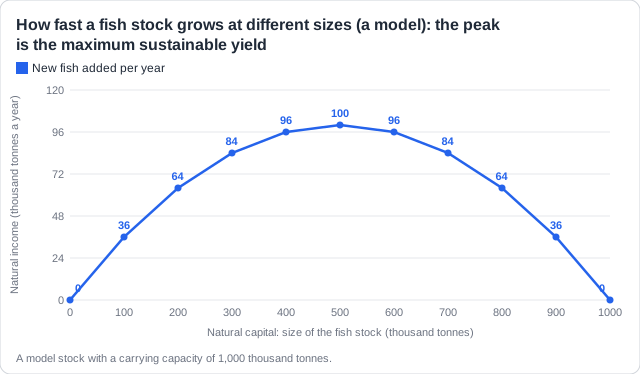
- Sustainable yield: the harvest that can be taken each year without reducing the stock.
- Maximum sustainable yield (MSY): the largest such harvest; taking more makes the stock decline.
- Break either rule and both ecosystems and people are harmed over time.
Remember it as: Take no more than grows back; dump no more than nature breaks down.
Real example: in 1713 Hans Carl von Carlowitz, who ran the silver mines of Saxony, saw the forests cut faster than they grew. He wrote that only as much wood should be felled as could regrow: the first written idea of sustainable yield.
Free preview
This is the free notes preview
You're reading the free notes. Aimnova Pro unlocks the full study experience — and you can try it with your first topic free to keep:
- FlashcardsLock in vocabulary and key terms with spaced repetition.
- Practice questionsAnswer exam-style questions and get instant AI marking.
- Mock exams & past-paper vaultSit full mocks and see exactly how examiners award marks.
- Personalised study planA daily plan built around your exam date and weak areas.
When either rule is broken, the damage spreads from the ecosystem to the people who depend on it.
Harvesting too fast
- Cod caught faster than they bred
- Stock crashed; fishery closed in 1992
- Over 30,000 people lost work
Wastes faster than nature copes
- Farm fertiliser washed into Lake Erie
- Toxic algae bloomed in 2014
- Toledo's tap water unsafe for days
Real example: off Newfoundland, Canada, cod were caught faster than they could breed. In 1992 the stock collapsed and fishing was banned; over 30,000 people lost their jobs, and the ban lasted 32 years, until 2024. In August 2014 a toxic algal bloom in Lake Erie, fed by fertiliser from farms, left about 400,000 people in Toledo, USA, unable to drink their tap water.
Ecosystem AND society: For each example, give one harm to the ecosystem and one to people: fewer fish, then lost jobs.
Feeling unprepared for exams?
Get a clear study plan, practice with real questions, and know exactly where you stand before exam day. No more guessing.
A toolbox, not one tool: Sustainable management balances economic use with environmental protection and fairness. It uses rules, money and new technology together.
Principles of sustainable management
- Three pillars: environmental (healthy ecosystems), economic (lasting income), social (fair shares).
- Precautionary principle: act to prevent harm even without full scientific certainty.
- Polluter pays: those who cause pollution bear its costs.
- Intergenerational equity: leave enough for future generations.
- Substitution and efficiency: swap scarce resources for renewable ones; get more from less.
- Judge a strategy by effectiveness, cost, feasibility, equity and scalability.
Rules
- Quotas and logging permits
- Protected areas and marine reserves
- Laws, pollution limits, impact assessments
- Moratoriums, e.g. on whaling
- Certification: FSC timber, MSC fish
Money
- Taxes and charges on extraction or pollution
- Subsidies for sustainable options
- Tradeable permits for emissions or catch
- Payments to landowners for ecosystem services
- Governments buying green products
Technology and behaviour
- Recycling and a circular economy
- Substitution of scarce materials
- Efficiency: less resource per product
- Using less: sharing, repairing, eating less meat
Real example: Alaska's salmon fisheries count the fish swimming upriver to breed and close fishing once enough have passed. In 2000 they became one of the first fisheries certified by the Marine Stewardship Council.
Questions ask how to manage a named renewable resource. Fish and forests come up most.
Managing fish sustainably
- Estimate the MSY and set quotas at or below it, agreed nationally and internationally.
- Protect young fish: bigger net mesh, closed breeding seasons.
- Use selective gear: cut bycatch, ban bottom trawling; create marine protected areas.
- Monitor boats (e.g. by satellite), fine illegal fishing, certify sustainable catches.
- Aquaculture: fewer fish per tank, fewer antibiotics, treat waste water, mix species (polyculture).
- Educate fishers and fund research on how fast each species grows.
On land, the shape of the land matters. Steep slopes make forestry harder to run sustainably.
Managing forests on slopes
- Felling and replanting on steep slopes is harder and costs more.
- Bare slopes lose soil to run-off, erosion and landslides, so new trees regrow slowly.
- Access roads are hard to build and keep open on steep, eroding ground.
- Mountain tourism can conflict with logging; but empty uplands leave land available.
- Sustainable forestry: selective felling, replanting native trees, protecting seedlings.
Real example: on the steep coast mountains of British Columbia, Canada, logs are often lifted out by cable systems or helicopters, which costs far more than on flat land, and logging roads can trigger landslides into salmon rivers.
Link every strategy: Say how each strategy keeps the harvest within regrowth: 'bigger mesh, so young fish survive to breed', not just 'bigger mesh'.
Memorize terms 3x faster
Smart flashcards show you cards right before you forget them. Perfect for definitions and key concepts.
A useful way of thinking?: Seeing nature as natural capital gives a simple rule: spend the income, never the capital. Essays ask how far that idea really helps.
It helps
- A clear rule: harvest only the income
- Basis for MSY, quotas and footprints
- Puts a value on services so they count
- Stresses keeping future income
Its limits
- Natural income is hard to measure
- MSY ignores the wider ecosystem
- Treats nature as a thing to sell
- Ignores intrinsic and cultural value
Real example: in 2005 the Millennium Ecosystem Assessment, by over 1,300 scientists, found that about 60% of the ecosystem services it studied were being degraded or used unsustainably: the world was spending its natural capital.
Optimal, not maximum: Many managers aim below MSY, at an optimal sustainable yield, because MSY estimates are often too high.
How this comes up: Paper 2, Section B (b): a 7-mark explain question, one linked point per mark.
In August 2014, a toxic algal bloom in Lake Erie, fed by phosphorus from farm fertiliser and manure, left about 400,000 people in Toledo, USA, without safe tap water.
Explain how the release of waste into a named ecosystem can be managed so that it does not exceed the rate at which the waste is transformed.
Model answer plan
See the mark-by-mark plan — for / against / judgement, with marking guidance — in study mode.