A thin shield, high up: Ozone is spread through the air, but most of it sits in the stratosphere. The part with the most ozone is called the ozone layer.
The points to remember
- Ozone (O₃) is a gas made of three oxygen atoms.
- About 90% of all ozone is in the stratosphere; about 10% is in the troposphere.
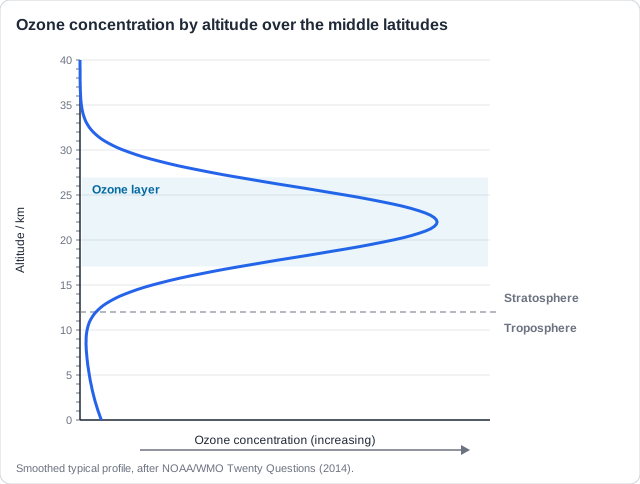
- The ozone layer is the part of the stratosphere with the most ozone: about 15 to 35 km up.
- The peak is usually at about 20 to 25 km; it is higher over the tropics and lower near the poles.
- There is very little of it: brought down to the ground, all the ozone would make a layer only about 3 mm thick.
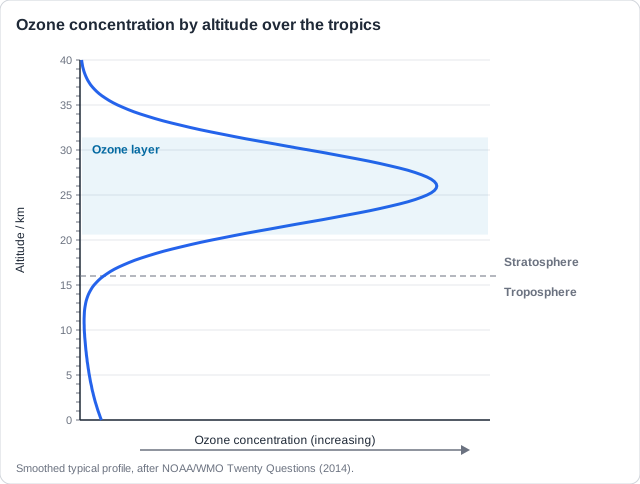
Real example: in the 1920s the British scientist Gordon Dobson built an instrument that measures how much ozone is in the air above it by reading sunlight. The amount is still given in Dobson units, and typical values are 200 to 500.
Free preview
This is the free notes preview
You're reading the free notes. Aimnova Pro unlocks the full study experience — and you can try it with your first topic free to keep:
- FlashcardsLock in vocabulary and key terms with spaced repetition.
- Practice questionsAnswer exam-style questions and get instant AI marking.
- Mock exams & past-paper vaultSit full mocks and see exactly how examiners award marks.
- Personalised study planA daily plan built around your exam date and weak areas.
The job of the ozone layer is to absorb UV. Every bit of UV it absorbs is UV that never reaches living things on the ground.
The points to remember
- Stratospheric ozone absorbs UV radiation from the Sun.
- It absorbs all UVC and most UVB, so much less UV reaches Earth's surface.
- UV is harmful because it is high-energy radiation, especially the shortest wavelengths.
- So the ozone layer protects living organisms from UV damage: DNA, skin, eyes, plants and plankton.
- Absorbing UV also warms the stratosphere: it gets warmer with height.
Sun's UV
- UVA, UVB and UVC arrive at the top of the atmosphere.
Ozone layer
- Absorbs all UVC and most UVB, 15-35 km up.
Surface
- Much less UV reaches plants, animals, plankton and people.
Remember it as: Ozone absorbs, so less UV arrives, so life is protected.
Real example: Mars has almost no ozone layer. UV at its surface is strong enough to kill unprotected bacteria within minutes, which is one reason scientists look for signs of life under Mars's surface, not on it.
Say what it absorbs AND why it matters: 'It protects life on Earth' or 'it absorbs the Sun's rays' is too vague. Write: 'ozone absorbs UV, so less UV reaches the surface, so less damage to DNA'.
Know your predicted grade
Take timed mock exams and get detailed feedback on every answer. See exactly where you're losing marks.
Ozone is the same gas everywhere, but where it is changes what it does: good up high, bad nearby.
The points to remember
- Up high (stratosphere): good ozone; it absorbs UV and protects life.
- Near the ground (troposphere): bad ozone; a pollutant in summer smog.
- Ground-level ozone irritates lungs and eyes and damages plants and materials.
- Ground-level ozone does not cause skin cancer or cataracts: those come from UV.
- The ozone layer is not the greenhouse effect: one absorbs incoming UV, the other outgoing infrared.
Stratospheric ozone (good)
- About 15-35 km up
- Forms the ozone layer
- Absorbs UVC and most UVB
- Protects life: we want more
Ground-level ozone (bad)
- At ground level
- Part of summer smog
- Irritates lungs and eyes; damages crops
- A pollutant: we want less
Real example: on hot, sunny days Los Angeles issues smog alerts: sunlight turns car exhaust into ground-level ozone, and people with asthma are told to stay indoors.
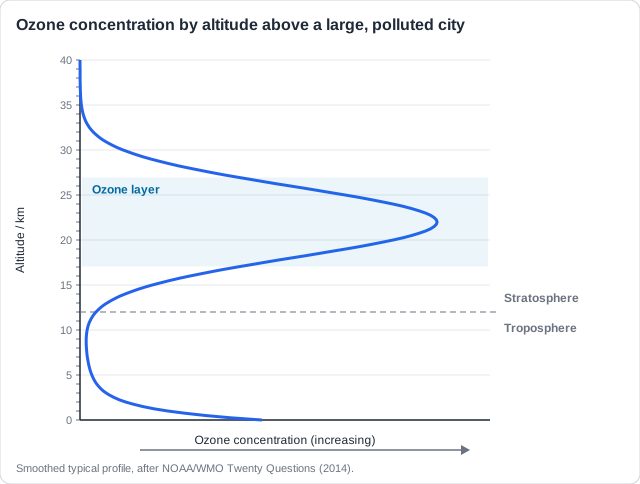
Papers give a graph of ozone against altitude, then ask where the peak is and what the ozone there does for living things. Practise on this one.
The points to remember
- Identify the altitude: find the widest point of the curve, read across, and give the unit (km).
- Point 1: ozone absorbs UV from the Sun, so less ozone = more UV at the surface.
- Point 2: UV harms living tissue: cataracts, mutations in dividing cells, skin cancer, a weaker immune system.
- Point 3: UV damages leaves, algae and phytoplankton, so less photosynthesis.
- Point 4: so less food up the food chain, e.g. fewer krill around Antarctica.
- Never just 'it protects life' or 'it absorbs the Sun's rays'; never 'global warming'.
Read the peak
About 22 km: write the unit, or the mark is lost.
Absorbs UV
Less ozone at 20-30 km lets more UV reach the ground.
Harm
Cataracts, mutations, skin cancer; damaged phytoplankton.
Food chain
Less photosynthesis, so fewer krill in the Southern Ocean.
Three answers that score nothing: '22' with no unit. 'It protects life on Earth'. 'Less ozone causes global warming': ozone loss is not a cause of climate change.
Get feedback like a real examiner
Submit your answers and get instant feedback — what you did well, what's missing, and exactly what to write to score full marks.
How this comes up: Paper 2, Section A (May 2025, all three time zones): (a) read the altitude of the peak [1], then (b) what the ozone there does for living things [2].
The figure shows the concentration of ozone at different altitudes above a large city.
(a) Identify the altitude with the highest concentration of ozone.
(b) Describe how a decreased concentration of ozone between 20 and 30 km could affect living organisms.
Model answer plan
See the mark-by-mark plan — for / against / judgement, with marking guidance — in study mode.