In versus out: Whether a soil is a carbon sink, a carbon store or a carbon source depends on two rates: how fast dead organic matter goes in, and how fast it decomposes.
The points to remember
- Carbon enters the soil as dead organic matter: leaves, roots, dung (plants took it from the air).
- It leaves as carbon dioxide, or methane where there is no oxygen, when decomposers break it down.
- Store: the amount of carbon the soil holds.
- Sink: dead matter added faster than it decomposes: the store grows and carbon is taken from the air.
- Source: decomposition faster than the input: the store shrinks and carbon is added to the air.
- Soils hold more carbon than the atmosphere and all plants put together.
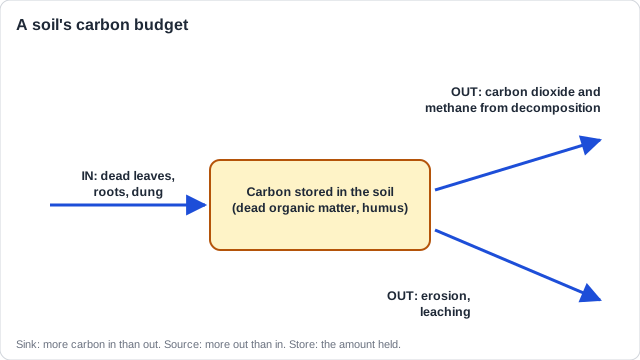
Remember it as: More in than out: sink. More out than in: source.
Real example: at the 2015 Paris climate talks, France launched the '4 per 1000' initiative: raising the carbon in the world's soils by 0.4% a year could cancel out a large share of the carbon dioxide people add to the air.
Do not mix up store and sink: A store is an amount (tonnes of carbon). A sink is a process: carbon going in faster than it comes out. A soil can be a big store and still be a source if it is losing carbon.
Free preview
This is the free notes preview
You're reading the free notes. Aimnova Pro unlocks the full study experience — and you can try it with your first topic free to keep:
- FlashcardsLock in vocabulary and key terms with spaced repetition.
- Practice questionsAnswer exam-style questions and get instant AI marking.
- Mock exams & past-paper vaultSit full mocks and see exactly how examiners award marks.
- Personalised study planA daily plan built around your exam date and weak areas.
A tropical rainforest makes a huge amount of dead matter, so you might expect a thick, carbon-rich soil. In fact its soil holds little, because everything that falls is broken down and taken up again quickly.
The points to remember
- Warm and wet all year: decomposers work fast, so dead leaves are gone in months.
- Roots and fungi take the released nutrients back at once: most carbon stays in the trees, not the soil.
- Heavy rain leaches old, weathered soils, so little organic matter builds up.
- So the input is large, but decomposition keeps pace: the soil store stays small.
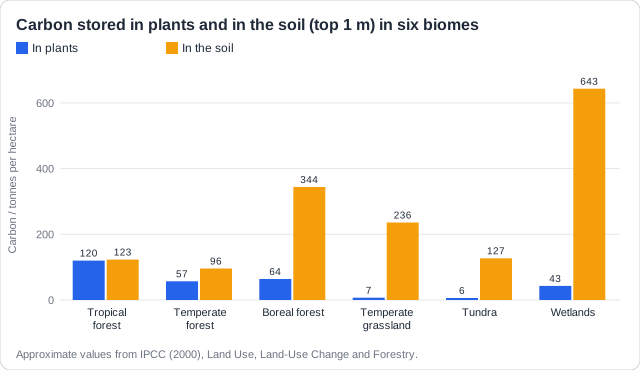
- In the chart: tropical forest about 120 t of carbon per hectare in plants, 123 t in the soil.
Remember it as: Hot and wet: carbon in the trees, not the soil.
Real example: when Amazon forest is cleared for cattle, the thin soil underneath soon loses its fertility, because most of the nutrients and carbon were in the trees that were removed.
Practice with exam-style questions
Answer exam-style questions and get AI feedback that shows you exactly what examiners want to see in a full-marks response.
Too cold or too wet to rot: Under tundra, in wetlands and in peat, dead matter builds up because decomposers can hardly work.
The points to remember
- Cold: decomposers work slowly; in permafrost the ground is frozen and decomposition almost stops.
- Waterlogged wetlands and bogs: no oxygen, so dead plants decompose very slowly and build up as peat.
- Input is small, but decomposition is slower still, so carbon builds up over thousands of years.
- Peatlands cover about 3% of the land yet hold about twice the carbon of all the world's forests.
- Permafrost soils hold about 1,500 billion tonnes of carbon, nearly twice the carbon in the atmosphere.
Remember it as: Cold or waterlogged: slow decay, big store.
Real example: the Flow Country in northern Scotland, the largest blanket bog in Europe and a World Heritage Site since 2024, holds about 400 million tonnes of carbon in its peat.
Give the cause, then the effect on decomposition: Write 'the bog is waterlogged, so there is no oxygen, so decomposers work very slowly and peat builds up', not just 'it is wet'.
Temperate grasslands have little carbon in their plants, but a great deal in their soils.
The points to remember
- Grasses put much of their growth below ground: deep, dense roots.
- Many roots die each year and new ones grow, a large, steady input of dead matter deep in the soil.
- Cold winters and dry summers slow the decomposers.
- Earthworms and burrowers mix organic matter downwards; fires leave charcoal, which hardly decays.
- Result: deep, dark, carbon-rich soils: about 236 t of carbon per hectare in the soil, only 7 t in plants.
Real example: the roots of the tallgrass prairie of the US Midwest can reach 3 to 4 m deep. Centuries of dying roots built some of the deepest, darkest soils on Earth.
Grassland is not 'little carbon': Grassland plants hold little carbon, but its soils hold a lot. Read which bar the question asks about: plants or soil.
Feeling unprepared for exams?
Get a clear study plan, practice with real questions, and know exactly where you stand before exam day. No more guessing.
People can tip the balance: Anything that speeds up decomposition or cuts the input of dead matter can turn a soil from a sink into a source. Anything that does the opposite can turn it back.
The points to remember
- Draining peat lets air in: decomposition speeds up, so the soil becomes a source; dry peat can also burn.
- Ploughing breaks the soil open to air, so stored carbon is decomposed and lost.
- Clearing forest cuts the input of dead matter and leaves soil open to erosion.
- Warming speeds up decomposers and thaws permafrost, releasing carbon dioxide and methane.
- Back to a sink: no-till farming, cover crops, compost, re-wetting peat, planting trees.
Sink to source
- Drain peat
- Plough grassland
- Clear and burn forest
- Warm and thaw permafrost
Source to sink
- Re-wet peat
- No-till and cover crops
- Add compost or manure
- Plant trees, restore grassland
Real example: in 2015, fires burned through drained peatlands in Indonesia. On many days the fires released more carbon dioxide than the whole US economy.
Name the rate that changes: Say whether an action changes the INPUT of dead matter or the rate of DECOMPOSITION, and which way.
How this comes up: Paper 2, Section B (b): explain why soils in different biomes store different amounts of carbon [7]. Both biomes, each reason linked to input or decomposition.
The soils under tundra and peat bogs store large amounts of carbon, while the soils under tropical rainforests store relatively little.
Explain these differences in soil carbon storage.
Model answer plan
See the mark-by-mark plan — for / against / judgement, with marking guidance — in study mode.