Nothing is wasted: The elements in a dead leaf are not lost: the soil breaks the leaf down and hands its elements back to living plants. This is part of the biogeochemical cycles.
The points to remember
- Elements such as carbon, nitrogen, phosphorus and potassium are used again and again: they cycle.
- The soil is where much of this recycling happens, as part of biogeochemical cycles.
- The major input is dead organic matter from plants: leaf litter, dead roots, fallen wood.
- Detritivores break it into small fragments; saprotrophs decompose the fragments.
- Decomposition releases mineral nutrients (nitrate, phosphate, potassium) that plant roots absorb again.
- Without it, nutrients would stay locked in dead matter and plants would run short.
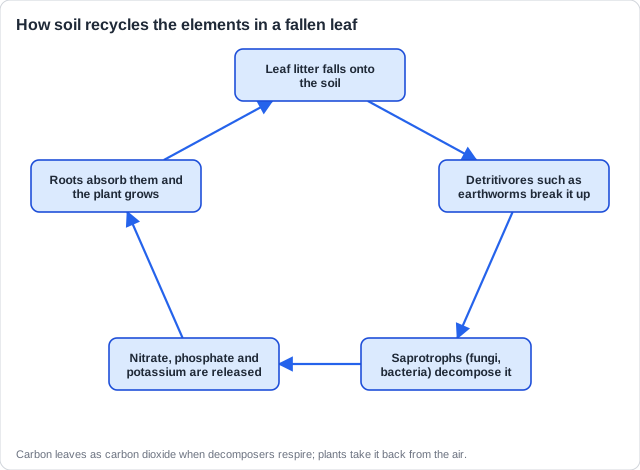
Remember it as: Fall, fragment, decompose, release, absorb.
Real example: on the floor of the Amazon rainforest, a fallen leaf can be gone within a few months. Its nutrients are taken up again by tree roots almost at once, so most of the forest's nutrients are held in the trees.
Free preview
This is the free notes preview
You're reading the free notes. Aimnova Pro unlocks the full study experience — and you can try it with your first topic free to keep:
- FlashcardsLock in vocabulary and key terms with spaced repetition.
- Practice questionsAnswer exam-style questions and get instant AI marking.
- Mock exams & past-paper vaultSit full mocks and see exactly how examiners award marks.
- Personalised study planA daily plan built around your exam date and weak areas.
The first step is done by detritivores. They eat dead leaves and break them into pieces, which makes the next step faster.
The points to remember
- Detritivores are animals that eat dead organic matter (detritus) inside their bodies.
- Examples: earthworms, woodlice, millipedes, springtails, mites, dung beetles.
- They break litter into small fragments, so it has a much larger surface area for decomposers.
- Their droppings (worm casts) are rich in nutrients; their burrowing mixes litter into the soil.
- They do the first step: they speed decomposition up but do not finish it.
Real example: in New Zealand, there were no European earthworms in many sheep pastures. Where farmers added them, the thick mat of dead grass on the surface disappeared into the soil and the grass grew better.
Detritivore or saprotroph?: Detritivores are animals that eat dead matter and break it into fragments. Saprotrophs are fungi and bacteria that digest it outside their cells. Earthworms are detritivores, not decomposers.
Study smarter, not longer
Most students waste 40% of study time on topics they already know. Our AI tracks your progress and optimizes every minute.
Digesting from the outside: Saprotrophs finish the job. As they feed, they release the elements in the dead matter as simple mineral nutrients.
The points to remember
- Saprotrophs are fungi and bacteria that feed on dead matter.
- They release enzymes onto it, digest it outside their cells, then absorb the products.
- This decomposition turns organic matter back into mineral nutrients, such as nitrate and phosphate.
- As they respire, they release carbon dioxide to the air, so carbon is recycled too.
- What resists decay, a dark crumbly material, builds up as humus.
- Some soil bacteria turn ammonium into nitrate; others fix nitrogen from the air.
Remember it as: Detritivores chop it up; saprotrophs break it down.
Real example: a fairy ring on a lawn in England is a circle of dark green grass. A fungus spreads outwards under the soil, decomposing dead matter and releasing nitrogen, so the grass on the ring grows greener.
Decomposers work fastest where it is warm, moist and airy, and slowest where it is cold, dry or waterlogged. People can also break the cycle.
The points to remember
- Warm soils decompose fast; cold soils slowly.
- Moist soils decompose fast; dry soils slowly; waterlogged soils very slowly (no oxygen).
- Soft leaves rot fast; tough needles and wood rot slowly.
- More detritivores and decomposers means faster recycling.
- The cycle is broken when crops are harvested, forests are cleared or burned, or nutrients are leached away.
Remember it as: Warm, wet and airy: fast. Cold, dry or drowned: slow.
Real example: in the Tea Bag Index project, started in the Netherlands in 2013, people around the world bury the same tea bags and weigh them three months later. More of the tea is lost in warm, moist soils than in cold or dry ones.
Explain the speed with a reason: Not 'it is hot'. Write 'warm, moist conditions let decomposers grow and respire faster, so nutrients are released sooner'.
Practice with exam-style questions
Answer exam-style questions and get AI feedback that shows you exactly what examiners want to see in a full-marks response.
How this comes up: Paper 2, Section B (a): outline the role of soil in recycling elements [4]. Four steps, in order, each a complete link.
Each autumn, a beech wood in Denmark drops a thick layer of leaves. By the next summer, much of this litter has gone and the trees are growing new leaves.
Outline the role of the soil in recycling the elements in the fallen leaves.
Model answer plan
See the mark-by-mark plan — for / against / judgement, with marking guidance — in study mode.