In one sentence: succession is the replacement of one community by another in an area over time, until a stable climax community is reached.
The points to remember
- Succession = the replacement of one community by another in an area over time.
- It happens because biotic and abiotic conditions change.
- Each step is a seral stage (a sere); the whole series runs from pioneer to climax.
- Pioneer community: the first colonisers of bare ground: few, tough species.
- Climax community: the final, stable community, in equilibrium with the climate and soil.
- It is slow: it can take hundreds of years.
Remember it as: Think of a relay race: each community runs its stage, then hands over to the next.
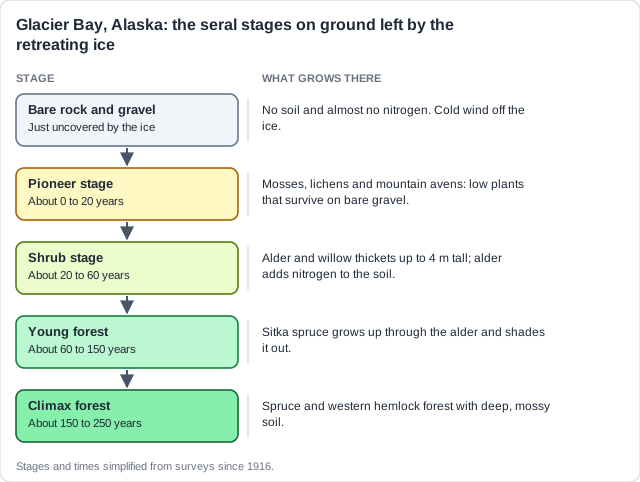
Real example: the ice of Glacier Bay has retreated about 100 km since the 1750s. Near the ice, gravel is bare. Further away, on older ground, you pass each seral stage in turn: mosses, then alder thickets, then spruce and hemlock forest.
Define it with both parts: Succession: the change in the community (the species present) of an area over time. A definition without time, or without the community, is only half an answer.
Free preview
This is the free notes preview
You're reading the free notes. Aimnova Pro unlocks the full study experience — and you can try it with your first topic free to keep:
- FlashcardsLock in vocabulary and key terms with spaced repetition.
- Practice questionsAnswer exam-style questions and get instant AI marking.
- Mock exams & past-paper vaultSit full mocks and see exactly how examiners award marks.
- Personalised study planA daily plan built around your exam date and weak areas.
Why does one community give way to another? Because each community changes the abiotic and biotic conditions of its own area, making it better for other species than for itself.
How one community replaces another
- A community changes the conditions of its area (soil, shade, nutrients, water).
- The new conditions let other species colonise.
- The newcomers outcompete and replace the first community.
- The cycle repeats, each community making way for the next, until the climax.
- Changes are abiotic (deeper soil, more nitrogen, more shade) and biotic (new species, competition).
Alder arrives
- Alder shrubs colonise gravel left by the ice, about 20 years after it melts.
It changes the soil
- Bacteria in alder roots fix nitrogen; fallen leaves build a deeper, richer soil.
Spruce moves in
- Spruce seedlings grow well in the new soil, which bare gravel could not support.
Spruce wins
- Spruce grows taller, shades the alder and outcompetes it for light.
Say what changed, then who won: Every step has two parts: the old community changes the conditions, then the new one outcompetes it. 'New species arrive' alone misses why the old ones leave.
Practice with exam-style questions
Answer exam-style questions and get AI feedback that shows you exactly what examiners want to see in a full-marks response.
Succession is too slow to watch, so how do we know it happened? One record is kept in peat.
Pollen in peat: the evidence
- Peat builds up in layers, year after year, in waterlogged bogs.
- It is wet and acidic, so pollen does not decay: it is preserved.
- Deeper = older. A core of peat is a record back through time.
- Each plant has its own pollen shape, so the plants of each period can be named.
- A change in pollen up the core shows one community replacing another: succession.
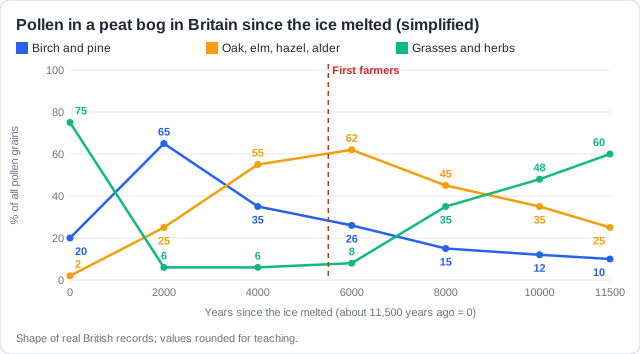
Real example: peat bogs across Britain tell the same story since the ice melted about 11,500 years ago: tundra grasses first, then birch and pine woodland, then oak, elm and hazel forest by about 7,000 years ago. Later, grass pollen rises again where farmers cleared the trees.
Deeper means older: In a peat core, read from the bottom up to go forward in time. A pollen type that replaces another higher up the core is a community replacing another.
Change over time can also be mapped. Old maps, air photos and satellite images of the same place show one community replacing another.
How to map change
- Compare maps, photos or satellite images of one area from different dates.
- Or compare sites of different, known ages side by side (young lava, old lava).
- Say what changed, from what to what, and give the numbers or dates.
- Name each community: 'birch woodland became heath', not 'the land got worse'.
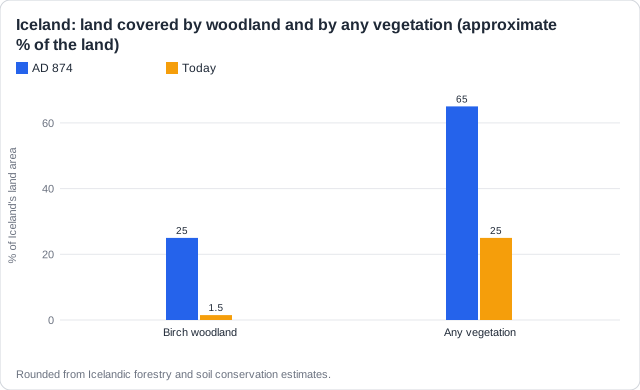
Real example: when settlers reached Iceland in AD 874, birch woodland covered about a quarter of the land. Felling and sheep grazing cut it to about 1.5%; heath, moor and bare, eroded ground took its place. Since 1945 the Nootka lupin, brought in to hold the soil, has spread and outcompetes native plants.
Name what changed into what: 'The vegetation changed to a desert' names nothing. Write 'birch woodland fell from about 25% to 1.5% of the land and was replaced by heath and bare ground'.
Feeling unprepared for exams?
Get a clear study plan, practice with real questions, and know exactly where you stand before exam day. No more guessing.
Zonation and succession both describe communities changing, so they are easy to mix up. The difference is space against time.
Zonation or succession?
- Zonation = change in communities across space, along an environmental gradient.
- Succession = change in the community of one area over time.
- Zonation: walk up a mountain today. Succession: stay in one spot for 200 years.
- In a comparison, always finish with the contrast: distance (space) v time.
Zonation
- Change across space
- Along a gradient: tide, height, distance
- Rocky shore: seaweeds change from low to high tide
Succession
- Change over time
- In one place, stage after stage
- Glacier Bay: mosses, then alder, then spruce
Real example: on a rocky shore in Cornwall you see zonation in one low tide: different seaweeds from the low-tide line to the top of the shore. At Glacier Bay, succession is the same patch of gravel becoming forest over 250 years.
Finish with the contrast: Describing each one is not enough. Say the difference directly: zonation is a change over space (distance along a gradient); succession is a change over time.
The papers often ask how a climax community differs from a pioneer community. Each point is a comparison: say which has more, or what each has. Pioneers are r-selected; climax species are K-selected.
How a climax differs from a pioneer community
- Climax has more species and more habitats and niches.
- Climax has longer food chains and more branched food webs.
- Climax has deeper soil, more nutrient cycling and a larger decomposer community.
- Climax has more biomass, gross productivity and community respiration.
- Climax has K-selected species and trees; pioneers are small, fast-growing r-selected species.
- Climax is more resilient (more stable) because it is more complex.
| Pioneer community | Climax community | |
|---|---|---|
| Species and niches | Few species, few niches | Many species, many niches |
| Food webs | Short chains, simple | Long chains, many branches |
| Soil | Thin or none, few nutrients | Deep, fertile, fast cycling |
| Biomass and productivity | Low biomass, low gross productivity | High biomass and gross productivity |
| Typical plants | Lichens, mosses, grasses | Trees and woody shrubs |
| Strategy | r-selected: small, fast, many seeds | K-selected: large, slow, long-lived |
| Stability | Easily disturbed | More resilient |
Real example: at Glacier Bay the pioneer mosses and mountain avens are a few centimetres tall on bare gravel; the climax spruce and hemlock forest is 40 m tall, on deep mossy soil, with bears, birds and many more species.
Compare, every time: 'Trees' alone is not a difference. Write 'the climax has trees, while the pioneer community has lichens and mosses'. The opposite way round (pioneer has fewer species) counts too.
Memorize terms 3x faster
Smart flashcards show you cards right before you forget them. Perfect for definitions and key concepts.
How this comes up: Paper 2, Section B, part (a): identify four differences between a climax and a pioneer community [4].
At Glacier Bay, Alaska, gravel uncovered by the ice in the 1990s holds mosses and mountain avens. Ground uncovered in the 1760s holds a spruce and hemlock forest.
Identify four differences between a climax community and a pioneer community.
Model answer plan
See the mark-by-mark plan — for / against / judgement, with marking guidance — in study mode.