Change across space: Ecosystems change across space as well as over time. The change across space is zonation: it happens along an environmental gradient. Each species lives only where conditions stay within its tolerance limits.
The points to remember
- Zonation: the community changes along an environmental gradient.
- Along the gradient, abiotic factors (temperature, water, salt, exposure) change bit by bit.
- Each species has tolerance limits, so it can only live where conditions suit its niche.
- Competition sets the edges: a stronger species pushes a weaker one out of part of the gradient.
- So species form bands (zones) that change over distance, across space.
Remember it as: Gradient, tolerance, competition: three words, three reasons for bands.
Real example: in 1961 Joseph Connell studied two barnacles on the Isle of Cumbrae, Scotland. Chthamalus lives high on the shore, Semibalanus lower down. When Connell removed Semibalanus, Chthamalus grew lower too: competition had kept it out. Semibalanus dies higher up because it dries out.
Name the gradient: Always say WHAT changes along the gradient (temperature, time out of water) and HOW that changes which species live there.
Free preview
This is the free notes preview
You're reading the free notes. Aimnova Pro unlocks the full study experience — and you can try it with your first topic free to keep:
- FlashcardsLock in vocabulary and key terms with spaced repetition.
- Practice questionsAnswer exam-style questions and get instant AI marking.
- Mock exams & past-paper vaultSit full mocks and see exactly how examiners award marks.
- Personalised study planA daily plan built around your exam date and weak areas.
Climb a mountain and you pass through bands of different vegetation: altitudinal zonation. The number of species usually falls as you go up.
Why the vegetation changes with altitude
- Higher up it is colder (about 6.5 °C less per 1,000 m), so the growing season is shorter.
- Plants that survive cold grow higher up: conifers photosynthesise as soon as it is above 0 °C.
- Plants that need a long growing season (deciduous trees) grow lower down.
- Soils get thinner and poorer, so tree roots cannot grow: alpine grassland replaces forest.
- Wind gets stronger, so only low-growing plants survive; more UV favours waxy, compact plants.
- Less oxygen and less water higher up; on south-facing slopes (north of the equator) zones sit higher.
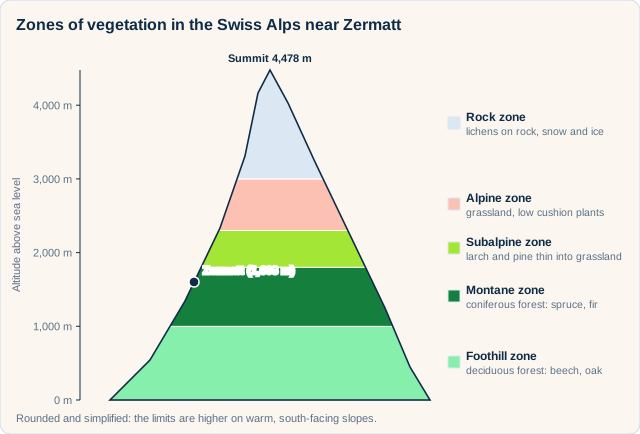
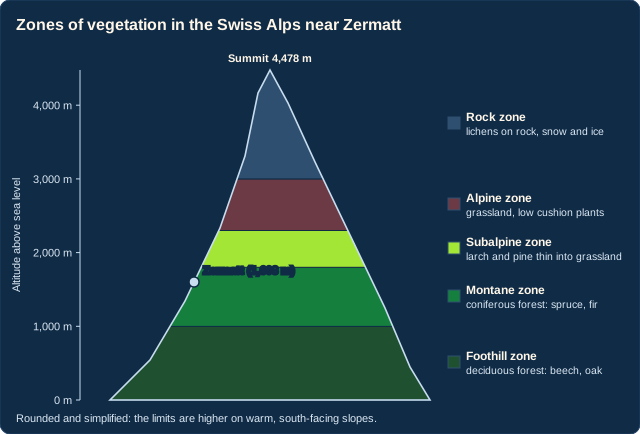
Real example: around Zermatt in the Swiss Alps, beech and oak forest grows below about 1,000 m, spruce and fir forest to about 1,800 m, larch and pine thin out into grassland near 2,300 m, and above 3,000 m only lichens grow on the rock.
Two answers that fail: 'There is less vegetation higher up' does not count: say the TYPE of vegetation changes. And 'the vegetation changes because the temperature changes' is not enough on its own: say how the cold changes which plants can grow.
Reading two maps: Pair a vegetation type with its height: 'alpine grassland grows at high altitude'. A range of numbers alone is not a relationship.
Know your predicted grade
Take timed mock exams and get detailed feedback on every answer. See exactly where you're losing marks.
On a coast the gradient is tidal level. The sea covers the lowest shore for most of the day and the highest shore for almost none of it.
The points to remember
- Tidal level is the gradient: the higher up the shore, the longer it is out of water.
- Low shore: under water most of the time: stable conditions, the most species.
- Middle shore: wet and dry every tide.
- Upper shore: out of water most of the time: drying out, heat and salt, few species.
- Upper limits are often set by drying out; lower limits by competition and predators.
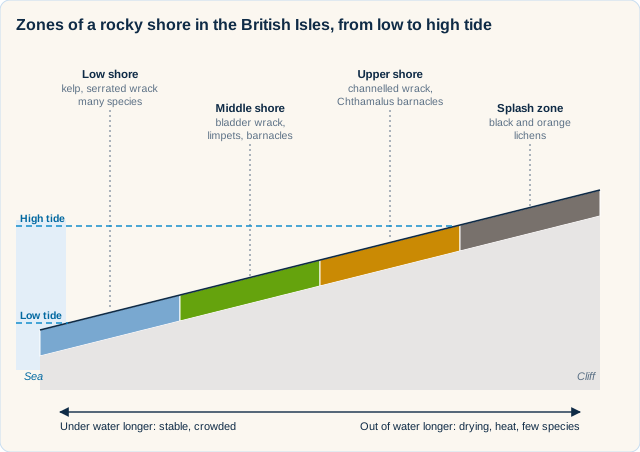
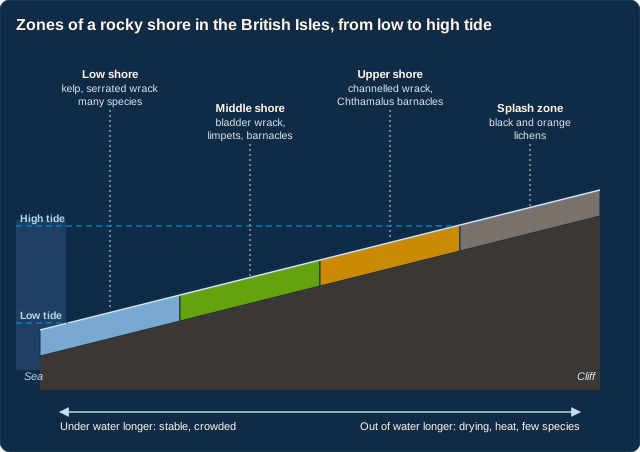
Real example: on rocky shores around the British Isles, kelp grows at the low-tide mark, bladder wrack in the middle and channelled wrack near the top. Channelled wrack survives losing most of its water for hours and recovers when the tide returns.
Why the low shore is richest: Link it to stability: under water most of the time, so temperature and moisture hardly change, and many species can live there. Higher up, fewer species can tolerate drying out.
Mountains and shores are the classic cases, but any steady change across space can make zones: latitude, soil depth or distance from a river or lake.
The points to remember
- Latitude: less solar energy towards the poles, so biomes change from the equator to the poles.
- Soil horizons: organisms change with depth, as oxygen, water and organic matter change.
- Distance from a water source: water in the soil falls, so plants change from wet-loving to dry-tolerant.
- Local scale: a shore or lake edge (metres). Global scale: biomes by latitude (thousands of km).
- Abiotic factors form zones too: water temperature changes with depth, distance from land, latitude and ocean currents.
Local scale
- A rocky shore, a lake edge, a forest edge
- Metres to a few kilometres
- Gradients such as tide or soil moisture
Global scale
- Biomes from the equator to the poles
- Thousands of kilometres
- Gradients such as solar energy and rainfall
Real example: along the River Nile in Egypt, a strip of reeds and farmland only a few kilometres wide follows the river. Beyond it, with no water in the soil, the desert begins at once.
A map of water temperature: Asked why sea or lake water forms bands of temperature? Give one reason with its link: shallow water near land warms faster; the water is cooler further from the equator; a cold current brings cold water. 'Climate change' or 'salinity' do not explain the pattern.
Get feedback like a real examiner
Submit your answers and get instant feedback — what you did well, what's missing, and exactly what to write to score full marks.
Zonation is easy to confuse with succession. Both are about communities changing, but along different axes: one across space, the other through time.
The points to remember
- Zonation: a gradient of abiotic factors; each species settles where the conditions suit its niche.
- So the community changes over distance: zonation is spatial.
- Succession: pioneer species colonise bare ground and change the abiotic conditions.
- Then other species can colonise and outcompete them, on towards a climax community.
- So the community changes over time: succession is temporal.
Remember it as: Zonation: walk across it. Succession: wait for it.
Zonation
- Changes over distance (space)
- Caused by an abiotic gradient
- e.g. a mountainside, a rocky shore
Succession
- Changes over time
- Caused by each community changing conditions
- e.g. after a fire, on new volcanic rock
Real example: walk up from Zermatt and the forest changes to grassland over a few kilometres: zonation. After Mount St Helens, USA, erupted in 1980, the bare ash was colonised first by lupins, then by shrubs and young trees over decades: succession.
End on the contrast: In a [7] on both ideas, finish with the key difference: zonation changes over distance, succession over time. Leaving that out caps the answer at 6. Writing about only one of them caps it at 4.
How this comes up: Paper 2, Section B (b): discuss, with named examples, the differences between zonation and succession [7].
Communities change across mountainsides and after natural disasters.
Discuss, with reference to named examples, the differences between zonation and succession.
Model answer plan
See the answer broken into clear points, with guidance on how each point earns marks.