One climate, one kind of ecosystem: A biome is a group of ecosystems that look alike because they grew up in the same kind of climate.
Climate works through three things: how much rain falls, how warm it is, and the insolation. Together they decide how much water and energy plants get, so they decide which plants grow.
The points to remember
- An ecosystem is a community of living things and its physical surroundings, in one place.
- A biome groups many comparable ecosystems that developed in similar climatic conditions.
- The same biome occurs wherever that climate occurs, even on different continents.
- Precipitation, temperature and insolation are the major influences on land biomes.
- A biome is named after its main vegetation: tropical rainforest, taiga, savanna, hot desert.
Remember it as: Same climate, same kind of ecosystem, anywhere on Earth.
Real example: the Mediterranean biome is found in five places: California, central Chile, the Cape of South Africa, south-west Australia and around the Mediterranean Sea. All have hot, dry summers and mild, wet winters, and all are covered in tough, small-leaved shrubs that regrow after fire.
Two parts to the definition: 'A biome is a large area' is not enough. Say both parts: a group of comparable ecosystems, and developed in similar climatic conditions.
Free preview
This is the free notes preview
You're reading the free notes. Aimnova Pro unlocks the full study experience — and you can try it with your first topic free to keep:
- FlashcardsLock in vocabulary and key terms with spaced repetition.
- Practice questionsAnswer exam-style questions and get instant AI marking.
- Mock exams & past-paper vaultSit full mocks and see exactly how examiners award marks.
- Personalised study planA daily plan built around your exam date and weak areas.
Why do biomes on different continents look alike? The same conditions favour the same solutions, even in species that are not related.
Parallel features
- Ecosystems in similar conditions have many parallel features, even when they are far apart.
- The species are usually different, but they look and live alike.
- The same conditions favour the same features, such as water-storing stems in deserts.
- So a biome shares a structure (layers, plant forms), not a list of species.
Cacti (the Americas)
- Thick stems store water
- Spines instead of leaves
- Grow in the Sonoran Desert, Mexico and USA
Euphorbias (Africa)
- Thick stems store water
- Spines instead of leaves
- Grow in the deserts of Morocco and Namibia
Real example: cacti and euphorbias are not closely related, yet a euphorbia in Morocco looks so like a cactus in Mexico that many people cannot tell them apart. Both deserts are hot and dry, so the same water-saving features were favoured in each.
Know your predicted grade
Take timed mock exams and get detailed feedback on every answer. See exactly where you're losing marks.
Papers often start with a biome or vegetation map of the case-study country. The first question is usually a one-mark reading: name a biome from the map.
Reading a biome map
- Match each colour to the key before you answer.
- Most widespread = the biome covering the largest area.
- Give the full name from the key: 'boreal forest (taiga)', not just 'forest'.
- Write one answer: when several are given, only the first is marked.
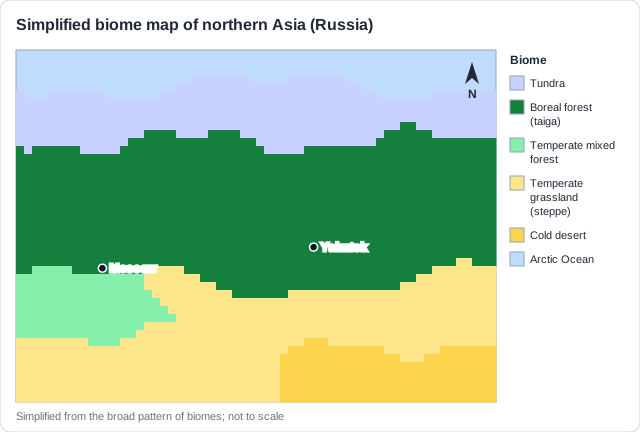
Real example: across northern Asia the taiga covers more land than any other biome: it is the largest forest on Earth. Tundra lies to its north, and steppe to its south.
Use the key's words: 'Forest' alone, or 'rainforest' when the key says 'subtropical rainforest', does not earn the mark. Copy the biome's full name from the key.
How this comes up: Paper 1, question 1(a): a biome map in the resource booklet. Identify the most widespread biome [1].
Figure 1 shows a simplified biome map of northern Asia.
With reference to Figure 1, identify the most widespread biome in northern Asia.
Model answer plan
See the mark-by-mark plan — for / against / judgement, with marking guidance — in study mode.