Food made by someone else: A consumer gets its energy from the carbon compounds it takes from other organisms, alive or dead.
The points to remember
- Consumers cannot make their own food: they take carbon compounds from other organisms.
- These carbon (organic) compounds, such as sugars, fats and proteins, hold chemical energy.
- Respiration in the consumer's cells then releases that energy for life (more in 2.2.6).
- Consumers have diverse strategies: some feed on living organisms, others on dead matter.
Remember it as: Can't make it, so take it.
Real example: on the Serengeti plains of Tanzania, a wildebeest gets its energy from grass, a lion from the wildebeest, and a vulture from what the lion leaves behind.
Where this fits: Producers make their own carbon compounds and start every food chain (2.2.10). The words autotroph and heterotroph come later, in 2.2.21.
Free preview
This is the free notes preview
You're reading the free notes. Aimnova Pro unlocks the full study experience — and you can try it with your first topic free to keep:
- FlashcardsLock in vocabulary and key terms with spaced repetition.
- Practice questionsAnswer exam-style questions and get instant AI marking.
- Mock exams & past-paper vaultSit full mocks and see exactly how examiners award marks.
- Personalised study planA daily plan built around your exam date and weak areas.
Some consumers feed on organisms that are still alive. What they eat, and whether they kill it, decides their strategy.
Feeding on the living
- Herbivores eat producers: plants or algae (cows, rabbits, caterpillars).
- Carnivores eat other animals; most are predators, which kill and eat their prey (lions, hawks, spiders).
- Parasites live on or in a living host and feed on it, usually without killing it quickly.
- Omnivores eat both plants and animals (humans, bears, crows), so they feed at more than one level.
- Predators and parasites help control population sizes of the species they feed on.
Remember it as: Plants, prey or a host: three ways to eat the living.
Herbivore
- Wildebeest grazing grass
Predator
- Lions hunting wildebeest
Parasite
- Ticks sucking wildebeest blood
Real example: about 1.3 million wildebeest follow the rains across the Serengeti each year, grazing as they go; lions and hyenas follow the herds, and ticks ride on them.
A parasite is not a predator: A predator kills its prey and eats it. A parasite needs its host alive: it feeds on it, often for a long time.
Study smarter, not longer
Most students waste 40% of study time on topics they already know. Our AI tracks your progress and optimizes every minute.
Dead bodies, fallen leaves and dung still hold carbon compounds, and so energy. A whole group of consumers lives on them: detritus.
Feeding on the dead
- Scavengers eat the bodies of dead animals (vultures, hyenas, crabs).
- Detritivores eat dead or decaying plant or animal matter and dung, digesting it inside their bodies.
- Saprotrophs release enzymes onto dead matter and absorb the digested food: most fungi, many bacteria.
- Decomposers break dead matter down into inorganic nutrients: saprotrophic fungi and bacteria, helped by detritivores.
Remember it as: Scavengers take the bodies, detritivores eat the bits, saprotrophs dissolve the rest.
Detritivore
- Eats dead matter
- Digests it inside its body
- e.g. earthworms, woodlice, dung beetles
Saprotroph
- Grows into dead matter
- Digests it outside its body with enzymes
- e.g. fungi, many bacteria
Real example: on the Serengeti, vultures strip a carcass in hours, dung beetles roll away and bury the herds' dung, and fungi and bacteria break down what is left.
Define it cleanly: A detritivore eats dead or decaying plant or animal matter. Keep extra facts out of the definition: 'eats carrion and live animals' contradicts it, unless you are describing one named species.
Energy flows, nutrients cycle: Energy passes through an ecosystem once and is lost as heat. Nutrients are used again and again, and decomposers make that possible.
The points to remember
- Decomposers feed on dead matter, so leaves, dung and bodies do not pile up.
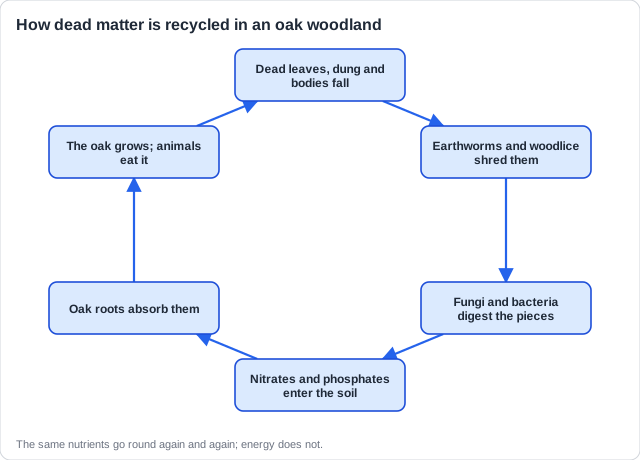
- Detritivores such as earthworms shred it first; fungi and bacteria finish the job.
- They turn organic matter into inorganic nutrients, such as nitrates and phosphates, in the soil or water.
- Plant roots absorb these nutrients, so the soil stays fertile and plants keep growing.
- So decomposers drive the carbon, nitrogen and phosphorus cycles.
- Earthworms also loosen the soil, letting in air and water for roots.
Real example: Australia's native dung beetles could not deal with cattle dung, so pats piled up on the pastures. From 1965 to 1985 scientists brought in dung beetles from Africa and Europe; about 23 species settled, burying dung and returning its nutrients to the soil.
Practice with real exam questions
Answer exam-style questions and get AI feedback that shows you exactly what examiners want to see in a full-marks response.
A stable ecosystem keeps itself going and recovers after a disturbance. Decomposers help in several separate ways, and each one can be a mark.
The points to remember
- More nutrients mean more plants, so more habitats and niches for other species.
- Decomposers are food too: the base of a detritus food web that feeds carnivores.
- Negative feedback: when decomposers boom, their predators eat more of them, so numbers settle.
- Decomposers compete with each other, which also keeps their numbers in check.
- When decomposers die or egest waste, other decomposers feed on it, so matter keeps cycling.
- They build humus, which holds water and nutrients in the soil.
- After a fire or flood they speed up and return nutrients fast: the ecosystem recovers (resilience).
Remember it as: Clean up, feed the soil, feed the web, bounce back.
Real example: an English oak woodland drops tonnes of leaves each autumn, yet by the next summer most have gone: earthworms, woodlice, fungi and bacteria have turned them into soil, feeding the trees and the shrews, beetles and birds that eat the decomposers.
Finish every point with the effect: In an Explain [7], write each point as a cause and its effect on stability: 'decomposers release nitrates, so plants keep growing, so the ecosystem keeps its habitats'.
How this comes up: Paper 2, Section B (b): explain how decomposers contribute to the stability of an ecosystem [7].
Every autumn an oak woodland in England drops a thick layer of dead leaves.
Explain how detritivores and decomposers contribute to the stability of the oak woodland ecosystem.
Model answer plan
See the mark-by-mark plan — for / against / judgement, with marking guidance — in study mode.