Self-feeders: An autotroph builds its own food. It takes simple inorganic substances and turns them into the carbon compounds that make up its body.
The points to remember
- An autotroph makes its own carbon compounds: sugars, starch, cellulose, proteins and fats.
- It builds them from inorganic carbon: carbon dioxide from the air or dissolved in water.
- It also takes in other elements as simple ions from soil or water, such as nitrate and phosphate.
- It needs an external energy source: for plants and algae this is light, used in photosynthesis.
- Autotrophs are the producers: plants, algae, phytoplankton and some bacteria.
Remember it as: Auto = self: it makes its own.
Real example: General Sherman, a giant sequoia, has a trunk of about 1,487 cubic metres. Almost all of it was built from carbon dioxide taken from the air.
Free preview
This is the free notes preview
You're reading the free notes. Aimnova Pro unlocks the full study experience — and you can try it with your first topic free to keep:
- FlashcardsLock in vocabulary and key terms with spaced repetition.
- Practice questionsAnswer exam-style questions and get instant AI marking.
- Mock exams & past-paper vaultSit full mocks and see exactly how examiners award marks.
- Personalised study planA daily plan built around your exam date and weak areas.
A heterotroph cannot build carbon compounds from carbon dioxide. It has to take them, ready-made, from other organisms, by eating them or by absorbing them.
The points to remember
- A heterotroph cannot make carbon compounds from inorganic carbon.
- It obtains carbon compounds from other organisms, living or dead.
- Consumers eat them: herbivores eat producers, carnivores eat other animals.
- Decomposers, such as fungi and many bacteria, absorb them from dead matter.
- It digests what it takes in and builds its own compounds from the pieces.
- All animals and fungi, and most bacteria, are heterotrophs.
Remember it as: Hetero = other: it takes from others.
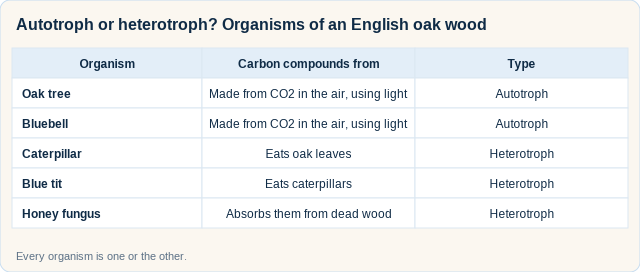
Real example: in an English oak wood, winter moth caterpillars eat the young oak leaves in spring, and blue tits time their nesting so they can feed the caterpillars to their chicks.
Stop wasting time on topics you know
Our AI identifies your weak areas and focuses your study time where it matters. No more overstudying easy topics.
All living organisms can be sorted into these two groups. One question decides it: where do its carbon compounds come from?
The points to remember
- Every living organism is either an autotroph or a heterotroph.
- The test: are its carbon compounds made from CO2, or taken from another organism?
- Fungi are not plants: they absorb carbon compounds, so they are heterotrophs.
- A plant that catches insects, such as the Venus flytrap, is still an autotroph: insects give it nitrogen, not carbon.
- A plant with almost no green pigment that feeds on another plant, such as dodder, is a heterotroph.
Two common mix-ups: 'Fungi are plants' is wrong: fungi are heterotrophs.
Autotroph does not mean 'green' or 'plant' alone: say it makes carbon compounds from inorganic carbon.
Real example: the Venus flytrap grows wild only in the wet pine savannas of North and South Carolina, USA. It catches insects because the soil there is poor in nitrogen, but it makes all its carbon compounds by photosynthesis: an autotroph.
How this comes up: Paper 2, Section A: a short question on two organisms from a food chain [2].
On a rocky shore in Cornwall, England, limpets graze on the green seaweed that covers the rocks.
Distinguish between the way the seaweed and the limpets obtain their carbon compounds.
Model answer plan
See the answer broken into clear points, with guidance on how each point earns marks.