Two kinds of factor: The distribution of a population is decided by abiotic factors and biotic factors.
The points to remember
- Abiotic factors are the non-living, physical parts: temperature, sunlight, rainfall, pH, salinity, soil.
- Biotic factors are the living parts: food organisms, predators, competitors, parasites, disease.
- Biotic factors include interactions: predation, herbivory, competition, parasitism, mutualism, disease.
- Both kinds decide the distribution of a population: where it is found.
- To describe them: say what each kind is, then give an example from a named ecosystem.
Remember it as: A-biotic: 'a' means 'not', so not living. Biotic: living.
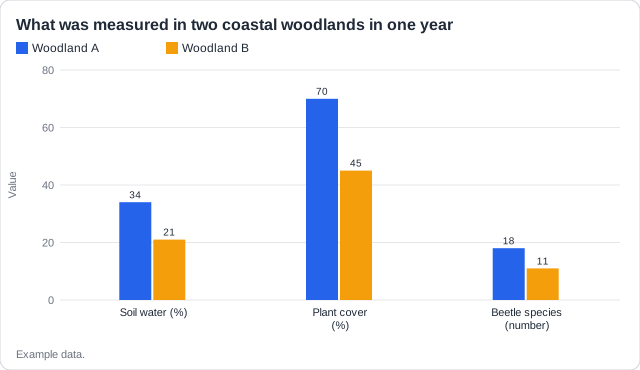
Real example: on the Great Barrier Reef, Australia, the abiotic factors include warm, clear, salty water and bright sunlight. The biotic factors include crown-of-thorns starfish, which prey on the coral, and tiny algae that live inside the coral and feed it (mutualism).
Name the ecosystem: An answer with no named ecosystem cannot get full marks. A biome, such as 'tropical rainforest', counts as named.
Free preview
This is the free notes preview
You're reading the free notes. Aimnova Pro unlocks the full study experience — and you can try it with your first topic free to keep:
- FlashcardsLock in vocabulary and key terms with spaced repetition.
- Practice questionsAnswer exam-style questions and get instant AI marking.
- Mock exams & past-paper vaultSit full mocks and see exactly how examiners award marks.
- Personalised study planA daily plan built around your exam date and weak areas.
Abiotic factors often set the broad pattern of where each species can live.
The points to remember
- Abiotic factors often change steadily across an area: up a mountain, away from a river, inland from the sea.
- Each species lives where the conditions suit it, so vegetation changes in zones.
- To describe a relationship, pair each vegetation type with its condition: 'pine forest on thin, dry soil'.
- Use the figure's own words and numbers, such as altitudes.
Remember it as: Change the conditions, change the vegetation.
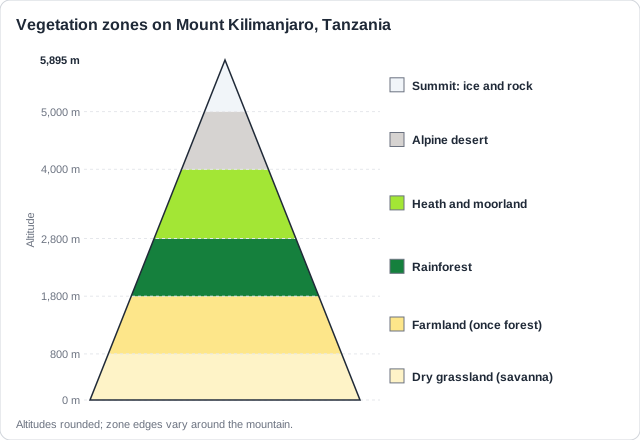
Real example: on Kilimanjaro it gets colder as you climb, and above about 2,800 m it is too cold and dry for rainforest, so heath and moorland take over. Above 4,000 m, frost every night leaves only an alpine desert.
Practice with real exam questions
Answer exam-style questions and get AI feedback that shows you exactly what examiners want to see in a full-marks response.
A map or a plot shows a distribution. Name the pattern you see, in words that show where.
Words for a distribution pattern
- In patches (clumped): grouped together, often around a resource.
- Scattered (fragmented): small areas spread out, with gaps between them.
- Evenly spaced: about the same distance apart, often because they compete for space.
- Along a line: following a river, a coast or a road.
- In one part: say where, using the compass: 'most green space is on the edges of the city'.
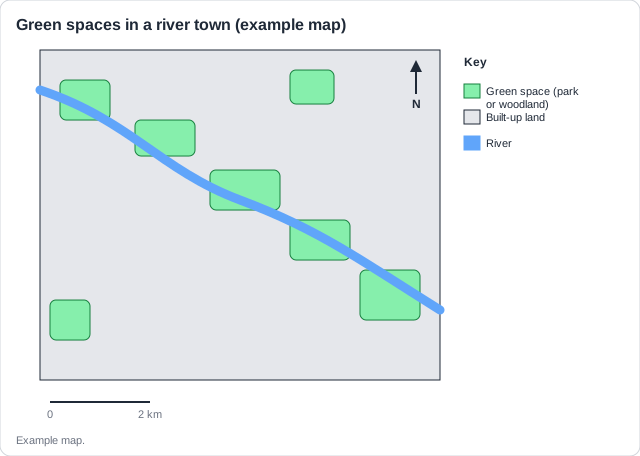
Reading it: most green spaces form a line along the river, from the north-west to the south-east; only two small ones lie away from it.
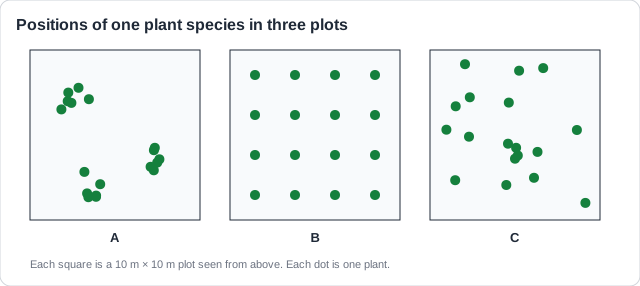
Say what the pattern is: 'Uneven' or 'found in the south' alone is not a pattern. Say how it is spread: 'along the river', 'on the edges'.
A common task: explain why one place has more of a species than another.
The points to remember
- Give a cause, then link it to more or fewer individuals.
- More food, water or shelter: more survive and breed, and more arrive.
- More predators, disease or competitors: more die, and fewer young survive.
- More human disturbance (housing, roads, noise): animals leave or die.
- The survey itself: animals that avoid traps or cameras are undercounted.
Remember it as: Cause, then 'so more survive' or 'so more die'.
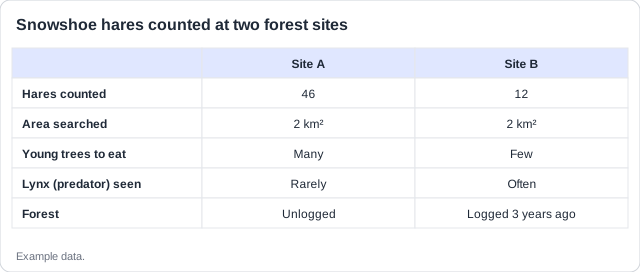
Reading it: Site A has more young trees, so hares have more food and more survive and breed. Site B has more lynx, so more hares are eaten.
Real example: Since the 1990s a contagious cancer has killed most Tasmanian devils in the east of Tasmania, a biotic factor. Devils are still more common in the far north-west, which the disease reached last.
Feeling unprepared for exams?
Get a clear study plan, practice with real questions, and know exactly where you stand before exam day. No more guessing.
How this comes up: Paper 2, Section B (a): describe biotic and abiotic factors with reference to a named ecosystem [4]. Paper 1 and Section A: read a map, a table or a chart of two places.
A school field trip is planned to study the organisms of a local ecosystem.
Describe biotic and abiotic factors with reference to a named ecosystem.
Model answer plan
See the mark-by-mark plan — for / against / judgement, with marking guidance — in study mode.