Count a part, estimate the whole: Abundance is rarely counted in full. Ecologists count the organisms in samples and scale up.
The points to remember
- A full count (a census) works only for small, visible, slow-moving populations.
- Most animals are hard to count: they move, hide, are active at night or are camouflaged.
- Many live in remote or dense habitats, or range over huge areas.
- Some look like other species, so they are hard to identify.
- So we count a sample of the area and scale up to estimate the whole population.
Remember it as: Moves, hides, comes out at night, lives far away, looks like another: so we sample.
Real example: snow leopards live on remote mountains, are camouflaged against rock and snow, and roam huge areas, so the world total is only estimated, at roughly 4000 to 6500.
Give a reason they are hard to find, see or identify: 'They are dangerous' or 'quadrats do not work for animals' does not explain why counting is hard.
Free preview
This is the free notes preview
You're reading the free notes. Aimnova Pro unlocks the full study experience — and you can try it with your first topic free to keep:
- FlashcardsLock in vocabulary and key terms with spaced repetition.
- Practice questionsAnswer exam-style questions and get instant AI marking.
- Mock exams & past-paper vaultSit full mocks and see exactly how examiners award marks.
- Personalised study planA daily plan built around your exam date and weak areas.
Where you put your samples matters as much as how many you take.
The three ways to place samples
- Random sampling: points chosen by random numbers on a grid, so there is no bias.
- Systematic sampling: samples at regular intervals, e.g. every 10 m, for quick, even coverage.
- Transect sampling: samples at regular points along a line across a habitat, to show change.
- Choose random when the habitat looks the same throughout.
- Choose a transect when conditions change across the habitat (a gradient).
- Choose systematic to cover a large area quickly; it can miss a pattern that repeats.
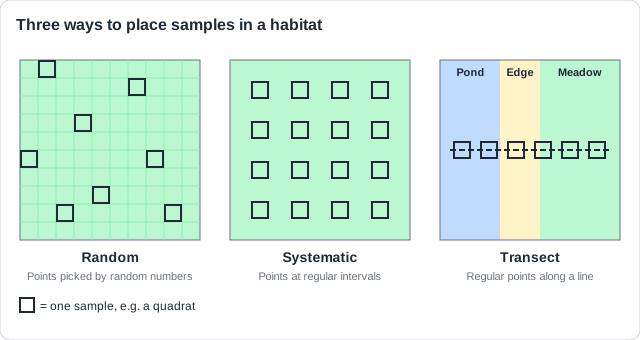
Remember it as: Random: fair. Systematic: regular. Transect: shows change.
Real example: a transect from the beach inland across the sand dunes at Studland Bay in Dorset shows the plants changing from marram grass on the young dunes to heather further inland.
Practice with real exam questions
Answer exam-style questions and get AI feedback that shows you exactly what examiners want to see in a full-marks response.
An estimate is only as good as its samples: Reliable means you would get a similar answer if you did the survey again.
The points to remember
- Take many samples and repeat the survey: one sample may be unusual.
- Place samples at random (or regularly), never where it looks interesting: this avoids bias.
- Use the same method and effort each time, at the same time of day.
- Survey in different seasons, because numbers change through the year.
- Scale up: mean per sample × (total area ÷ area of one sample).
- Every sample is an estimate; only a total census is exact, and it is rarely possible.
Photograph
Take aerial photos of the whole area.
Grid
Place a grid over each photo.
Count
Count the animals in squares chosen at random.
Scale up
Multiply the mean per square by the number of squares.
Remember it as: Many, random, same method, every season.
Worked example: percentage change = (new − old) ÷ old × 100. Mountain gorillas in the Virunga mountains rose from 480 in 2010 to 604 in 2016: (604 − 480) ÷ 480 × 100 = 26%.
Measuring a human impact: To measure the effect of pollution, sample both the living (biotic) and non-living (abiotic) parts, at several sites and times.
The points to remember
- Choose sites at increasing distance from the source, along a transect, plus a clean control site.
- Abiotic: probes for oxygen, pH, temperature and salinity; a Secchi disc for light.
- Biotic: kick samples or grabs; identify and count species with a key.
- Turn the counts into a biotic index or a diversity index, and count animals killed.
- Take several samples at each site, and repeat over time to see recovery.
Remember it as: Sites, control, abiotic probes, biotic samples, repeat.
Real example: after the 2010 Deepwater Horizon oil spill, scientists sampled Louisiana's coastal marshes, comparing oiled sites with clean ones.
Plan both kinds: Only living, or only non-living, measurements is half a plan: give both.
Feeling unprepared for exams?
Get a clear study plan, practice with real questions, and know exactly where you stand before exam day. No more guessing.
How this comes up: Paper 1 or Section A: why a population is hard to count [1-2], how data were collected [2-3], a percentage change [1]. Section B: plan a field study [7] or judge how reliable sampling is [9].
Scientists estimate that between 4000 and 6500 snow leopards live in the wild.
Outline two reasons why it is so difficult to estimate the number of snow leopards accurately.
Model answer plan
See the mark-by-mark plan — for / against / judgement, with marking guidance — in study mode.