Climate change and ecosystems at Higher Level: The same ideas as SL, with different cases: Alaska's walruses, Florida's 2023 marine heatwave, Lake Chad, the tuatara, the Bramble Cay melomys and Europe's mountain summits. At HL, practise judging how far a region gains or loses, and why some ecosystems are more resilient than others.
Practise this as you read
- Chain each impact to biodiversity or productivity.
- Judge gains against losses for one named region.
Free preview
This is the free notes preview
You're reading the free notes. Aimnova Pro unlocks the full study experience — and you can try it with your first topic free to keep:
- FlashcardsLock in vocabulary and key terms with spaced repetition.
- Practice questionsAnswer exam-style questions and get instant AI marking.
- Mock exams & past-paper vaultSit full mocks and see exactly how examiners award marks.
- Personalised study planA daily plan built around your exam date and weak areas.
From one reef to the whole ocean: Climate change acts at every scale: it can bleach one reef, dry out one grassland, or raise the sea everywhere. It also weakens an ecosystem's resilience.
The points to remember
- Local impacts change one ecosystem: coral bleaching on a reef, desertification of dry grassland.
- Global impacts change the whole planet: rising sea level and changes to ocean circulation.
- Over time, whole biomes shift towards the poles and up mountains.
- Climate change is an indirect impact: it changes conditions rather than removing organisms at once.
- It is a multiplier: it adds stress and makes habitat loss, pollution and overfishing worse.
- Many species cannot adapt or move as fast as the climate is changing, so populations fall.
Local impacts
- Coral bleaching on a reef
- Desertification of dry grassland
- Wildfire in one forest
- Plants moving up one mountain
Global impacts
- Rising sea level
- Changes to ocean circulation
- Ocean acidification
- Biomes shifting towards the poles
Remember it as: Climate change does not knock the house down; it weakens every wall.
Real example: Pacific walruses rest on floating sea ice between dives. As the ice retreats in late summer, tens of thousands now crowd onto beaches in Alaska instead, where many young are crushed in stampedes.
Practice with exam-style questions
Answer exam-style questions and get AI feedback that shows you exactly what examiners want to see in a full-marks response.
Coral reefs are the clearest local impact. They are also the ecosystem the guide suggests you explore with temperature data.
The points to remember
- Coral bleaching: when water stays too warm for weeks, corals expel the algae living in them.
- The algae feed the coral and give its colour, so a bleached coral starves and may die.
- Dead coral means lost habitat: reef fish and other species decline, so biodiversity falls.
- Ocean acidification: the ocean absorbs CO2, which forms carbonic acid; pH has fallen by about 0.1 since 1750.
- Lower pH leaves fewer carbonate ions, so corals and shellfish struggle to build shells and skeletons.
- Other causes of bleaching: El Niño heat, runoff, sediment, extreme low tides, salinity changes, UV.
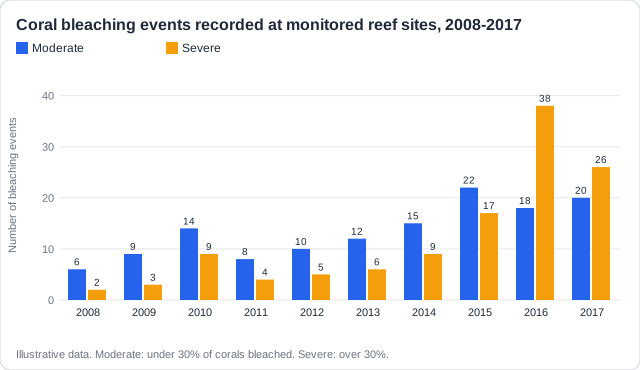
Real example: in July 2023 the sea at Manatee Bay, Florida, reached about 38 °C, as warm as a hot bath. Corals across the Florida Keys bleached, and scientists moved some to land-based tanks to save them.
Causes of bleaching: what does not count: Rising sea level, scuba divers and overfishing do not cause bleaching. Anything that breaks or kills the coral outright is damage, not bleaching.
On land, the local impacts are drought, desertification, heat and fire.
The points to remember
- Desertification: less rain and more evaporation, plus overgrazing, turn dry grassland into desert.
- Droughts, including sudden flash droughts, are becoming more frequent in many regions, but not everywhere.
- Human causes: warming raises evaporation and shifts rainfall; also water extraction, deforestation and poor farming.
- Heatwaves close leaf pores and stress plants, so primary productivity falls.
- Wildfires spread further in drier, windier conditions and where dead vegetation (fuel) has built up.
- Fire kills organisms, destroys habitat and exposes soil to erosion.
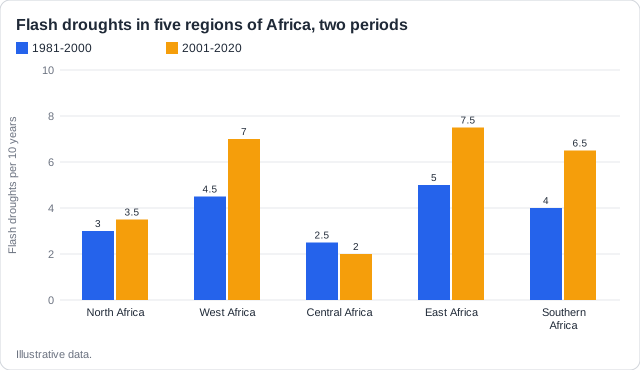
Real example: Lake Chad in central Africa has shrunk by about 90% since the 1960s, through drought and water taken for irrigation. Grassland around it is turning to desert.
Reading a fire chart: If the number of fires stays the same but the area burnt rises, the fires were bigger, not more numerous. Explain it with drier or windier weather or built-up fuel, not just 'global warming'.
Feeling unprepared for exams?
Get a clear study plan, practice with real questions, and know exactly where you stand before exam day. No more guessing.
Species respond to warming in three ways: they move, they change their timing, or they decline.
The points to remember
- Range shifts: species move towards the poles or uphill to stay in the temperatures they need.
- Mountain and polar species can run out of space: nowhere left to go.
- Timing (phenology): spring comes earlier, so species that depend on each other can fall out of step.
- Food supply: warmer water can cut upwelling of nutrients, so plankton and fish fall, and their predators go hungry.
- Prey may move away to cooler water, or new species and competitors may arrive.
- Reptiles: the temperature of the nest can set the sex of the young; extremes, drought, fire and disease add risk.
Move
- Towards the poles
- Uphill
Change timing
- Earlier spring
- Out of step with food
Decline
- Nowhere to go
- Less food, more disease
Real example: for the tuatara, a reptile found only in New Zealand, warmer nests produce more males. As the climate warms, some island populations could end up with too few females to breed.
Link it to food: In a 'food supply' question, say whether the prey increases or decreases, and why: 'warmer water reduces upwelling, so fewer plankton and fish are available for seals'.
Global impacts: the sea and its currents: Some impacts reach every coast and ocean. The two the guide names are rising sea level and changes to ocean circulation.
The points to remember
- Sea level rises for two reasons: thermal expansion of warmer water and melting land ice (glaciers, ice sheets).
- Melting sea ice does not raise sea level: it is already floating.
- Global sea level rose by about 0.20 m from 1901 to 2018, and the rise is speeding up.
- Rising seas flood and erode coastal habitats: salt marshes, mangroves, beaches used by turtles, seals and birds.
- Mangroves can keep up with a slow rise, but not a fast one; more sediment can smother corals.
- Ocean circulation: warming and meltwater can weaken currents and upwelling, changing where nutrients and fish are.
Raises sea level
- Warmer water expanding
- Glaciers melting
- Greenland and Antarctic ice sheets melting
Does not raise it
- Floating sea ice melting
- Daily tides (they average out)
Real example: the Bramble Cay melomys, a small rodent living on one low island in Australia's Torres Strait, was declared extinct in 2019, after storm surges and rising seas destroyed its plants. It was the first mammal extinction linked to climate change.
Marine, not land: In a question on marine biodiversity, flooding the land of a low island does not count, unless you link it to coastal or marine habitats such as beaches, reefs or mangroves.
Memorize terms 3x faster
Smart flashcards show you cards right before you forget them. Perfect for definitions and key concepts.
Climate change does not harm every ecosystem in the same way. Some gain, many lose, and how well each copes depends on its resilience.
The points to remember
- In cold places, warming and longer growing seasons can raise productivity: tundra greens, the treeline rises.
- More CO2 can speed up photosynthesis where water and nutrients are not limiting.
- But heat, drought and fire lower productivity elsewhere, and less primary productivity means less for consumers.
- Other human changes to the air also cut productivity: UV from ozone loss, acid rain, smog.
- Resilience is higher with more biodiversity, larger and connected habitats, and genetic diversity.
- Resilience is lower when change is fast and the ecosystem is already stressed by other impacts.
Productivity may rise
- Tundra and boreal forest
- High mountains
- Places where cold limits growth
Productivity falls
- Places hit by drought and heat
- Coral reefs
- Ecosystems already stressed
Real example: a study of 302 mountain summits in Europe found that more plant species now grow on them than a century ago, as plants climb uphill, and the increase has sped up as warming has.
Weighing benefits: In a 'to what extent' question about one region, give gains (more growth, new species) and losses (lost habitat, extinctions), then a judgement such as 'gains now, losses later'.
How this comes up: Paper 1, final question [6]: 'To what extent will climate change benefit...' a region. Up to [4] for each side and [1] for a balanced conclusion.
The Arctic is warming about four times faster than the world as a whole.
To what extent will climate change benefit the ecosystems of the Arctic?
Model answer plan
See the mark-by-mark plan — for / against / judgement, with marking guidance — in study mode.