Soil biodiversity at Higher Level: The same ideas as SL, with different examples: Antarctica's nearly empty soils, the fungus farms of leafcutter ants, oil palm in Borneo and an invasive flatworm in Britain. At HL, notice how land use decides which soil life survives.
Practise this as you read
- Name the habitat and the niche each time.
- Read data on two kinds of site and give a reason tied to a value.
Free preview
This is the free notes preview
You're reading the free notes. Aimnova Pro unlocks the full study experience — and you can try it with your first topic free to keep:
- FlashcardsLock in vocabulary and key terms with spaced repetition.
- Practice questionsAnswer exam-style questions and get instant AI marking.
- Mock exams & past-paper vaultSit full mocks and see exactly how examiners award marks.
- Personalised study planA daily plan built around your exam date and weak areas.
A crowded world under your feet: Soil is one of the richest places for life on Earth. Its biodiversity includes tiny microorganisms, fungi and many animals.
The points to remember
- Soil holds a huge biodiversity: by one estimate, more than half of all species live in it.
- Microorganisms: bacteria (up to about a billion in a gram of fertile soil) and other microbes.
- Fungi: fine threads that spread through the soil; many decompose, some partner with roots.
- Animals: earthworms, nematodes, mites, springtails, ants, termites, beetle larvae, moles.
- Many soil species are still unknown: most soil microbes have never been named.
Remember it as: Bugs, bacteria and fungi: most of the soil's life is too small to see.
Real example: the dry, freezing soils of Antarctica's Dry Valleys hold only a few kinds of animal: some tiny nematode worms, mites and springtails. A spadeful of meadow soil holds far more.
Name all three groups: When asked who lives in soil, cover microorganisms (bacteria), fungi and animals, and say that many species are still unknown.
Feeling unprepared for exams?
Get a clear study plan, practice with real questions, and know exactly where you stand before exam day. No more guessing.
Soil supports so many species because it gives each of them a habitat and a niche. A handful of soil holds many different places to live and many different ways to make a living.
The points to remember
- Habitat = where an organism lives; niche = its role, and the conditions and resources it uses.
- Soil has pores of every size: tunnels for worms, gaps for mites, water films for bacteria.
- It offers many kinds of food: dead leaves, roots, dung, fungi and other soil animals.
- Conditions change with depth: fresh litter on top, dark, damp and steady below, so species share the soil out.
- Soil shelters organisms from light, heat, frost and drying out.
- Many niches: decomposers, grazers of fungi, predators, root partners, nitrogen-fixing bacteria.
Remember it as: A city in a handful: rooms of every size, and a job for everyone.
Real example: in the forests of Central and South America, leafcutter ants carry cut leaves into underground chambers and feed them to a fungus they farm; the ants then eat the fungus. One nest can hold millions of ants.
Habitat is not niche: The habitat is the place (the leaf litter). The niche is the role in that place (eating fungi in the litter). Questions on soil biodiversity reward both words.
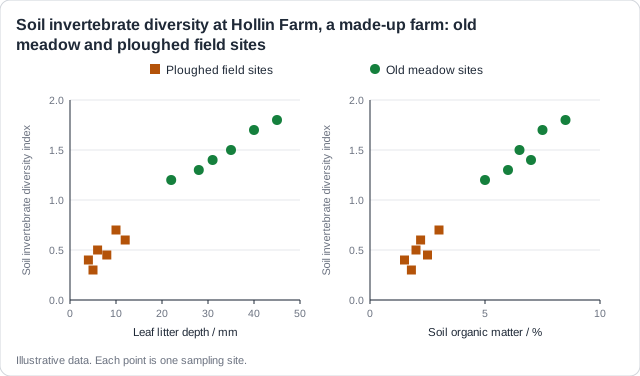
Questions give data on soil animals at two kinds of site and ask you to suggest why one has more. Read each graph, quote the values, then give the reason.
The points to remember
- More plant cover gives more litter, roots, food and shade: more habitats and niches, so more species.
- More plant cover also means less erosion, so the soil habitat is not washed away.
- More soil water supports biological activity and nutrient cycling: most soil organisms need moist soil.
- An old, stable (climax) community has more complex food webs, so it supports more species.
- A monoculture plantation or a ploughed field gives fewer kinds of food and shelter, so diversity is lower.
Real example: in Borneo, soils under oil palm plantations hold fewer kinds of ants and beetles than the rainforest soils they replaced, which had a deep layer of mixed leaf litter.
Quote, then explain: 'The meadow sites have 22-45 mm of litter and a diversity of 1.2-1.8; more litter gives more food and habitats.' A value from the graph plus a reason scores; a reason alone may not.
Memorize terms 3x faster
Smart flashcards show you cards right before you forget them. Perfect for definitions and key concepts.
The life that keeps the soil working: Soil life matters for the whole ecosystem: it recycles nutrients, builds the soil's structure and feeds animals above ground. Losing it makes soil less fertile.
The points to remember
- Soil organisms decompose dead matter and recycle nutrients for plants.
- Earthworms and burrowers mix and aerate the soil and help rain soak in.
- Fungi and bacteria glue particles into crumbs; root fungi feed plants; some bacteria fix nitrogen.
- Soil animals are food for birds, moles and hedgehogs, so they support biodiversity above ground too.
- Harmed by ploughing, pesticides, compaction, monocultures, erosion, pollution and invasive species.
Real example: the New Zealand flatworm, carried to Britain in plant pots, eats earthworms. Where it has spread, fewer earthworms means slower decomposition and wetter, less airy soil.
Link the organism to its job: 'Earthworms' alone is a name. 'Earthworms burrow, which aerates the soil and helps water soak in' is a point.
How this comes up: Paper 2, Section B (a): outline four ways soils contribute to biodiversity [4]. Four different points, each a complete link.
Scientists estimate that a single hectare of grassland soil can hold several tonnes of living organisms, more than the mass of the cattle grazing on it.
Outline four ways in which soils contribute to biodiversity.
Model answer plan
See the mark-by-mark plan — for / against / judgement, with marking guidance — in study mode.