Tipping points at Higher Level: The same idea as SL, with alternative stable states: each held by its own negative feedback.
Practise this as you read
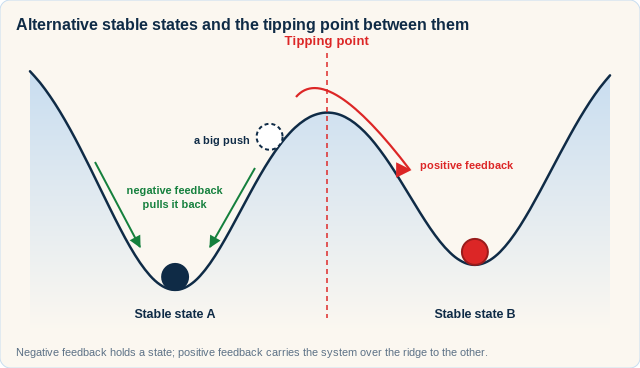
- Draw the landscape: two valleys, one ridge.
- Explain why tipping is hard to undo.
Free preview
This is the free notes preview
You're reading the free notes. Aimnova Pro unlocks the full study experience — and you can try it with your first topic free to keep:
- FlashcardsLock in vocabulary and key terms with spaced repetition.
- Practice questionsAnswer exam-style questions and get instant AI marking.
- Mock exams & past-paper vaultSit full mocks and see exactly how examiners award marks.
- Personalised study planA daily plan built around your exam date and weak areas.
Past the point of no return: A tipping point is the smallest change that destabilises a system. Past it, the system shifts to a new equilibrium.
The points to remember
- A tipping point is the minimum change that destabilises a system.
- Negative feedback inhibits change: it holds the system in one stable state.
- Positive feedback amplifies change: it drives the system towards the tipping point.
- Past it, the system shifts to a new equilibrium: an alternative stable state.
- The new state is stable too, so the shift is hard to undo.
A system can have more than one stable state. The tipping point is the ridge between them.
Try it on a real system: add nutrients to a lake and find the point where it tips.
Drag the slider: the lake stays clear, then tips suddenly, and only clears again when nutrients fall much lower.
Interactive diagram
Explore the labelled diagram, charts and maps for this topic in full study mode.
Know your predicted grade
Take timed mock exams and get detailed feedback on every answer. See exactly where you're losing marks.
Feedback decides which way the system goes.
Negative feedback (1.2.8)
- Counteracts change.
- Holds the system in one stable state.
Positive feedback (1.2.10)
- Amplifies change.
- Drives the system towards a tipping point.
Remember it as: Ball in a valley: negative feedback rolls it back; positive feedback pushes it over the ridge.
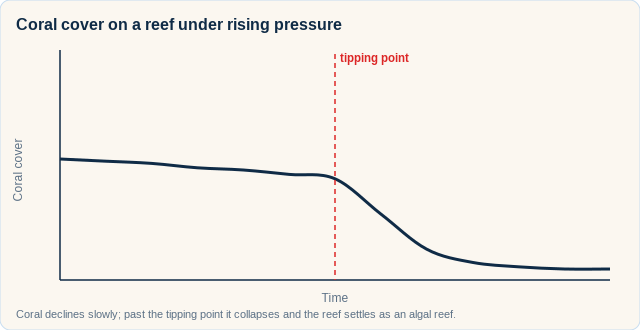
Hard to undo: The new state has its own negative feedback. Undoing it needs a bigger change than the one that tipped it.
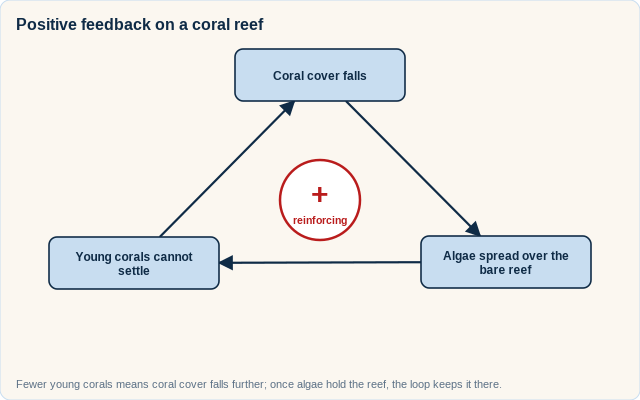
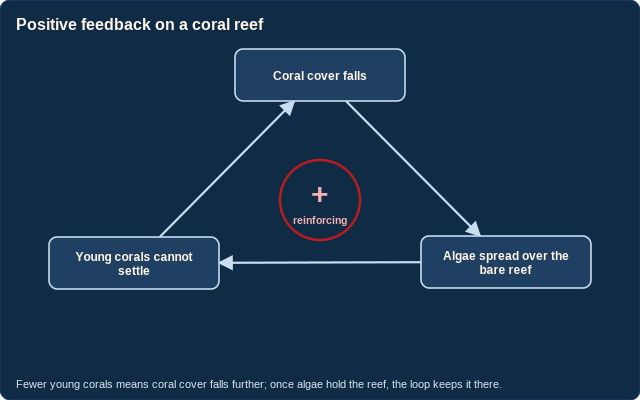
In the 1980s, many Caribbean reefs tipped from coral to algae. Fishing had already removed most grazing fish.
What happened
- A hurricane broke up the coral.
- Disease then killed the sea urchins, the last grazers.
- Algae spread; on Jamaica's reefs coral cover fell from about 50% to under 5%.
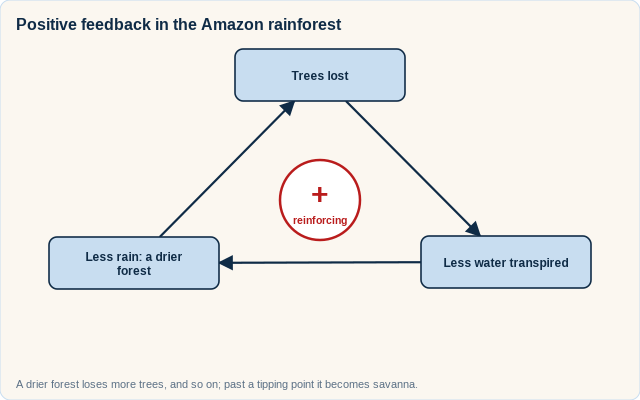
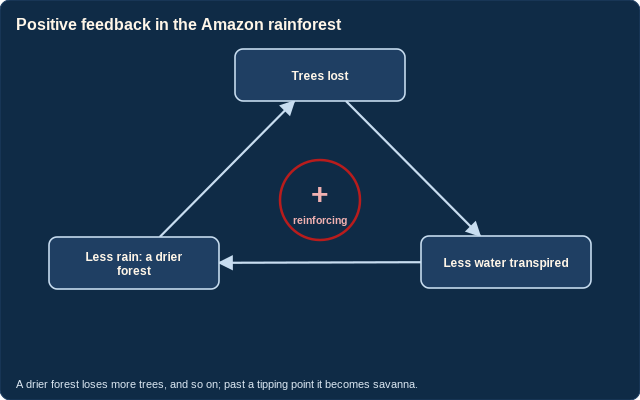
The Amazon rainforest has a tipping point still ahead. Its trees transpire water that falls again as rain, so clearing trees means less rain:
Get feedback like a real examiner
Submit your answers and get instant feedback — what you did well, what's missing, and exactly what to write to score full marks.
How this comes up: Outline how feedback links stable states and tipping points [4]. Name an example or draw the landscape.
Outline how feedback loops are involved in alternate stable states and the tipping points between them.
Model answer plan
See the answer broken into clear points, with guidance on how each point earns marks.