Positive feedback at Higher Level: The same idea as SL. At HL, trace where a positive loop leads: to a tipping point and a new equilibrium.
Practise this as you read
- Draw positive loops that close.
- Link positive feedback to tipping points.
Free preview
This is the free notes preview
You're reading the free notes. Aimnova Pro unlocks the full study experience — and you can try it with your first topic free to keep:
- FlashcardsLock in vocabulary and key terms with spaced repetition.
- Practice questionsAnswer exam-style questions and get instant AI marking.
- Mock exams & past-paper vaultSit full mocks and see exactly how examiners award marks.
- Personalised study planA daily plan built around your exam date and weak areas.
A change that feeds itself: In positive feedback, the result of a change makes the change bigger. It pushes a system away from equilibrium.
Negative feedback (1.2.8)
- The result counteracts the change.
- Stabilising.
Positive feedback
- The result amplifies the change.
- Destabilising: away from equilibrium.
See how examiners mark answers
Access past paper questions with model answers. Learn exactly what earns marks and what doesn't.
Positive feedback can drive a component up or down. What matters is that the change grows.
Growth
- More people, more parents, more births.
- The population grows faster and faster.
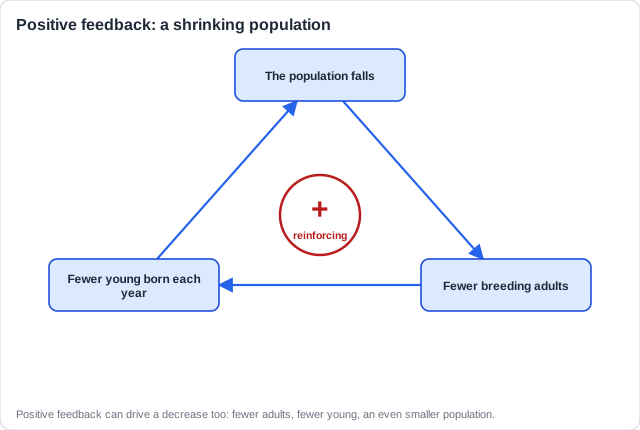
Decline
- Fewer adults, fewer young born.
- A small population shrinks faster.
Many climate loops are positive. Each amplifies warming.
| Loop | The steps |
|---|---|
| Ice and albedo | Warming melts ice; dark sea and rock absorb more heat; more warming |
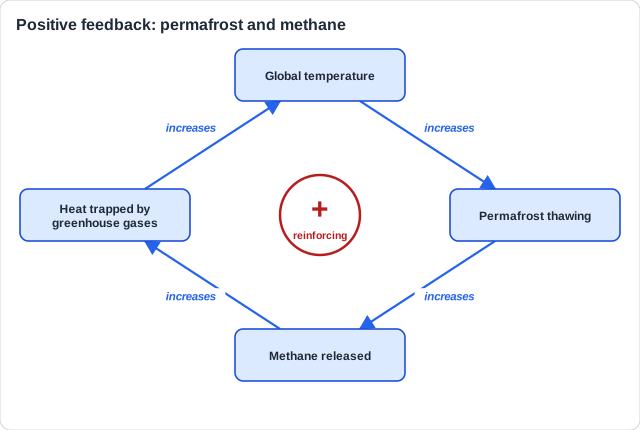
| Permafrost | Warming thaws permafrost; methane is released; more warming |
| Wildfires | Hotter, drier forests burn; soot and CO₂ warm the climate; more fires |
| Forest dieback | Fewer trees, less water returned to the air; less rain; more trees die |
Match the loop to the question: Name the gas or surface that does the amplifying. For permafrost it is methane; albedo is not credited there.
Try it: tap each loop to follow it round.
R marks a reinforcing (positive) loop, B a balancing (negative) loop.
Interactive diagram
Explore the labelled diagram, charts and maps for this topic in full study mode.
Study smarter, not longer
Most students waste 40% of study time on topics they already know. Our AI tracks your progress and optimizes every minute.
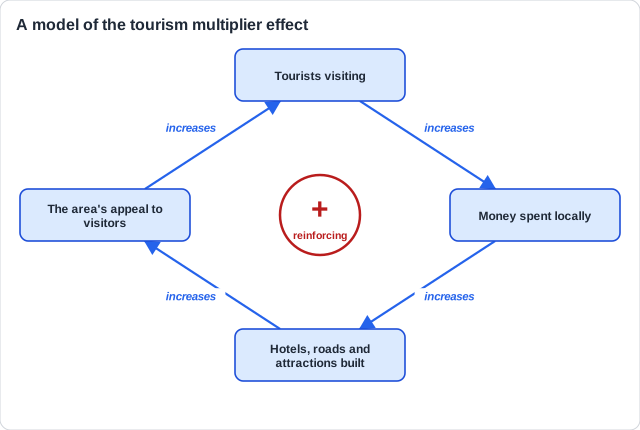
Positive feedback works in human systems too. Papers give a model like this one and ask how it shows positive feedback.
Reading a model
- Follow the arrows round from any box.
- Say what increases at each step.
- Show that the last step returns to increase the first: the change is amplified.
How this comes up: Outline how positive feedback can change an ecosystem, or give a loop for a named change.
Outline how a positive feedback loop can impact an ecosystem.
Model answer plan
See the mark-by-mark plan — for / against / judgement, with marking guidance — in study mode.