Values surveys at Higher Level: At HL, treat a survey as evidence to test, not a fact to repeat: who was asked, how, and whether behaviour agrees.
Practise this as you read
- Question the sample and the wording.
- Test the ratings against what people did.
- Link to ethics (HL.c): whose perspectives a survey includes, and whose it leaves out.
Free preview
This is the free notes preview
You're reading the free notes. Aimnova Pro unlocks the full study experience — and you can try it with your first topic free to keep:
- FlashcardsLock in vocabulary and key terms with spaced repetition.
- Practice questionsAnswer exam-style questions and get instant AI marking.
- Mock exams & past-paper vaultSit full mocks and see exactly how examiners award marks.
- Personalised study planA daily plan built around your exam date and weak areas.
Asking the whole bay: Before the resort vote, a university team asks 300 people in Coral Bay to rate statements from 1 to 5.
They are running a values survey: measuring how a group of people, not one person, sees the resort plan.
The points to remember
- A values survey finds out how a particular group sees an environmental issue.
- The methods: questionnaires, surveys and interviews.
- The same methods can measure well-being: how happy and healthy people feel.
- Records, such as hospital or prison statistics, can show well-being too.
Choose
- Fishers, hotel staff and families
Ask
- Statements rated 1 to 5
Read
- Which group ranks what highest
Questionnaire
- Fixed statements rated 1 to 5.
- Large samples; numbers to compare.
Interview
- Open questions: the why behind a view.
- Small samples; the interviewer can sway answers.
Memorize terms 3x faster
Smart flashcards show you cards right before you forget them. Perfect for definitions and key concepts.
A survey is only as good as its design. At Coral Bay that means fishers, hotel staff and families, with statements for jobs and for mangroves.
The points to remember
- Hear every side: ask every group affected, with statements for each side.
- Show the likely impact: who will back the resort, who will fight it, and how hard.
- Use a 1 to 5 scale to show how strongly people feel, not just yes or no.
- Ask a fair sample: fishers and hotel staff, in fair numbers.
- Use neutral wording: no statement that pushes people to one answer.
- Online survey tools let a class collect many answers in one spreadsheet.
Remember it as: Every side, a fair sample, fair words, then what each side will do.
Loaded
- Should greedy developers be allowed to destroy our mangroves?
Neutral
- The mangroves should stay, even if the resort is not built. (1 to 5)
Compare groups: Split the ratings by job to see how fishers and hotel staff differ.
Every set of survey results is read the same way.
The points to remember
- Compare the groups: find the biggest gap in the % who agree.
- Look for a pattern: do two answers go up together (a correlation)?
- Name a statistical test, such as Spearman's rank, to check it is not chance.
- Say what the results mean for the issue: what is likely to happen.
- Handle with care: people may give the answer that sounds good.
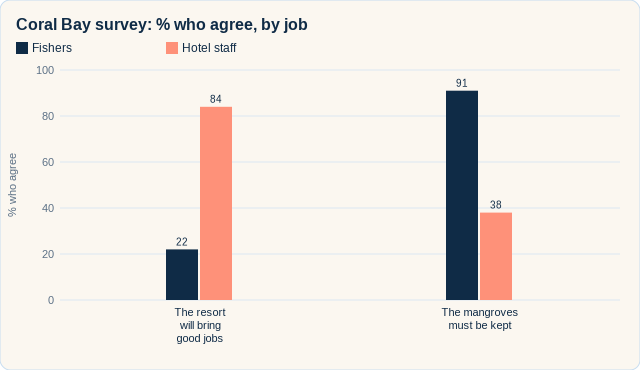
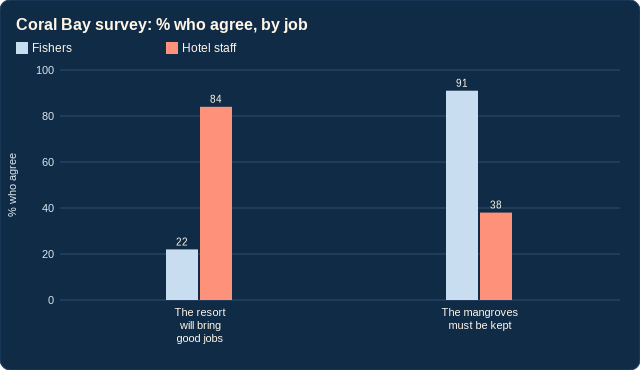
Part of the results, as % who agree:
| Statement | Fishers | Hotel staff |
|---|---|---|
| The resort will bring the bay good jobs | 22% | 84% |
| The mangroves must be kept | 91% | 38% |
Step 1. Compare the groups. In the exam the results are given, often as a bar chart. Read the % who agree in each group and look for the biggest gap.
What it shows
- Hotel staff rank jobs highest.
- Fishers rank the mangroves highest.
- Where someone works predicts their view.
Step 2. Look for a pattern. On a scatter graph each dot is one person. If the dots rise to the right, the two answers go together.
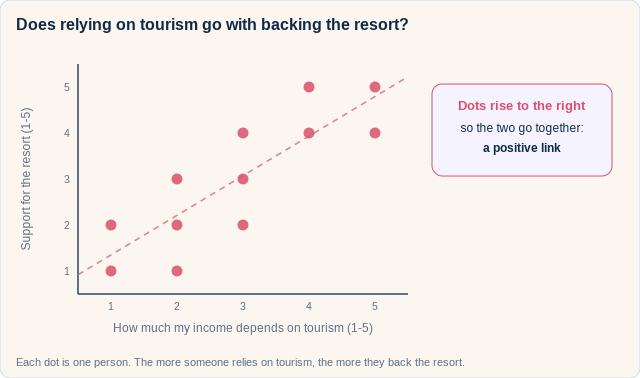
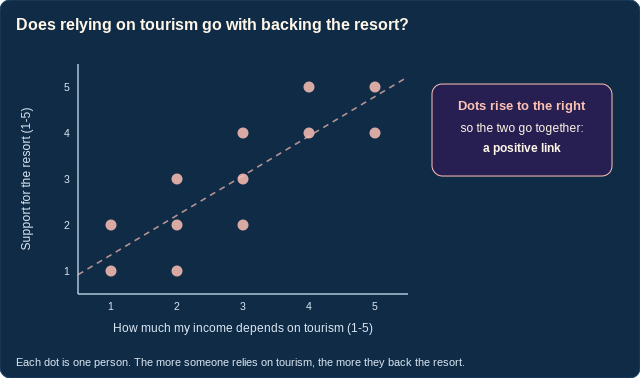
To check that a difference or pattern is real and not chance, scientists use a statistical test, such as chi-squared or Spearman's rank. You need to know that such tests exist and name a suitable one, not work them out.
Step 3. So what will happen to the mangroves?: Hotel staff mostly back the resort; fishers mostly want the mangroves kept. If there are more hotel staff, the resort will probably go ahead, but the fishers may win conditions, such as a strip of mangroves left protected.
Handle with care: a small or one-sided sample distorts results, and people may say what they think the researcher wants.
Know your predicted grade
Take timed mock exams and get detailed feedback on every answer. See exactly where you're losing marks.
Ratings record intentions. Behaviour is the test.
The points to remember
- A survey shows what people say; their actions show what they do.
- Evidence for: actions that match, such as renewable energy or conservation projects.
- Evidence against: actions that clash, such as forest clearing, pollution or rising energy use.
- A gap means something else is winning: cost, jobs or convenience.
- End with a verdict backed by evidence: fully, partly or not at all.
- Plot results year by year on a behaviour-time graph to track change.
Remember it as: Said versus did: pair every survey figure with an action.
In the survey
- 65% of the bay: the mangroves must be kept.
In practice
- The council approved the clearing.
- Few people objected at the hearing.
Say versus do: When actions match the ratings, the values are shaping choices. When they do not, ask what outweighs them: jobs, money or convenience.
Tracking change over time: Plot survey results or behaviour year by year: a behaviour-time graph shows whether a lifestyle is really changing (1.1.9).
How this comes up: Survey results plus a record of what a place did: do the actions reflect the values?
In a survey, 64% of a coastal nation's people said the ocean matters more than tourism growth. Over ten years the nation created three marine reserves and banned bottom trawling, but hotel beds on its coast doubled and its mangrove area fell by 12%. Discuss whether the nation's actions reflect these values.
Model answer plan
See the answer broken into clear points, with guidance on how each point earns marks.
The trap: Summarising the survey instead of testing it. Pair every figure with an action.