The news report as a text type: A news report is a mass media text type. Its job is to inform the reader about an event in a neutral, objective way.
Tasks where it fits
- Reporting an event that took place in your town
- Informing the public about a new local project
- Reporting what people thought of an event
Conventions the examiner checks
- A factual headline and a byline
- The first paragraph: who, what, where, when
- Quotations from people involved and what happens next
Traps that cost Criterion C
- "I think" and other personal opinions
- The most important facts buried at the end
- Quotations without saying who said them
What it tells the reader
- What happened
- Who was involved
- When and where it happened
| Where you meet it | What you do |
|---|---|
| Paper 2 (Reading) | You read news reports. |
| Paper 1 (Writing) | You may be asked to write one. |
Know the conventions: Either way, the conventions below are what mark you out as someone who knows the text type.
- headline
- a short factual title at the top that names the event
- lead (or opening line)
- the first sentence, which answers who / what / when / where
- the body
- the middle paragraphs that add details, figures and quotes
- a quote
- the exact words of a person involved, attributed to a source
- to attribute
- to say where a fact comes from ("according to…", "the police said")
- a source
- the person or organisation a fact or quote comes from
- the closing
- the last line, usually about what will happen next
- objective
- based on facts, not on the writer's personal opinion
- an event
- the thing that happened and that the report is about
- to take place
- to happen ("the festival took place on Saturday")
- to report on
- to give an account of an event for readers
- a bulletin
- a short news broadcast or summary of the latest news
| Part of a news report | What it does |
|---|---|
| Headline | Names the event in a few factual words. |
| Lead / opening | Answers who, what, when and where in one sentence. |
| Body | Adds details, figures and a quote — all attributed. |
| Quote | Gives a person's words: "…," said the mayor. |
| Closing | Says what happens next: "For now, the council plans to…" |
Why the parts matter: In Paper 1 the examiner checks whether you produced the conventions of the text type — a headline, a lead, an attributed quote and an objective tone. Hitting those conventions is exactly what earns Criterion C (Conceptual understanding).
Free preview
Reading it is one thing — hearing it is another
You're reading the free notes. Aimnova Pro unlocks the full study experience — and you can try it with your first topic free to keep:
- Audio on every wordTap any vocabulary word or example to hear it read aloud in natural English.
- FlashcardsLock in vocabulary and key terms with spaced repetition.
- Practice questionsAnswer exam-style questions and get instant AI marking.
- Mock exams & past-paper vaultSit full mocks and see exactly how examiners award marks.
- Personalised study planA daily plan built around your exam date and weak areas.
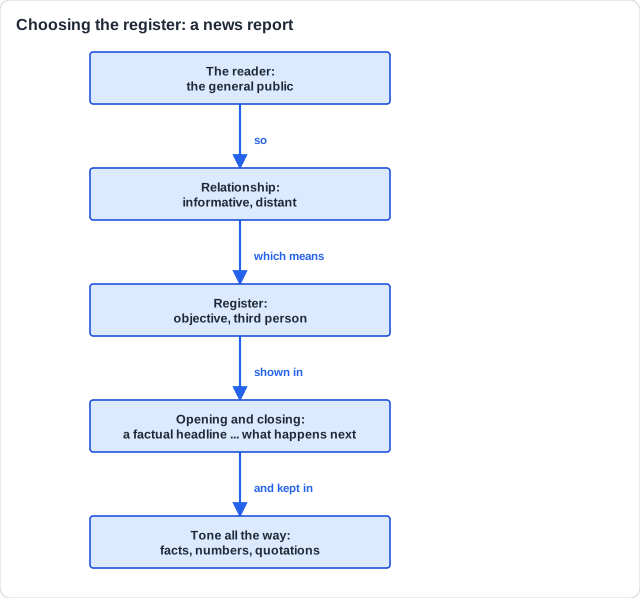
Stay objective: The register of a news report is objective: third person, past tense, and no personal opinion.
Let the facts speak: You report what happened and let the facts (and the quotes) speak. Drop the "I", drop the exclamation marks, and attribute every claim to a source.
How to keep the objective register
- Use the third person, not "I" or "you" — "residents opened…", not "I went to…"
- Use the past tense for the event — "took place", "opened", "said".
- Attribute facts: "according to the council…", "the police said…".
- Give figures, not adjectives — "more than fifty families", not "loads of people".
- Report opinions as quotes from others — never give your own.
Subjective (wrong for a report)
- "I think the new park is amazing!"
- "It was an unbelievable day, honestly."
- "You really should go and see it."
Objective (right for a report)
- "The council opened a new park in the city centre."
- "More than two thousand people attended the event."
- "According to organisers, the park cost 1.2 million euros."
Turn an opinion into a report: To convert a chatty, opinionated sentence into report register: remove the "I" and the exclamations, switch to third person + past tense, and replace the emotion with a fact. "Wow, the concert was amazing!" becomes "The concert took place on Saturday and drew around two thousand people."
Know your predicted grade
Take timed mock exams and get detailed feedback on every answer. See exactly where you're losing marks.
Read like Paper 2: Here is a short news report — the kind of text Paper 2 (Reading) gives you.
How to read it: Read it once for the general idea, then we'll work through one exam question together.
As you read, notice
- the headline
- the lead
- the quote
- the closing
A first repair café (1 of 2): Volunteers fix 120 broken items at town's first repair café
On Saturday morning, the town hall in Westbrook hosted the town's first repair café, where volunteers mended household items for free. According to the organisers, more than 120 lamps, toasters, bicycles and coats were repaired in five hours.
A first repair café (2 of 2)
"Every item we fix is one less thing in the bin," said the café's coordinator. For now, the café will open on the first Saturday of every month.
- to host
- to provide the place for an event
- to mend
- to repair something that is broken or torn
- household items
- everyday objects used at home
- according to
- as stated by a particular source
- coordinator
- the person who organises and is in charge of an activity
- for now
- at the present time; until something changes
IB-style task — one Paper 2 question
One question, step by step
- The question — "According to the text, where was the repair café held?"
- Find it in the text. Look for the word "hosted": "the town hall in Westbrook hosted the town's first repair café."
- The answer — In the town hall in Westbrook. The words are right there, so no outside knowledge is needed.
Reading technique: For an "according to the text" question, find the exact line that proves your answer. For attributed facts, look for signal words like "according to" and "said" — they point straight to the detail.
The task: Your school has won a national environment award. Write a news report for the school magazine informing readers about the event.
Include a headline, the key facts and a quote. Keep an objective register throughout. Write 450–600 words.
News-report structure — 5 steps
Headline
A short factual title naming the event. "School wins national environment award."
Lead
One sentence: who, what, when, where. "On Friday, our school won the national award for…"
Body + quote
Add a detail and a quote. "According to the head teacher… '…,' she said."
More detail
A figure or fact, attributed. "The school cut its energy use by 30%."
Closing
What happens next. "For now, the school plans to…"
Headline → Lead → Body + quote → Detail → Closing
Model: the 5 steps in action
The news report, step by step
- Headline — "Greenwood School wins national environment award."
- Lead — "On Friday, Greenwood School won the national School Environment Award at a ceremony in the capital, the first time the school has received the prize."
- Body + quote — "According to the organisers, the award recognises three years of recycling and energy-saving projects led by students. 'We are very proud of what our students have achieved,' said the head teacher."
- More detail — "The school reported that it had cut its energy use by almost a third and planted more than two hundred trees on the grounds."
- Closing — "For now, the school plans to share its ideas with other schools in the region next term."
Why it scores: This answer hits all three Paper 1 criteria — here's what earns each one:
A — Language /12
- Third person and past tense, used accurately throughout
- Reporting verbs: "said", "reported", "recognises"
- Topic vocabulary, used accurately
B — Message /12
- Task fully done: reports the event with details
- Ideas developed with figures and a quote
C — Conceptual /6
- Report conventions: headline + lead
- An attributed quote
- A neutral, objective tone — no opinion
Get feedback like a real examiner
Submit your answers and get instant feedback — what you did well, what's missing, and exactly what to write to score full marks.
How listening is tested: Paper 2 also tests listening: you hear short clips, each played twice, and you never see the words.
Practising with a bulletin
- A spoken news bulletin uses the same objective register as a written report.
- Here we'll use a transcript so you can practise the technique on the page.
- Read the questions first, then find the answer in the newsreader's words.
Transcript — this evening's bulletin (1 of 2): Good evening. Here is tonight's local news. Earlier today, the city council opened a new cycle lane along the riverside, the first of its kind in the city. According to the council, the lane is three kilometres long and cost two hundred thousand euros.
Transcript — this evening's bulletin (2 of 2)
"This is a big step for safer travel," said the mayor at the opening. For now, the council plans to add two more lanes before the end of the year. And that's all for this evening's bulletin.
IB-style task — two listening questions
Two questions, step by step
- Q1 — How long is the new cycle lane? Listen after "According to the council": "the lane is three kilometres long and cost two hundred thousand euros." Answer: three kilometres.
- Q2 — What does the council plan to do next? Listen near the end: "For now, the council plans to add two more lanes before the end of the year." That is your answer.
Listening technique: Read the questions before the clip plays. In a bulletin, the attributed facts ("according to the council…") and the closing ("for now…") usually hold the answers — listen for those signal phrases.