The text type: a social media post: A social media post is a short, public message to your followers. It is one of the personal text types in Unit 2.
Tasks where it fits
- Promoting an event or a club
- Sharing an experience with followers
- Asking people to act: volunteer, sign, come along
Conventions the examiner checks
- A handle and an eye-catching first line
- Short paragraphs, a few hashtags, direct questions
- A clear call to act, comment or share
Traps that cost Criterion C
- A long essay with no first-line hook
- Twenty hashtags and no message
- Formal phrases such as "Yours faithfully"
Where you meet it
- Paper 1: you might be asked to write one.
- Paper 2: you might read one and answer questions on it.
Its register and shape
- Register: close and direct (you/your, not formal)
- A hook
- A short message
- A call to action
- Hashtags — often with emojis
The glossary below: The words below are the vocabulary you need to talk about, read and write one. Treat the list as a glossary.
- post (a post)
- a short public message you share on social media
- follower(s)
- the people who see and follow what you share online
- hook
- the eye-catching first line that makes people stop and read
- call to action (CTA)
- a line that tells the reader exactly what to do — e.g. share, tag, sign up
- to share
- to pass a post on so your followers see it too
- to tag (someone)
- to mention a specific person so they get notified
- hashtag (#)
- a keyword after a # symbol that groups posts by topic
- emoji
- a small picture (, ) used to add tone or draw the eye
- register
- how formal or informal the language is for a given reader
- close / direct register
- friendly, informal language that speaks straight to the reader (you/your)
- to go viral
- to be shared so widely that huge numbers of people see it
- caption
- the short text written under a photo or video in a post
- audience
- the people a text is aimed at; here, your followers
| Feature of a post | What it does |
|---|---|
| Hook: "Did you know…?" | Grabs attention in the first line so people keep reading. |
| Message: what, when, where | Gives the key facts quickly and clearly — no long paragraphs. |
| Call to action: "Share and tag a friend" | Tells the reader exactly what to do next. |
| Hashtags: #ZeroWaste | Group the post by topic so the right people find it. |
| Emojis: | Add tone and point the eye to the important bit. |
Why this matters: Knowing the conventions of the text type is how you score Criterion C (Conceptual understanding) in Paper 1: examiners check that your post actually looks and sounds like a post — hook, call to action, hashtags, close register — not like a letter.
Free preview
Reading it is one thing — hearing it is another
You're reading the free notes. Aimnova Pro unlocks the full study experience — and you can try it with your first topic free to keep:
- Audio on every wordTap any vocabulary word or example to hear it read aloud in natural English.
- FlashcardsLock in vocabulary and key terms with spaced repetition.
- Practice questionsAnswer exam-style questions and get instant AI marking.
- Mock exams & past-paper vaultSit full mocks and see exactly how examiners award marks.
- Personalised study planA daily plan built around your exam date and weak areas.
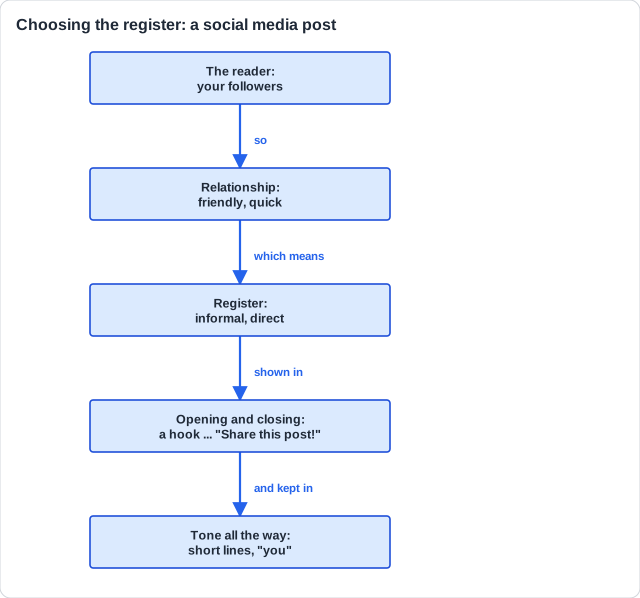
Speak to your followers: A post is written to followers, so the register is close and direct.
The post register
- Address the reader as you
- Short and punchy sentences
- An energetic tone
The most common purposes
- To invite people to an event
- To raise awareness of an issue (recycling, food waste, well-being)
- To share an experience
Useful phrases for a post (close, direct register)
- Did you know that…? / Guess what? — to open with a hook
- Don't miss it! / You won't want to miss this — to build excitement
- Share this post / Tag a friend / Spread the word — calls to action
- Who's in? / Let's do this together — to invite participation
- Swipe up / Link in bio / Comment below — typical post directions
Post register (what to use)
- You / your — speak straight to the reader.
- Short, lively sentences and the odd emoji.
- Contractions: we're, don't, you'll.
- A hook, a call to action, hashtags.
Formal register (avoid in a post)
- Dear Sir or Madam / I am writing to inform you…
- Long, dense paragraphs with no white space.
- Full, stiff forms: we are, do not, you will.
- A formal sign-off such as 'Yours faithfully'.
Keep it consistent: Pick the close, direct register and keep it from the hook to the hashtags. Mixing in a formal greeting or sign-off breaks the conventions and costs you Criterion C marks.
Feeling unprepared for exams?
Get a clear study plan, practice with real questions, and know exactly where you stand before exam day. No more guessing.
Read like Paper 2: Here is a short social media post — the kind of personal text Paper 2 (Reading) might give you. Read it once for the general idea; don't worry about every word. Then we'll work through one exam question together.
Post: a charity market (1/2): Did you know that every year we throw away tonnes of food that could still be eaten?
This Saturday we're opening a charity market in the main square, from 10am to 2pm. Everything is second-hand or surplus, and all the money goes to the local food bank. Don't miss it!
Post: a charity market (2/2)
Share this post and tag a friend who'd love to lend a hand.
#CharityMarket #ZeroWaste
- to throw away
- to get rid of something as rubbish
- surplus
- extra; more than is needed
- second-hand
- previously owned or used; not new
- food bank
- a place that gives free food to people in need
- to lend a hand
- to help with something
IB-style task — one Paper 2 question
One question, step by step
- The question — "According to the post, where does the money from the market go?"
- Find it in the text. Look for the word "money": "…and all the money goes to the local food bank."
- The answer — It goes to the local food bank. The words are right there in the post, so no outside knowledge is needed.
Reading technique: For an "according to the text" question, find the exact line that proves your answer — don't rely on memory or general knowledge.
The task: Your school is running an environment week. Write a social media post for other students to invite them to a beach clean-up.
Register and length
- Use a close, direct register.
- Write 450–600 words.
- Include a hook, a clear message, a call to action and a couple of hashtags.
Post structure — 4 steps
Hook
A first line that grabs attention — often a question or a surprising fact + emoji. "Did you know…?"
Message
Say what is happening, when and where, in a direct tone. "This Saturday we're running a beach clean-up at…"
Call to action
Tell the reader what to do. "Share this post and tag a friend."
Hashtags
Two or three relevant hashtags. "#CleanBeach #ZeroPlastic"
Hook → Message → Call to action → Hashtags
Model: the 4 steps in action
The post, step by step
- Hook (first line): Did you know that every tide leaves kilos of plastic on our beach? Let's change that!
- Message: This Saturday we're running a beach clean-up at Lighthouse Cove, from 10am to 1pm. We'll bring the gloves and bags — you just bring your energy and a friend.
- Call to action: Don't miss it! Share this post and tag anyone you want to bring along.
- Hashtags: #CleanBeach #ZeroPlastic #OurTown
Why it scores: This answer hits all three Paper 1 criteria — here's what earns each one:
A — Language /12
- Range of structures: imperatives "share", "tag"; future "we'll bring"
- Connectors and contractions used naturally
- Topic vocabulary, used accurately
B — Message /12
- Task fully done: invites readers AND gives what/when/where
- Ideas developed with concrete details
C — Conceptual /6
- Post conventions: a hook and hashtags
- Direct address: "you just bring your energy"
- A close, energetic register throughout
Memorize terms 3x faster
Smart flashcards show you cards right before you forget them. Perfect for definitions and key concepts.
How analysis is tested: Paper 2 sometimes asks you to spot the features of a text: the hook, the register, the purpose and the audience.
The clues are in the words on the page
- The verbs (bring, tag)
- The questions
- The hashtags
A different post: This time we'll analyse a different post: a drama club looking for new members.
Post: the drama club needs you: Ever dreamed of being on stage?
Our school drama club is looking for actors, singers and backstage helpers for the spring musical. Auditions are on Wednesday at 4pm in the school hall. No experience needed — just bring your energy!
Tag a friend who sings in the shower.
#SpringMusical #JoinTheCast
IB-style task — analysing the post
Three features, step by step
- The hook — The first line is a short question: "Ever dreamed of being on stage?" It speaks to the reader's own wishes and grabs attention immediately.
- The register — It is close and direct, with imperatives and "your": "just bring your energy!", "Tag a friend who sings in the shower." The reader is addressed straight on.
- The purpose & audience — It invites students at the school to audition for the spring musical and to spread the word: "Tag a friend…". The hashtag #JoinTheCast repeats the call to action.
Analysis technique: For "which feature" or "what register" questions, quote the words that prove it — a feature named with no evidence from the text scores no mark.