What 'customs & traditions' covers: Customs and traditions is part of the theme Experiences. You need vocabulary to talk about it — and to give your opinion about it.
What you need words for
- festivals
- celebrations
- traditional food
- regional customs across the English-speaking world
Use the list as a glossary: The words below are common English B vocabulary. Treat the list as a glossary: learn each term with its meaning and a synonym, then reuse them in the reading and writing sections.
- custom
- an accepted way of doing something in a particular group or place
- tradition
- a belief or practice passed down over many years
- festival / celebration
- a special event held to mark an occasion, often yearly
- to celebrate
- to mark a special day or event with enjoyable activities
- parade / procession
- a public march of people through the streets, often in costume
- traditional costume / dress
- the special clothing worn for a region's festivals
- traditional recipe / dish
- a food prepared the same way for generations
- to gather / to get together
- to come together in one place, often as a family
- roots
- the place and culture a person or family comes from
- heritage
- the customs, history and culture a group passes on
- to pass on (from generation to generation)
- to hand a custom down from older to younger people
- to keep a tradition alive
- to keep practising a custom so it does not disappear
- to take part / to join in
- to become actively involved in an event
| Useful expression | What it means |
|---|---|
| In my region we celebrate a very old festival. | My area holds a long-standing yearly event. |
| The whole family gets together to share a traditional dish. | Everyone meets to eat a food made the local way. |
| People come out into the streets in traditional costume. | Crowds appear outside, dressed in the regional way. |
| This custom is passed on from generation to generation. | Older people teach the custom to younger ones. |
| Traditions bring us together as a community. | Shared customs make people feel part of one group. |
Why this matters: This vocabulary turns up in every skill — a reading text on a festival, a listening interview about a celebration, a Paper 1 blog about a tradition, or your oral. Reusing precise topic words is how you score Criterion A (Language).
Free preview
Reading it is one thing — hearing it is another
You're reading the free notes. Aimnova Pro unlocks the full study experience — and you can try it with your first topic free to keep:
- Audio on every wordTap any vocabulary word or example to hear it read aloud in natural English.
- FlashcardsLock in vocabulary and key terms with spaced repetition.
- Practice questionsAnswer exam-style questions and get instant AI marking.
- Mock exams & past-paper vaultSit full mocks and see exactly how examiners award marks.
- Personalised study planA daily plan built around your exam date and weak areas.
Have something to say: Examiners reward developed ideas, not just vocabulary. Take a position and back it up.
The common debates on customs and traditions
- Keeping old traditions alive vs modern life.
- Festivals as tourism vs community.
- How regional identity and food connect the generations.
Opinion phrases (use these to introduce a view)
- In my opinion… / From my point of view… — to introduce what you think
- It seems to me that… / I believe that… — a slightly softer way to give a view
- The most important thing is… — to highlight your main point
- On the one hand… on the other hand… — to weigh up two sides
- I (completely) agree that… / I'm not convinced that… — to react to an idea
Risks for traditions (drawbacks)
- Many young people no longer take part in the festivals.
- Some festivals have become too touristy and commercial.
- If no one practises them, customs are slowly lost.
Benefits of traditions
- Traditions bring us together as a community.
- They preserve our identity and our roots.
- They bring several generations of a family together.
Festivals
- A school International Day: why and what happened
- Diwali, Hogmanay, Valentine's Day, a carnival
- Old festivals that young people keep alive
Meeting other cultures
- A month with a host family abroad
- A multicultural summer camp
- A conversation that changed your view
Heritage
- Places that keep history alive
- Crafts that few young people learn
- A documentary about a culture: what it showed
- a host family
- a family you live with during an exchange
- a cultural exchange
- a programme where people from two cultures visit and learn from each other
- to broaden your horizons
- to learn about new things and see the world differently
- culture shock
- the confused feeling you can have in a very different culture
- a craft
- a skill of making things by hand, such as masks or pottery
- to revive (a custom)
- to make it popular or used again
Link your ideas: Connectors lift your answer from a list into an argument: moreover (to add), however (to contrast), therefore (to conclude), although (to concede). Use at least two or three in any written answer.
Stop wasting time on topics you know
Our AI identifies your weak areas and focuses your study time where it matters. No more overstudying easy topics.
Read like Paper 2: Here is a short blog post — the kind of text Paper 2 (Reading) gives you. Read it once just for the general idea; don't worry about every word. Then we'll work through one exam question together.
My first grape-harvest festival (1 of 3): In my village, the most anticipated moment of the year is the grape-harvest festival, when the grapes are picked. It used to seem like something only for the older people, but last year I took part for the first time.
My first grape-harvest festival (2 of 3)
The whole family gets together: my grandmother makes a traditional recipe from the region and my cousins play music through the streets. What I liked most was the parade in traditional costumes and the dancing in the square. At first I felt embarrassed, but I ended up dancing with everyone.
My first grape-harvest festival (3 of 3)
Now I understand that these customs are not things of the past: they bring us together as a community and remind us where we come from.
- grape harvest
- the season when grapes are picked from the vines
- to take part
- to become involved in an activity or event
- to feel embarrassed
- to feel awkward or self-conscious in front of others
- to end up (doing something)
- to finally do something after some hesitation
- things of the past
- ideas or customs that no longer matter today
IB-style task — one Paper 2 question
One question, step by step
- The question — "According to the text, what did the writer like most at the festival?"
- Find it in the text. Look for the words "liked most": "What I liked most was the parade in traditional costumes and the dancing in the square."
- The answer — The parade in traditional costumes and the dancing in the square. The words are right there in the text, so no outside knowledge is needed.
Reading technique: For an "according to the text" question, find the exact line that proves your answer — don't rely on memory or general knowledge.
The task: Your school is holding a world cultures week. Write an article for the school magazine: describe a festival or custom from your region and explain how young people can keep it alive.
Write 450–600 words.
Article structure — 4 steps
Headline and standfirst
A headline, then one line that sums up the article. "Our village festival: why young people should keep it alive"
Introduction
Set the scene and present the topic. "Every August my village celebrates…"
Body
Develop your ideas with examples, in paragraphs. "I never used to take part… So, first…"
Conclusion
Sum up and leave the reader with a final thought. "This year, why not let it be you?"
Headline → Introduction → Body → Conclusion
Model: the 4 steps in ~100 words
The article, step by step
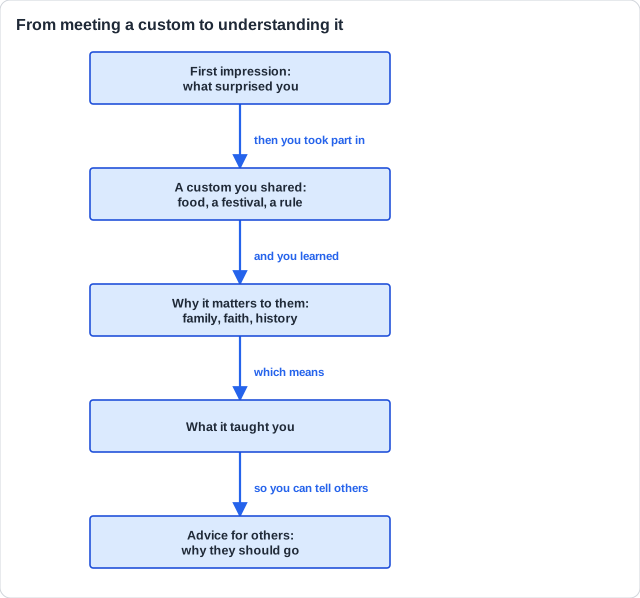
- Our village festival: why young people should keep it alive. Traditions are not just for grandparents, says Diego Ruiz.
- Every August my village celebrates its harvest festival with music, dancing and a huge shared dinner in the square. For centuries it has brought the whole community together.
- I never used to take part in my village's festival. It seemed boring and just for the older people. Last year, though, I helped my grandmother cook the traditional dish, and I finally understood what it means. So, first, take part in a festival from your region; second, ask your grandparents about the customs of the past.
- Traditions only survive if someone carries them on. This year, why not let it be you?
Why it works: A strong article does this for each of the three Paper 1 criteria:
A — Language /12
- Range of tenses: present perfect "it has brought", past "I never used to", "I helped"
- Connectors: "though", "so", "first/second"
- Topic vocabulary: harvest festival, customs, carry on
B — Message /12
- Task fully done: describes the festival AND how to keep it alive
- A personal example supports the advice
C — Conceptual /6
- Article conventions: headline + standfirst
- Introduction, body and a concluding question
- Semi-formal tone for magazine readers
Ready to ace Customs & traditions?
You've seen the preview. Here's what you'll unlock:
Bite-Sized Study Notes
Full syllabus broken into chunks that stick
Exam Practice
See exactly how to score full marks
AI Feedback
Know exactly what examiners want
Smart Study Plan
Know exactly what to study next