What 'rites of passage' covers: Rites of passage is part of the theme Experiences. A rite of passage is a milestone that marks the move from one stage of life to another.
Examples of milestones
- a graduation
- a coming-of-age party such as a quinceañera
- a first job
- leaving home
Use the list as a glossary: You need vocabulary to describe these milestones and to give an opinion about them. The words below are common English B vocabulary. Treat the list as a glossary: learn each term with its meaning and a synonym, then reuse them in the reading and writing sections.
- rite of passage
- an event or ceremony marking an important change in someone's life
- milestone
- a significant moment or turning point in your life
- coming of age
- the point at which a young person is treated as an adult
- graduation
- the ceremony where you receive your diploma after finishing studies
- ceremony
- a formal event held to mark a special occasion
- quinceañera
- a Latin American celebration of a girl's fifteenth birthday and her step into adulthood
- to grow up
- to become an adult; to develop and mature
- to leave home / to move out
- to stop living with your family and live independently
- to become independent
- to start looking after yourself and making your own decisions
- a turning point
- a moment when an important change happens; a 'before and after'
- tradition
- a custom or belief passed down within a family or culture
- unforgettable
- so special or memorable that you will never forget it
- to say goodbye to childhood
- to mark the end of being a child and start a new stage
| Useful expression | What it means |
|---|---|
| It was a real rite of passage for me. | It clearly marked the move into a new stage of my life. |
| That day marked a turning point. | After that day, things were noticeably different. |
| It was an unforgettable moment. | It was so special I will always remember it. |
| I finally felt grown up. | I felt I had become an adult. |
| It's a tradition in my family. | It's a custom we pass down and repeat over the years. |
Why this matters: This vocabulary turns up in every skill — a reading text about a graduation, a listening interview about leaving home, a Paper 1 blog about growing up, or your oral. Reusing precise topic words is how you score Criterion A (Language).
Free preview
Reading it is one thing — hearing it is another
You're reading the free notes. Aimnova Pro unlocks the full study experience — and you can try it with your first topic free to keep:
- Audio on every wordTap any vocabulary word or example to hear it read aloud in natural English.
- FlashcardsLock in vocabulary and key terms with spaced repetition.
- Practice questionsAnswer exam-style questions and get instant AI marking.
- Mock exams & past-paper vaultSit full mocks and see exactly how examiners award marks.
- Personalised study planA daily plan built around your exam date and weak areas.
Have something to say: Examiners reward developed ideas, not just vocabulary. Take a position and back it up.
The common debates on rites of passage
- Whether big ceremonies are worth the cost and pressure.
- What really makes someone an adult.
- How traditions connect us to family and culture.
Opinion phrases (use these to introduce a view)
- In my opinion… / From my point of view… — to introduce what you think
- It seems to me that… / I believe that… — a slightly softer way to give a view
- The most important thing is… — to highlight your main point
- On the one hand… on the other hand… — to weigh up two sides
- I (completely) agree that… / I'm not convinced that… — to react to an idea
Drawbacks of big ceremonies
- They can be very expensive and put families under pressure.
- Sometimes the party matters more than the meaning.
- Not everyone can afford the same kind of celebration.
Benefits
- They bring the whole family and community together.
- They give a young person confidence as they grow up.
- They create unforgettable memories and keep traditions alive.
School milestones
- The first day of school
- Graduation: how you celebrated and why it mattered
- The prom: a night to remember or too expensive?
Coming of age
- An 18th birthday, a driving licence, a first job
- Religious ceremonies and non-religious alternatives
- Moving out of the family home
Joining a group
- University initiation rituals: why students join in
- When a ritual becomes dangerous
- Ceremonies such as a passing-out parade
- a milestone
- an important event that marks a stage in life
- coming of age
- the moment you are treated as an adult
- to mark (an occasion)
- to celebrate or do something to show it is important
- an initiation (ritual)
- a ceremony or test for new members of a group
- hazing
- humiliating or dangerous initiation activities, often banned
- a passing-out parade
- a ceremony when new soldiers or police officers finish training
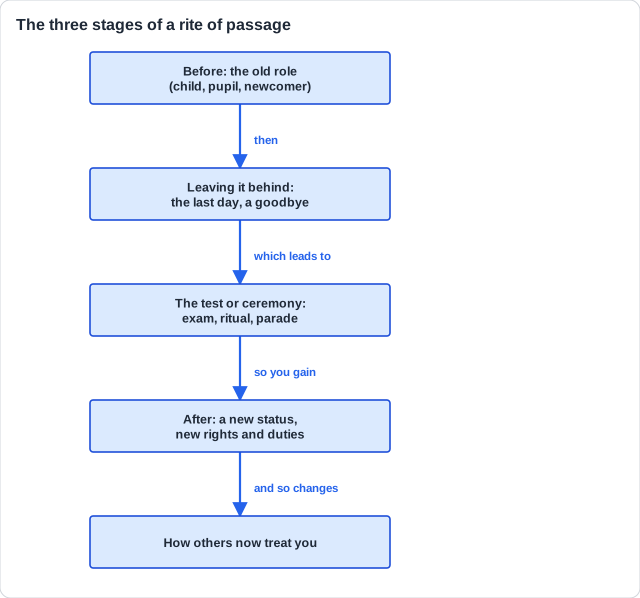
Link your ideas: Connectors lift your answer from a list into an argument: moreover (to add), however (to contrast), therefore (to conclude), although (to concede). Use at least two or three in any written answer.
Get feedback like a real examiner
Submit your answers and get instant feedback — what you did well, what's missing, and exactly what to write to score full marks.
Read like Paper 2: Here is a short blog post — the kind of text Paper 2 (Reading) gives you. Read it once just for the general idea; don't worry about every word. Then we'll work through one exam question together.
The day I graduated (1 of 3): Last year I celebrated my graduation from secondary school, and for me it was a real rite of passage. For weeks I had been nervous, because I knew that a very different stage of my life would begin straight afterwards.
The day I graduated (2 of 3)
On the day of the ceremony I put on the dress I had chosen with my mum and collected my diploma in front of my whole family. My grandparents came all the way from the coast, and my little brother filmed the whole thing on his phone.
The day I graduated (3 of 3)
That evening we had dinner together, and my parents gave me a travel journal as a present. More than just a party, the day was a way of saying goodbye to childhood and welcoming adult life. That day I finally understood that growing up isn't only about having birthdays — it's about learning to make your own decisions.
- to collect (a diploma)
- to go up and receive something that is given to you
- stage (of life)
- a particular period or phase in your life
- to welcome
- to greet or accept something gladly as it begins
- to make your own decisions
- to choose for yourself, without others deciding for you
- travel journal
- a notebook for writing about journeys and experiences
IB-style task — one Paper 2 question
One question, step by step
- The question — "According to the text, what did the writer's parents give her as a present?"
- Find it in the text. Look for the word "present": "my parents gave me a travel journal as a present."
- The answer — A travel journal. The words are right there in the text, so no outside knowledge is needed.
Reading technique: For an "according to the text" question, find the exact line that proves your answer — don't rely on memory or general knowledge.
The task: Your school magazine is running an issue about growing up. Write a letter to a younger cousin who is about to finish primary school: describe a rite of passage you experienced and give advice for facing big changes.
Write 450–600 words.
Personal letter structure — 4 steps
Place and date
Top right: where you are and the date. "Oxford, 12 June"
Greeting
Dear + first name. "Dear Ella,"
Body
Your news, your experience and your advice. "It reminds me of my own graduation… My advice?"
Friendly close
A warm line, then Lots of love or Best wishes + your name. "Lots of love, Sofia"
Date → Greeting → Body → Friendly close
Model: the 4 steps in ~100 words
The letter, step by step
- Oxford, 12 June
- Dear Ella,
- Mum told me you're finishing primary school next week — congratulations! It reminds me of my own graduation last year. I'll be honest: for weeks beforehand I was a bundle of nerves, because I knew childhood was officially over. But the day itself was wonderful. My advice? Enjoy the moment instead of rushing past it, share it with the people who matter, and don't be afraid of what comes next.
- Write and tell me all about it. Lots of love, Sofia
Why it works: A strong personal letter does this for each of the three Paper 1 criteria:
A — Language /12
- Range of tenses: present continuous "you're finishing", past "I was", imperatives
- Connectors: "because", "but", "instead of"
- Topic vocabulary: graduation, childhood, a bundle of nerves
B — Message /12
- Task fully done: describes her graduation AND gives advice
- Advice tied to her own experience
C — Conceptual /6
- Letter conventions: place and date, "Dear Ella"
- A warm, family tone with news and questions
- A friendly close: "Lots of love, Sofia"
Ready to ace Rites of passage?
You've seen the preview. Here's what you'll unlock:
Bite-Sized Study Notes
Full syllabus broken into chunks that stick
Exam Practice
See exactly how to score full marks
AI Feedback
Know exactly what examiners want
Smart Study Plan
Know exactly what to study next