What 'travel & holidays' covers: Travel and holidays is part of the theme Experiences. You need vocabulary to talk about it — and to give your opinion about it.
What you need words for
- types of trip
- transport
- accommodation
- planning a holiday
- what you do there
Use the list as a glossary: The words below are common English B vocabulary. Treat the list as a glossary: learn each term with its meaning and a synonym, then reuse them in the reading and writing sections.
- trip / journey
- the act of travelling from one place to another
- holiday(s) / vacation
- time off spent travelling or relaxing away from work or study
- destination
- the place you are travelling to
- accommodation — hostel
- a place to stay — a cheap, simple place to sleep, often shared
- to book (a hotel / a ticket)
- to reserve something in advance
- to pack — luggage
- to put your things in a bag for a trip — the bags you take
- means of transport
- the way you travel (train, bus, plane, bike…)
- mass tourism
- tourism in very large numbers, often harming a place
- package trip / organised trip
- a holiday where travel and hotels are arranged for you
- to travel independently
- to plan and travel on your own, not on a package trip
- to go sightseeing — tourist
- to visit the interesting places of an area — a person who does this
- landscape / scenery
- the natural features of an area you can see
- (school) exchange
- a visit where students stay with a family abroad and host them in return
| Useful expression | What it means |
|---|---|
| I'd rather travel independently than take a package trip. | I prefer planning my own trip to a pre-arranged one. |
| We stayed in a cheap hostel. | We slept in a simple, low-cost place. |
| Mass tourism damages the most beautiful places. | Too many visitors harm the nicest spots. |
| What I like most is discovering the scenery. | My favourite part is seeing the landscape. |
| I'm going to do an exchange with a host family. | I'll stay with a family abroad to practise the language. |
Why this matters: This vocabulary turns up in every skill — a reading text about a trip, a listening interview about a holiday, a Paper 1 blog or postcard, or your oral. Reusing the right topic words is how you score Criterion A (Language).
Free preview
Reading it is one thing — hearing it is another
You're reading the free notes. Aimnova Pro unlocks the full study experience — and you can try it with your first topic free to keep:
- Audio on every wordTap any vocabulary word or example to hear it read aloud in natural English.
- FlashcardsLock in vocabulary and key terms with spaced repetition.
- Practice questionsAnswer exam-style questions and get instant AI marking.
- Mock exams & past-paper vaultSit full mocks and see exactly how examiners award marks.
- Personalised study planA daily plan built around your exam date and weak areas.
Have something to say: Examiners reward developed ideas, not just vocabulary. Take a position and back it up.
The common debates on travel
- Package holidays vs travelling independently.
- The impact of mass tourism on places and monuments.
- What we really gain from travelling.
Opinion phrases (use these to introduce a view)
- In my opinion… / From my point of view… — to introduce what you think
- It seems to me that… / I think that… — a slightly softer way to give a view
- The most important thing is… — to highlight your main point
- On the one hand… on the other hand… — to weigh up two sides
- I (completely) agree that… / I'm not convinced that… — to react to an idea
Drawbacks of mass tourism
- Mass tourism damages monuments and the environment.
- The most beautiful places get overcrowded.
- Prices rise and local residents are pushed out.
Benefits of travelling
- Travelling opens our minds and makes us more tolerant.
- We get to know other cultures and practise languages.
- Responsible tourism supports the local economy.
Ways to travel
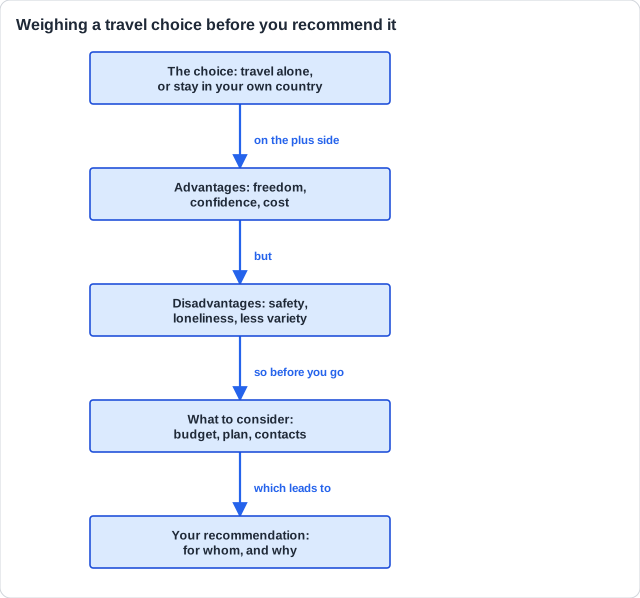
- Travelling alone: highlights, benefits, risks
- A holiday in your own country or abroad?
- A school trip: where, and what to learn there
Tourism and places
- Mass tourism: who gains and who loses
- Historic sites: kept safe and attractive
- Eco-friendly hotels and responsible travel
When things go wrong
- A delayed flight, unhelpful staff
- Writing a complaint: what happened, what you want
- Booking and planning: cheap tickets, accommodation
- a staycation
- a holiday spent in your own country or at home
- to go solo / a solo traveller
- to travel alone / a person who travels alone
- overtourism
- too many tourists in one place, which harms it and its residents
- a heritage site
- a historic place protected because of its value
- eco-friendly
- designed to harm the environment as little as possible
- compensation / a refund
- money paid because something went wrong / money given back
- an itinerary
- a plan of a journey: places, dates, times
Link your ideas: Connectors lift your answer from a list into an argument: moreover (to add), however (to contrast), therefore (to conclude), although (to concede). Use at least two or three in any written answer.
See how examiners mark answers
Answer exam-style questions with model answers. Learn exactly what earns marks and what doesn't.
Read like Paper 2: Here is a short blog post — the kind of text Paper 2 (Reading) gives you. Read it once just for the general idea; don't worry about every word. Then we'll work through one exam question together.
A summer without bookings (1 of 3): Last summer I took a train trip around the north of the country with my brother. We didn't book any hotels: we slept in cheap hostels and bought our tickets each morning.
At first it was a bit chaotic.
A summer without bookings (2 of 3)
On the first day we missed our train and, exhausted after hours in the station, I thought the whole thing had been a bad idea. However, that freedom turned out to be the best part of the trip: we met other travellers, changed our plans without any stress and discovered beautiful villages that don't appear in the guidebooks.
A summer without bookings (3 of 3)
That's why next summer I want to do it all again — but this time by bike. Travelling like that, without rushing, has taught me to enjoy the journey, not just the destination.
- hostel
- a cheap, simple place to sleep, often with shared rooms
- ticket
- the document that lets you travel or enter somewhere
- exhausted
- completely tired, worn out
- guidebook
- a book with travel information about a place
- the journey (vs the destination)
- the act of travelling itself, not just the place you reach
IB-style task — one Paper 2 question
One question, step by step
- The question — "According to the text, where did the writer and their brother sleep during the trip?"
- Find it in the text. Look for the word "slept": "We didn't book any hotels: we slept in cheap hostels and bought our tickets each morning."
- The answer — They slept in cheap hostels. The words are right there in the text, so no outside knowledge is needed.
Reading technique: For an "according to the text" question, find the exact line that proves your answer — don't rely on memory or general knowledge.
The task: Your school's travel club is preparing for the summer holidays. Write a leaflet for other students: give advice for travelling responsibly, using a trip you took as an example.
Write 450–600 words.
Leaflet structure — 4 steps
Title
A clear title that says what the leaflet is for. "Travel smart, travel kind"
Sections with subheadings
Short sections, each under a bold subheading. "Why it matters."
Bullet points
List the key advice as short bullets. "• Travel light. • Talk to the locals."
Practical information and call to action
Where, when, who to contact, and what to do now. "Travel Club, Room 12, every Tuesday"
Title → Subheadings → Bullet points → Information + call to action
Model: the 4 steps in ~100 words
The leaflet, step by step
- Travel smart, travel kind: a student guide to responsible travel
- Why it matters. Mass tourism can damage the places we love. Last summer my brother and I travelled around the north by train, slept in hostels and ate in local markets — and we never missed a five-star hotel.
- Our top tips • Travel light. • Talk to the locals. • Buy from local shops and markets. • Leave every place as clean as you found it.
- Find out more: Travel Club, Room 12, every Tuesday at lunchtime. Come along and plan your next adventure with us!
Why it works: A strong leaflet does this for each of the three Paper 1 criteria:
A — Language /12
- Range of tenses: past "we travelled", imperatives "travel light", "talk to"
- Connectors: "and", "as… as"
- Topic vocabulary: mass tourism, hostels, local markets
B — Message /12
- Task fully done: uses a real trip AND gives responsible-travel advice
- Every tip is practical
C — Conceptual /6
- Leaflet conventions: a title and bold subheadings
- Bullet points for the tips
- Practical information (where, when) and a call to action
Ready to ace Travel & holidays?
You've seen the preview. Here's what you'll unlock:
Bite-Sized Study Notes
Full syllabus broken into chunks that stick
Exam Practice
See exactly how to score full marks
AI Feedback
Know exactly what examiners want
Smart Study Plan
Know exactly what to study next