What 'leisure & free time' covers: Leisure & free time is part of the theme Experiences. You need vocabulary for hobbies, sports, music, going out, screen time and how you use your spare time.
How to use this list
- Give your opinion about how people use their free time.
- These are common English B words. Treat the list as a glossary.
- Learn each term with its meaning and a synonym.
- Reuse the terms in the reading and writing sections.
- leisure / free time
- time when you are not working or studying
- a hobby / a pastime
- an activity you do regularly for enjoyment
- to make the most of your time
- to use your time well, not waste it
- to sign up for (a club / a course)
- to put your name down to join a club or course
- to meet up with friends
- to arrange to see your friends and spend time together
- to play / do a sport
- to take part in a sport regularly
- to play an instrument
- to make music on the guitar, piano, drums, etc.
- screen time
- the hours you spend looking at a phone, tablet, computer or TV
- to switch off / unwind
- to stop and relax; to take a break from work or screens
- to have fun / to have a good time
- to enjoy yourself
- a creative activity
- something that lets you make or invent (art, music, cooking, writing)
- outdoors / outdoor activities
- things you do outside, in the open air
- to take up (a hobby)
- to start doing a new activity
| Useful expression | What it means |
|---|---|
| In my free time I play the guitar. | Playing the guitar is how I spend my spare time. |
| I signed up for a cookery club. | I joined a club where people cook together. |
| I usually meet up with my friends at weekends. | I normally see my friends on Saturday and Sunday. |
| I spend too much time in front of a screen. | I use my phone, laptop or TV more than I should. |
| Reading is my favourite way to unwind. | Reading is how I relax best. |
Why this matters: This vocabulary turns up in every skill — a reading text about hobbies, a listening interview about a weekend, a Paper 1 blog about free time, or your oral. Reusing precise topic words is how you score Criterion A (Language).
Free preview
Reading it is one thing — hearing it is another
You're reading the free notes. Aimnova Pro unlocks the full study experience — and you can try it with your first topic free to keep:
- Audio on every wordTap any vocabulary word or example to hear it read aloud in natural English.
- FlashcardsLock in vocabulary and key terms with spaced repetition.
- Practice questionsAnswer exam-style questions and get instant AI marking.
- Mock exams & past-paper vaultSit full mocks and see exactly how examiners award marks.
- Personalised study planA daily plan built around your exam date and weak areas.
Have something to say: Examiners reward developed ideas, not just vocabulary. Take a position and back it up.
Common debates on leisure
- Active hobbies vs too much screen time
- Doing things alone vs with others
- Whether free time should be productive or just for resting
Opinion phrases (use these to introduce a view)
- In my opinion… / From my point of view… — to introduce what you think
- It seems to me that… / I believe that… — a slightly softer way to give a view
- The most important thing is… — to highlight your main point
- On the one hand… on the other hand… — to weigh up two sides
- I (completely) agree that… / I'm not convinced that… — to react to an idea
Too much screen time (drawbacks)
- Many young people spend their free time in front of a screen.
- Video games and scrolling can eat into hours of sleep.
- If we never go out, we make fewer friends in real life.
Active hobbies (benefits)
- A creative hobby helps you switch off and reduce stress.
- Signing up for a club is a great way to meet new people.
- Sport and music are good for both your body and your mind.
Starting or dropping a hobby
- Bored with a hobby: why it happened
- New activities you could take up
- Learning something new as an adult
Clubs and facilities
- After-school activities: what is on offer and why join
- Cuts to sports and leisure budgets
- How young people are affected
Outdoors and adventure
- Geocaching, hiking trails, stargazing
- Extreme sports: the thrill and the risk
- Rules that protect nature
- to take up (a hobby)
- to start doing a new activity
- to give up / to quit
- to stop doing an activity
- to lose interest in
- to stop enjoying or caring about something
- facilities
- places and equipment for an activity: a pool, courts, a youth centre
- budget cuts
- reductions in the money a council or school can spend
- an adrenaline rush
- the sudden excited feeling you get from danger or speed
- a thrill-seeker
- a person who looks for exciting, risky experiences
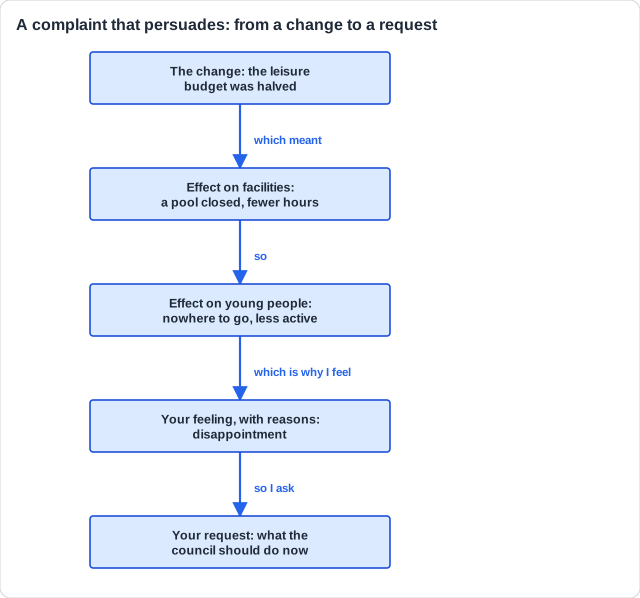
Link your ideas: Connectors lift your answer from a list into an argument: moreover (to add), however (to contrast), therefore (to conclude), although (to concede). Use at least two or three in any written answer.
Stop wasting time on topics you know
Our AI identifies your weak areas and focuses your study time where it matters. No more overstudying easy topics.
Read like Paper 2: Here is a short blog post — the kind of text Paper 2 (Reading) gives you. Read it once just for the general idea; don't worry about every word. Then we'll work through one exam question together.
A summer in the kitchen (part 1): Last summer I signed up for an international cookery course, and I spent two weeks with young people from several different countries.
A summer in the kitchen (part 2)
At first I was a little nervous, because I didn't know anyone and I was quite shy. But in the kitchen none of that mattered: we chopped, mixed and laughed together all day long.
A summer in the kitchen (part 3)
I learned to make fresh pasta from scratch, and I discovered that cooking is a brilliant way to switch off from my phone and to make new friends. I came home with a notebook full of recipes, far more confidence, and a real urge to keep using my free time on something creative.
- to sign up for
- to put your name down to join something
- shy
- nervous and uncomfortable around people you don't know
- from scratch
- from the very beginning, using basic ingredients
- to switch off
- to stop using screens / working and relax
- an urge
- a strong wish or need to do something
IB-style task — one Paper 2 question
One question, step by step
- The question — "According to the text, what did the writer learn to make on the course?"
- Find it in the text. Look for the words "I learned to make": "I learned to make fresh pasta from scratch, and I discovered that cooking is a brilliant way to switch off."
- The answer — They learned to make fresh pasta (from scratch). The words are right there in the text, so no outside knowledge is needed.
Reading technique: For an "according to the text" question, find the exact line that proves your answer — don't rely on memory or general knowledge.
The task: Your school is running a hobbies and activities week. Write a review for the school website of a course or activity you did in your free time: describe it and say whether you would recommend it.
Write 450–600 words.
Review structure — 4 steps
Introduction
Name what you are reviewing: what, where, when. "Review: International Cookery Course, City Youth Centre"
Description
Say what it is like, in a few details. "Every evening we cooked a dish from a different country…"
Strengths and weaknesses
Give at least one of each. "The best thing was… The only weak point was…"
Recommendation
Say who should try it, and give a rating. "I'd give it four stars out of five."
Introduction → Description → Strengths/weaknesses → Recommendation
Model: the 4 steps in ~100 words
The review, step by step
- Review: International Cookery Course, City Youth Centre. Last summer I signed up for an international cookery course: two weeks of evening classes for 15- to 18-year-olds.
- Every evening we cooked a dish from a different country, from Thai curry to Mexican tamales, in small teams with young people from all over the world.
- The best thing was the atmosphere: I learned new recipes and made lots of friends. The only weak point was the price, which is quite high for students.
- Overall, I'd give it four stars out of five. If you want to meet people, sign up for a club or a course like this one — it's time well spent.
Why it works: A strong review does this for each of the three Paper 1 criteria:
A — Language /12
- Range of tenses: past "I signed up", "we cooked", conditional "I'd give"
- Connectors: "from… to…", "overall", "if"
- Topic vocabulary: free time, sign up for, atmosphere
B — Message /12
- Task fully done: describes the course AND recommends it
- A balanced view: a strength and a weakness
C — Conceptual /6
- Review conventions: names the course and the place
- Weighs strengths against weaknesses
- Ends with a clear recommendation and a rating
Ready to ace Leisure & free time?
You've seen the preview. Here's what you'll unlock:
Bite-Sized Study Notes
Full syllabus broken into chunks that stick
Exam Practice
See exactly how to score full marks
AI Feedback
Know exactly what examiners want
Smart Study Plan
Know exactly what to study next