aımnova
DashboardMy LearningCrash CoursesStudy Plan

Aimnova site navigation

Stay in the loop

Get the latest study resources and updates

New features, study tips and exam insights — straight to your inbox.

IB Diploma

  • IB Past Papers
  • IB Study Notes
  • IB Question Bank
  • IB Mock Exams
  • IB Revision

IB Subjects

  • IB Math AA
  • IB Math AI
  • IB Economics
  • IB Business Management
  • IB Physics
  • IB Biology
  • View all IB subjects→

IB Past Papers

  • IB Math AA HL Past Papers
  • IB Math AA SL Past Papers
  • IB Math AI HL Past Papers
  • IB Math AI SL Past Papers
  • IB Economics HL Past Papers
  • IB Economics SL Past Papers
  • IB ESS Past Papers
  • View all past papers→

Study Resources

  • Study Notes
  • Question Bank
  • Mock Exams
  • Crash Courses
  • Flashcards
  • Revision Guide
  • Exam Skills
  • Command Terms
  • Grade Calculator
  • Exam Timetable 2026

Aimnova

  • Features
  • Pricing
  • For Teachers
  • For Schools
  • For Parents
  • About Us
  • Blog
  • Contact
aımnova

IB study, practice and feedback built around the real exam.

TermsPrivacyCookies·© 2026 Aimnova. All rights reserved.d92d737

Aimnova is not affiliated with or endorsed by the International Baccalaureate Organization (IB).

NotesEconomicsTopic 4.10Institutional change and social enterprise
Back to Economics Topics
4.10.64 min read

Institutional change and social enterprise

IB Economics · Unit 4

Smart study tools

Turn reading into results

Move beyond passive notes. Answer exam-style questions, get AI feedback, and build the skills that earn top marks.

Get Started Free

Contents

  1. 1Access to banking
  2. 2Rights, women and honest government
  3. 3Social enterprise
  4. 4Exam-style question

Institutional change means changing the rules and organisations an economy runs on. The first is access to banking.

Access to banking

1

Microfinance

Small loans to people with no collateral. Bangladesh's Grameen Bank lends mostly to women.

Loans
2

Mobile banking

Save and send money by phone. Kenya's M-Pesa has done this since 2007.

Phones
3

Savings accounts

A safe place to save, so savings can be lent to others.
Saving
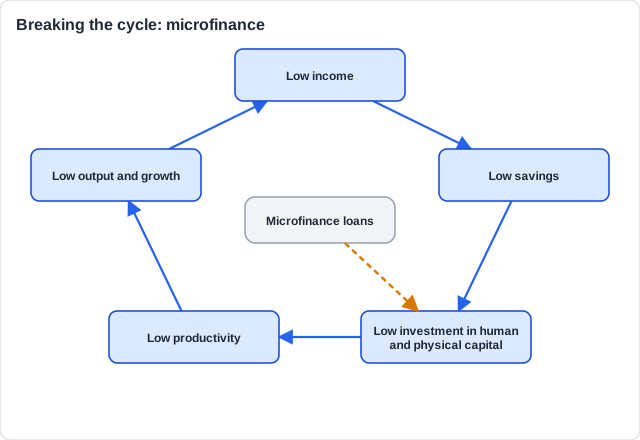
A poverty cycle: low income, then low savings, then low investment in human and physical capital, then low productivity, then low output and growth, back to low income; microfinance loans raises low investment in human and physical capital.
Microfinance raises investment in small businesses.

Free preview

This is the free notes preview

You're reading the free notes. Aimnova Pro unlocks the full study experience — and you can try it with your first topic free to keep:

  • FlashcardsLock in vocabulary and key terms with spaced repetition.
  • Practice questionsAnswer exam-style questions and get instant AI marking.
  • Mock exams & past-paper vaultSit full mocks and see exactly how examiners award marks.
  • Personalised study planA daily plan built around your exam date and weak areas.
Start Studying Free Full access to Aimnova Pro · cancel anytime

Other institutional changes give people rights and trust.

Rights, women and honest government

1

Property and land rights

A legal title lets land back a loan and makes improving it worthwhile.

Titles
2

Women's empowerment

Schooling, credit and land for women raise output and children's health.

Women
3

Less corruption

Fewer bribes cut firms' costs; public money reaches schools and clinics.

Honesty

The points to remember

  • Each change raises investment or human capital: say which.
  • Land titles: land can be collateral for a loan.

See how examiners mark answers

Answer exam-style questions with model answers. Learn exactly what earns marks and what doesn't.

Try Exam Vault FreeYour first topic is free to keep • No credit card required

A social enterprise is a business whose main aim is social or environmental: it sells, then reinvests its profit in that aim.

What a social enterprise is

1

A charity

Lives on donations; gives help away.

Gifts
2

A social enterprise

Sells goods or services, then reinvests profit in a social aim.

Trades for good
3

A profit-seeking firm

Sells to earn profit for its owners.

Profit

The points to remember

  • Strength: it pays its own way, so it lasts without donors.
  • Limit: it is small, and may struggle to earn enough.

Paper 1 asked this in May 2024, as part (a) for 10 marks.

IB-style questionExplain[10 marks]

Explain the importance of improved access to banking services, such as microfinance and mobile banking, in promoting economic development.

Model answer plan

See the answer broken into clear points, with guidance on how each point earns marks.

Claim your free topic

How the 10 marks are given

MarksWhat your answer needs
9–10Theory fully explained, terms used correctly all the way through, the diagram included and fully explained
7–8Theory explained, terms mostly right, the diagram included and explained
5–6Theory partly explained, some terms, the diagram included
1–4Theory only described or stated; few relevant terms

IB Exam Questions on Institutional change and social enterprise

Practice with IB-style questions filtered to Topic 4.10.6. Get instant AI feedback on every answer.

Practice Topic 4.10.6 QuestionsBrowse All Economics Topics

How Institutional change and social enterprise Appears in IB Exams

Examiners use specific command terms when asking about this topic. Here's what to expect:

  • Define

    Give the precise meaning of key terms related to Institutional change and social enterprise.

    AO1
  • Describe

    Give a detailed account of processes or features in Institutional change and social enterprise.

    AO2
  • Explain

    Give reasons WHY — cause and effect within Institutional change and social enterprise.

    AO3
  • Evaluate

    Weigh strengths AND limitations of approaches in Institutional change and social enterprise.

    AO3
  • Discuss

    Present arguments FOR and AGAINST with a balanced conclusion.

    AO3

See the full IB Command Terms guide

Related Economics Topics

Continue learning with these related topics from the same unit:

4.1.1Benefits of international trade4.1.2Free trade on a diagram: exports and imports4.2.1Tariffs4.10.1Trade strategies and diversification
View all Economics topics
Improve your exam techniqueCommand terms, paper structure, and mark-scheme tips for Economics
Previous4.10.5Foreign aid and multilateral assistanceNextEvaluating development strategies4.10.7

6 questions to test your understanding

Reading is just the start. Students who tested themselves scored 82% on average — try IB-style questions with AI feedback.

Start FreeView All Economics Topics