Foreign aid is money, goods or services given to poorer countries on better terms than markets offer.
Kinds of foreign aid
| Kind | What it is |
|---|---|
| Humanitarian aid | Emergency food, shelter and medicine after a disaster or war |
| Development aid | Long-term help: schools, clinics, roads, water |
| Official development assistance (ODA) | Aid from governments, as grants or cheap loans |
| NGOs | Charities such as Oxfam and Médecins Sans Frontières |
| Debt relief | Cancelling or cutting a poor country's debts |
| Tied aid | Aid that must be spent on the donor's goods |
The points to remember
- Humanitarian = short-term emergency; development = long-term.
- Tied aid must be spent on the donor's goods.
Free preview
This is the free notes preview
You're reading the free notes. Aimnova Pro unlocks the full study experience — and you can try it with your first topic free to keep:
- FlashcardsLock in vocabulary and key terms with spaced repetition.
- Practice questionsAnswer exam-style questions and get instant AI marking.
- Mock exams & past-paper vaultSit full mocks and see exactly how examiners award marks.
- Personalised study planA daily plan built around your exam date and weak areas.
Two big lenders work for many countries at once: multilateral assistance.
The World Bank
- Long-term loans and grants for development.
- Projects: roads, power, schools, health.
- Advice on running projects and policy.
The IMF
- Short-term loans in a balance of payments crisis.
- Loans come with conditions: spending cuts, reforms.
- Watches economies and gives technical advice.
The points to remember
- World Bank: development projects, long term.
- IMF: crisis loans, short term, with conditions.
Memorize terms 3x faster
Smart flashcards show you cards right before you forget them. Perfect for definitions and key concepts.
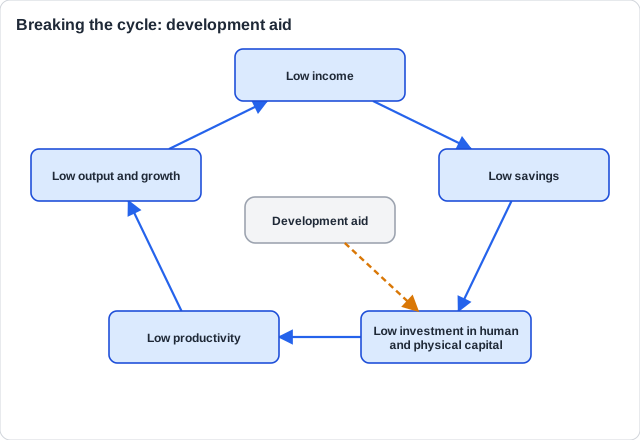
Aid breaks the poverty cycle when it raises investment.
When aid works
- It fills the savings and foreign-exchange gaps.
- It pays for health and schooling: smallpox was wiped out by 1980.
- South Korea used large aid flows in the 1950s and 1960s.
When it fails
- Corruption: aid to Zaire under Mobutu was stolen.
- Dependency: governments rely on donors, not taxes.
- Tied aid serves the donor's firms and politics.
Paper 1 asked this in May 2023, as part (b) for 15 marks.
Using real-world examples, evaluate the effectiveness of foreign aid in promoting economic development.
Model answer plan
See the answer broken into clear points, with guidance on how each point earns marks.
How the 15 marks are given
| Marks | What your answer needs |
|---|---|
| 13–15 | Theory fully explained, terms right all the way through, balanced evaluation, real examples fully developed to support the argument |
| 10–12 | Theory explained, terms mostly right, evaluation mostly balanced, real examples developed |
| 7–9 | Theory partly explained, some evaluation but one-sided, examples partly developed |
| 4–6 | Theory only described, evaluation superficial, examples only named |
| 1–3 | Theory stated but not relevant, no evaluation |