Institutional change, first: access to banking.
Access to banking
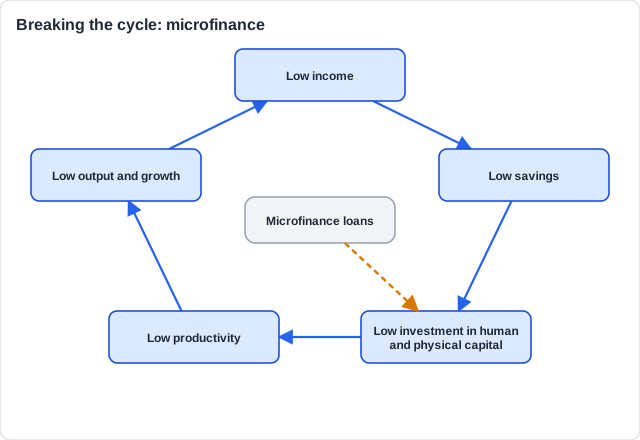
Microfinance
Small loans to people with no collateral. Bangladesh's Grameen Bank lends mostly to women.
Mobile banking
Save and send money by phone. Kenya's M-Pesa has done this since 2007.
Savings accounts
A safe place to save, so savings can be lent to others.
Free preview
This is the free notes preview
You're reading the free notes. Aimnova Pro unlocks the full study experience — and you can try it with your first topic free to keep:
- FlashcardsLock in vocabulary and key terms with spaced repetition.
- Practice questionsAnswer exam-style questions and get instant AI marking.
- Mock exams & past-paper vaultSit full mocks and see exactly how examiners award marks.
- Personalised study planA daily plan built around your exam date and weak areas.
Other institutional changes give people rights and trust.
Rights, women and honest government
Property and land rights
A legal title lets land back a loan and makes improving it worthwhile.
Women's empowerment
Schooling, credit and land for women raise output and children's health.
Less corruption
Fewer bribes cut firms' costs; public money reaches schools and clinics.
The points to remember
- Each change raises investment or human capital: say which.
- Land titles: land can be collateral for a loan.
See how examiners mark answers
Answer exam-style questions with model answers. Learn exactly what earns marks and what doesn't.
A social enterprise is a business whose main aim is social or environmental: it sells, then reinvests its profit in that aim.
What a social enterprise is
A charity
Lives on donations; gives help away.
A social enterprise
Sells goods or services, then reinvests profit in a social aim.
A profit-seeking firm
Sells to earn profit for its owners.
The points to remember
- Strength: it pays its own way, so it lasts without donors.
- Limit: it is small, and may struggle to earn enough.
Paper 2 asked this in May 2023, for 4 marks; May 2025 asked it about a micro-loan fund.
Text D says that a rural finance scheme now gives small loans to farmers in Ardena.
Using a poverty cycle diagram, explain how the scheme could raise farmers' incomes.
Model answer plan
See the answer broken into clear points, with guidance on how each point earns marks.
How the 4 marks are given
| Marks | What your answer needs |
|---|---|
| 3–4 | A correct diagram and a correct explanation |
| 1–2 | A correct diagram or a correct explanation, not both |
| 3 at most | A diagram with a wrong or missing label |