aımnova
DashboardMy LearningCrash CoursesStudy Plan

Aimnova site navigation

Stay in the loop

Get the latest study resources and updates

New features, study tips and exam insights — straight to your inbox.

IB Diploma

  • IB Past Papers
  • IB Study Notes
  • IB Question Bank
  • IB Mock Exams
  • IB Revision

IB Subjects

  • IB Math AA
  • IB Math AI
  • IB Economics
  • IB Business Management
  • IB Physics
  • IB Biology
  • View all IB subjects→

IB Past Papers

  • IB Math AA HL Past Papers
  • IB Math AA SL Past Papers
  • IB Math AI HL Past Papers
  • IB Math AI SL Past Papers
  • IB Economics HL Past Papers
  • IB Economics SL Past Papers
  • IB ESS Past Papers
  • View all past papers→

Study Resources

  • Study Notes
  • Question Bank
  • Mock Exams
  • Crash Courses
  • Flashcards
  • Revision Guide
  • Exam Skills
  • Command Terms
  • Grade Calculator
  • Exam Timetable 2026

Aimnova

  • Features
  • Pricing
  • For Teachers
  • For Schools
  • For Parents
  • About Us
  • Blog
  • Contact
aımnova

IB study, practice and feedback built around the real exam.

TermsPrivacyCookies·© 2026 Aimnova. All rights reserved.d92d737

Aimnova is not affiliated with or endorsed by the International Baccalaureate Organization (IB).

NotesEconomics HLTopic 4.10Foreign aid and multilateral assistance
Back to Economics HL Topics
4.10.54 min read

Foreign aid and multilateral assistance (Economics HL)

IB Economics · Unit 4

Smart study tools

Turn reading into results

Move beyond passive notes. Answer exam-style questions, get AI feedback, and build the skills that earn top marks.

Get Started Free

Contents

  1. 1Kinds of aid
  2. 2The World Bank and the IMF
  3. 3Does aid work?
  4. 4Exam-style question

Foreign aid: help on better terms than markets offer.

Kinds of foreign aid

KindWhat it is
Humanitarian aidEmergency food, shelter and medicine after a disaster or war
Development aidLong-term help: schools, clinics, roads, water
Official development assistance (ODA)Aid from governments, as grants or cheap loans
NGOsCharities such as Oxfam and Médecins Sans Frontières
Debt reliefCancelling or cutting a poor country's debts
Tied aidAid that must be spent on the donor's goods

The points to remember

  • Humanitarian = short-term emergency; development = long-term.
  • Tied aid must be spent on the donor's goods.

Free preview

This is the free notes preview

You're reading the free notes. Aimnova Pro unlocks the full study experience — and you can try it with your first topic free to keep:

  • FlashcardsLock in vocabulary and key terms with spaced repetition.
  • Practice questionsAnswer exam-style questions and get instant AI marking.
  • Mock exams & past-paper vaultSit full mocks and see exactly how examiners award marks.
  • Personalised study planA daily plan built around your exam date and weak areas.
Start Studying Free Full access to Aimnova Pro · cancel anytime

Two big lenders work for many countries at once: multilateral assistance.

The World Bank

  • Long-term loans and grants for development.
  • Projects: roads, power, schools, health.
  • Advice on running projects and policy.

The IMF

  • Short-term loans in a balance of payments crisis.
  • Loans come with conditions: spending cuts, reforms.
  • Watches economies and gives technical advice.

The points to remember

  • World Bank: development projects, long term.
  • IMF: crisis loans, short term, with conditions.

Memorize terms 3x faster

Smart flashcards show you cards right before you forget them. Perfect for definitions and key concepts.

Try Flashcards FreeYour first topic is free to keep • No credit card required

Aid breaks the poverty cycle when it raises investment.
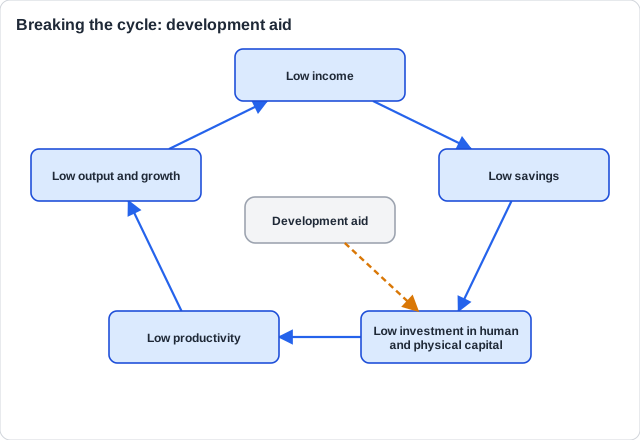
A poverty cycle: low income, then low savings, then low investment in human and physical capital, then low productivity, then low output and growth, back to low income; development aid raises low investment in human and physical capital.
Development aid raises investment in human and physical capital.

When aid works

  • It fills the savings and foreign-exchange gaps.
  • It pays for health and schooling: smallpox was wiped out by 1980.
  • South Korea used large aid flows in the 1950s and 1960s.

When it fails

  • Corruption: aid to Zaire under Mobutu was stolen.
  • Dependency: governments rely on donors, not taxes.
  • Tied aid serves the donor's firms and politics.

Paper 1 asked this in May 2024, as part (a) for 10 marks.

IB-style questionExplain[10 marks]

Explain the benefits of foreign aid for economically less developed countries.

Model answer plan

See the answer broken into clear points, with guidance on how each point earns marks.

Claim your free topic

How the 10 marks are given

MarksWhat your answer needs
9–10Theory fully explained, terms used correctly all the way through, the diagram included and fully explained
7–8Theory explained, terms mostly right, the diagram included and explained
5–6Theory partly explained, some terms, the diagram included
1–4Theory only described or stated; few relevant terms

Try an IB Exam Question — Free AI Feedback

Test yourself on Foreign aid and multilateral assistance. Write your answer and get instant AI feedback — just like a real IB examiner.

the term tied aid. [2 marks]

Related Economics HL Topics

Continue learning with these related topics from the same unit:

4.1.1Benefits of international trade4.1.2Free trade on a diagram: exports and imports4.1.3Absolute and comparative advantage (HL)4.1.4Limitations of comparative advantage (HL)
View all Economics HL topics
Improve your exam techniqueCommand terms, paper structure, and mark-scheme tips for Economics HL
Previous4.10.4Inward foreign direct investmentNextInstitutional change and social enterprise4.10.6

18 questions to test your understanding

Reading is just the start. Students who tested themselves scored 82% on average — try IB-style questions with AI feedback.

Start FreeView All Economics HL Topics