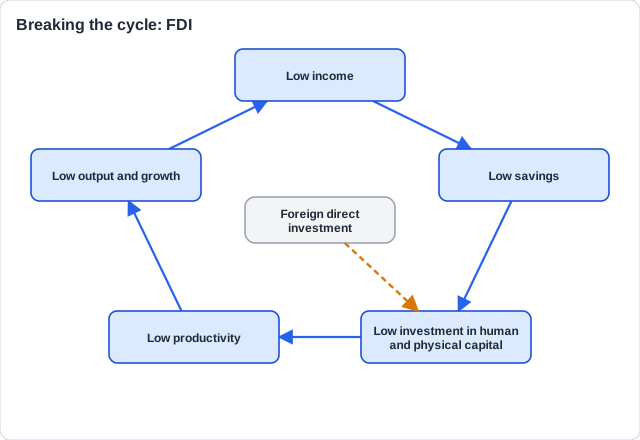
FDI: a multinational builds or buys a firm abroad.
What FDI can bring
Capital
Money a poor country cannot save itself: it fills the savings gap.
Jobs and skills
Workers learn new methods; local suppliers win orders.
Technology
Modern machines and know-how raise productivity.
Exports and tax
Foreign currency flows in; the firm pays tax.
Free preview
This is the free notes preview
You're reading the free notes. Aimnova Pro unlocks the full study experience — and you can try it with your first topic free to keep:
- FlashcardsLock in vocabulary and key terms with spaced repetition.
- Practice questionsAnswer exam-style questions and get instant AI marking.
- Mock exams & past-paper vaultSit full mocks and see exactly how examiners award marks.
- Personalised study planA daily plan built around your exam date and weak areas.
FDI also has costs, mostly for who keeps the gains.
What FDI can cost
Profits leave
Profits are sent back to the parent company abroad.
Low tax
Tax breaks to attract the firm, and profits shifted to low-tax countries.
Few links
Capital-intensive plants hire few local workers and buy little locally.
Damage
Mines and plants may pollute, with weak rules to stop them.
Memorize terms 3x faster
Smart flashcards show you cards right before you forget them. Perfect for definitions and key concepts.
Paper 1 asked this in May 2024 and May 2026, as part (b) for 15 marks.
Using real-world examples, discuss the benefits and costs of inward foreign direct investment (FDI) for economically less developed countries.
Model answer plan
See the answer broken into clear points, with guidance on how each point earns marks.
How the 15 marks are given
| Marks | What your answer needs |
|---|---|
| 13–15 | Theory fully explained, terms right all the way through, balanced evaluation, real examples fully developed to support the argument |
| 10–12 | Theory explained, terms mostly right, evaluation mostly balanced, real examples developed |
| 7–9 | Theory partly explained, some evaluation but one-sided, examples partly developed |
| 4–6 | Theory only described, evaluation superficial, examples only named |
| 1–3 | Theory stated but not relevant, no evaluation |