The big idea: Ergonomics is the relationship and interaction between people, the products they use, and the environments they use them in.
Three things — and what matters is the fit between them, not any one on its own.
A hospital drip stand is comfortable to push. It is still ergonomically wrong if its wheels jam on the lip of a lift door, because the environment is part of the problem. "Ergonomic" is not a synonym for "comfortable", and answers that treat it as one lose marks.
Step through each edge. The product–environment edge is the one students forget, and the one exam scenarios usually hide the mark in.
Interactive diagram
Explore the labelled diagram, charts and maps for this topic in full study mode.
Free preview
This is the free notes preview
You're reading the free notes. Aimnova Pro unlocks the full study experience — and you can try it with your first topic free to keep:
- FlashcardsLock in vocabulary and key terms with spaced repetition.
- Practice questionsAnswer exam-style questions and get instant AI marking.
- Mock exams & past-paper vaultSit full mocks and see exactly how examiners award marks.
- Personalised study planA daily plan built around your exam date and weak areas.
The guide asks you to describe how ergonomics improves a design. It names five specific improvements, and naming which one you mean is worth more than saying a product is "better".
The five improvements
Efficient
The task takes less time or less effort. A scanner angled towards the operator saves a wrist twist on every item — trivial once, hours across a shift.
Usable
A first-time user works it out without instructions. Hob controls laid out in the same pattern as the burners tell you which is which.
Functional
It does its job in the conditions it is actually used in — a cash machine screen readable in direct sun, not only indoors.
Effective
The user achieves what they came for. A blood-pressure cuff that is easy to position gives a reading you can trust.
Safe
It is harder to be hurt by it, and harder to use it wrongly. A guarded stop button cannot be knocked by a sleeve.
Use the words: "The handle is more efficient because it needs less grip force per lift" beats "the handle is nicer to hold" — same observation, one names the improvement.
Practice with exam-style questions
Answer exam-style questions and get AI feedback that shows you exactly what examiners want to see in a full-marks response.
Take a supermarket self-checkout. Every complaint about it is one edge of the triangle failing.
People ↔ product
- The bagging shelf sits at a height a shorter user has to lift over
- The screen text is too small to read without leaning in
People ↔ environment
- Queue noise drowns the error beep
- Overhead lights reflect off the screen at eye height
Product ↔ environment
- The card reader sits where the trolley cannot get near it
- The scanner glass fogs in a chilled aisle
The trap: Every one of those is an ergonomic failure, and only the first column is about the body. If your answer only ever talks about hands and heights, you are answering a third of the question.
The fits are judged with data about people. Exam questions ask you to sort it into three kinds:
Three kinds of data about people
Anthropometric
The sizes of bodies: hand width, seat height, reach.
Physiological
What bodies can do and how they tire: grip force, eyesight, endurance.
Psychological
What the senses pick up and how users feel about it: a sound, a colour, a texture.
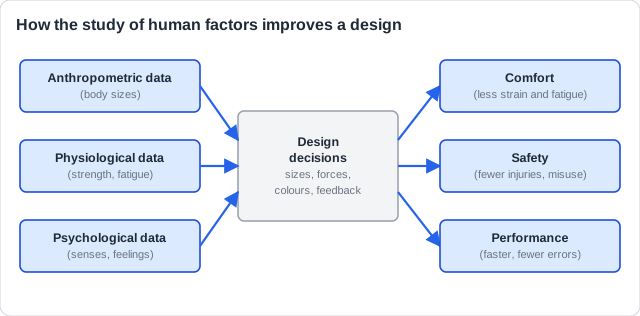
How this is tested — identifying what ergonomics covers and how improving it improves a product. It comes up two ways:
Paper 1 — multiple choice
- Pick the definition that includes the environment, not just the user.
- Spot which of five named improvements a change delivers.
Paper 2 — analysing a product
- Given a product, describe how an ergonomic change makes it safer or more efficient.
- Explain why a comfortable product can still be ergonomically poor.
The trap: "It is more comfortable" is not an ergonomic improvement on its own. Name which of the five — efficient, usable, functional, effective, safe — and say for whom.
A cordless drill is redesigned so its trigger can be squeezed with any finger and its grip is textured. Describe how these changes improve the drill ergonomically.
Model answer plan
See the answer broken into clear points, with guidance on how each point earns marks.
Explain how human factors data could make a hand-held hairdryer more comfortable, safer and better performing.
Model answer plan
See the answer broken into clear points, with guidance on how each point earns marks.