The big idea: A habitat is the place where an organism, a population, a species or a community lives. It is the address; what the species does there is its niche.
The points to remember
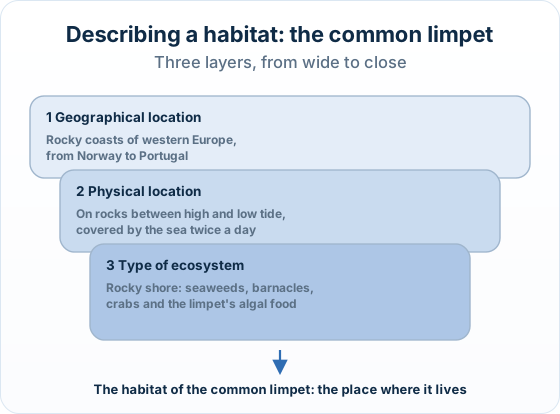
- Geographical location: where on Earth, such as a country, coastline or region.
- Physical location: where exactly, such as the middle shore, a riverbank or the forest floor.
- Type of ecosystem: rocky shore, coral reef, rainforest, grassland or swamp.
- A habitat can belong to one organism, a population, a species or a whole community.
Habitat
- Where it lives
- Geographical and physical location
- Type of ecosystem
Niche
- How it lives: its role
- How it feeds, grows and reproduces
- Its abiotic and biotic interactions
Remember it as: Habitat = address; niche = job.
Real example: a population of limpets. The limpets on one stretch of rocky shore are a population; with the barnacles, seaweeds and crabs that share those rocks they form a community, and all of them live in the same rocky-shore habitat.
Trap: A full habitat description has more than one layer: 'in the sea' is too vague. Give where on Earth, where exactly, and the ecosystem.
Free preview
This is the free notes preview
You're reading the free notes. Aimnova Pro unlocks the full study experience — and you can try it with your first topic free to keep:
- FlashcardsLock in vocabulary and key terms with spaced repetition.
- Practice questionsAnswer exam-style questions and get instant AI marking.
- Mock exams & past-paper vaultSit full mocks and see exactly how examiners award marks.
- Personalised study planA daily plan built around your exam date and weak areas.
Start Studying Free Full access to Aimnova Pro · cancel anytime
How it is asked: Expect 'outline the habitat of a named species', or a question that asks you to tell a habitat from a niche.
IB-style questionOutline[3 marks]
Outline the habitat of the Eurasian red squirrel in Scotland.
Model answer plan
See the answer broken into clear points, with guidance on how each point earns marks.