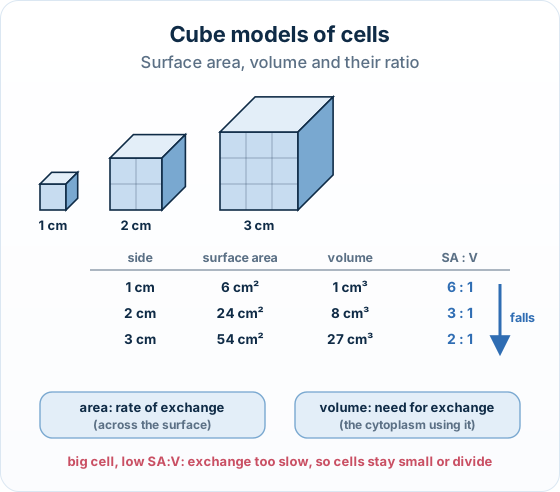
The big idea: As a cell gets bigger its volume grows faster than its surface area, so the SA:V ratio falls and exchange cannot keep up.
The points to remember
- Materials enter and leave across the surface, so the rate of exchange depends on the surface area.
- The need for exchange (oxygen used, waste made) depends on the volume of the cell.
- When a cell doubles its length, its area is multiplied by 4 but its volume by 8, so SA:V halves.
- A large cell would not exchange materials fast enough, so cells stay small or divide.
- A cube is a simplified model of a cell: real cells are not cubes, but area and volume scale the same way.
Remember it as: Bigger cell, smaller ratio, slower exchange per unit of cell.
| For a cube of side L | Formula |
|---|---|
| Surface area | 6 × L × L |
| Volume | L × L × L |
| SA:V ratio | surface area ÷ volume |
Real example: a bacterium and an egg: An E. coli bacterium is only about 2 µm long, so its surface area is large compared with its volume. It takes in food fast enough to divide every 20 minutes in good conditions, far faster than a large cell could.
Free preview
This is the free notes preview
You're reading the free notes. Aimnova Pro unlocks the full study experience — and you can try it with your first topic free to keep:
- FlashcardsLock in vocabulary and key terms with spaced repetition.
- Practice questionsAnswer exam-style questions and get instant AI marking.
- Mock exams & past-paper vaultSit full mocks and see exactly how examiners award marks.
- Personalised study planA daily plan built around your exam date and weak areas.
Start Studying Free Full access to Aimnova Pro · cancel anytime
How it is asked: Expect a Paper 1A item on how SA:V and the rate of exchange change as a cell grows, a cube calculation, or a Paper 2 Explain or Suggest about size, heat or exchange.
IB-style questionExplain[2 marks]
Explain why cells cannot keep growing larger without limit.
Model answer plan
See the answer broken into clear points, with guidance on how each point earns marks.