The big idea: In a eukaryotic cell transcription happens in the nucleus and translation in the cytoplasm, so the mRNA can be modified before any ribosome reads it.
The points to remember
- The nuclear membrane keeps the DNA and transcription inside the nucleus.
- Translation by ribosomes happens outside, in the cytoplasm.
- So there is time to modify the mRNA after transcription (for example, cutting out introns).
- Only the finished mRNA leaves through the nuclear pores to the ribosomes.
- Prokaryotes have no nucleus: ribosomes can join the mRNA at once, so it cannot be modified first.
Remember it as: Copy in the nucleus, edit, then read outside.
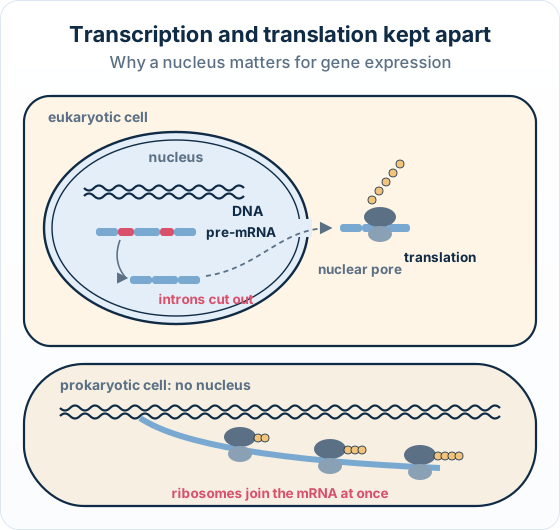
Real example: the human beta-globin gene: The gene for part of haemoglobin is copied into pre-mRNA with two introns in it. Both are cut out in the nucleus before the mRNA reaches a ribosome.
Free preview
This is the free notes preview
You're reading the free notes. Aimnova Pro unlocks the full study experience — and you can try it with your first topic free to keep:
- FlashcardsLock in vocabulary and key terms with spaced repetition.
- Practice questionsAnswer exam-style questions and get instant AI marking.
- Mock exams & past-paper vaultSit full mocks and see exactly how examiners award marks.
- Personalised study planA daily plan built around your exam date and weak areas.
Start Studying Free Full access to Aimnova Pro · cancel anytime
How it is asked: Expect it inside a question on compartments: an Explain [2] about the nucleus, or one point of a longer answer on why eukaryotic cells are divided up.
IB-style questionExplain[2 marks]
Explain one advantage to a eukaryotic cell of having its DNA inside a nucleus, separate from the cytoplasm.
Model answer plan
See the answer broken into clear points, with guidance on how each point earns marks.