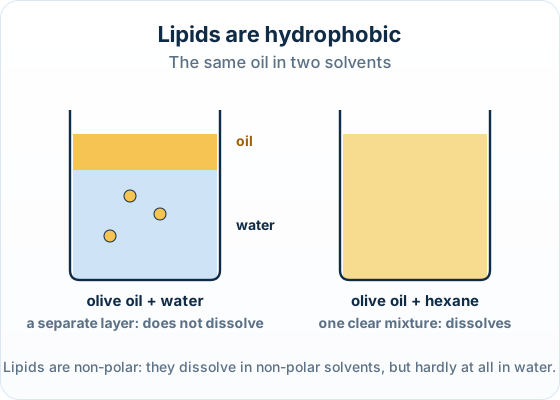
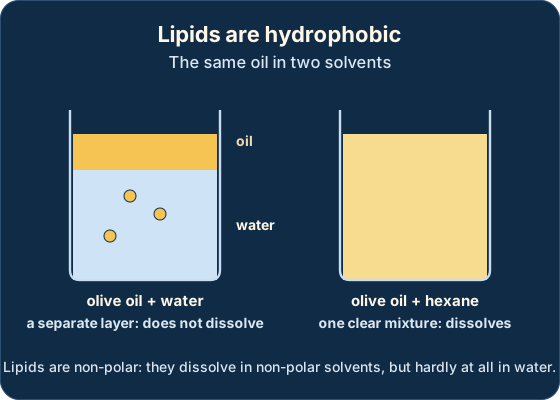
The big idea: Lipids are the molecules of life that dissolve in non-polar solvents but hardly at all in water.
The points to remember
- A lipid dissolves in non-polar solvents (such as hexane) but only sparingly in water.
- So lipids are hydrophobic: water-repelling.
- Fats (solid at room temperature) and oils (liquid) are lipids.
- Waxes and steroids (such as cholesterol and testosterone) are lipids too.
Fats and oils
- Butter is a fat: solid.
- Olive oil is an oil: liquid.
Waxes
- Beeswax in honeycomb.
- The waxy cuticle on leaves.
Steroids
- Cholesterol in membranes.
- Testosterone, a hormone.
Real example: a cabbage leaf: Rain forms round drops on a cabbage leaf and rolls off. The leaf is covered in a waxy cuticle, a lipid that water cannot wet.
Free preview
This is the free notes preview
You're reading the free notes. Aimnova Pro unlocks the full study experience — and you can try it with your first topic free to keep:
- FlashcardsLock in vocabulary and key terms with spaced repetition.
- Practice questionsAnswer exam-style questions and get instant AI marking.
- Mock exams & past-paper vaultSit full mocks and see exactly how examiners award marks.
- Personalised study planA daily plan built around your exam date and weak areas.
Start Studying Free Full access to Aimnova Pro · cancel anytime
The big idea: Lipids are non-polar, so they cannot form hydrogen bonds with water. Water keeps them out.
The points to remember
- Lipids are mostly long chains of carbon and hydrogen, which are non-polar.
- Non-polar molecules have no charges, so they cannot form hydrogen bonds with water.
- Water molecules hydrogen-bond to each other instead and push the lipid out.
- So lipid droplets join together and float on water as a separate layer.
Remember it as: Non-polar, no hydrogen bonds with water: hydrophobic.
Polar (hydrophilic)
- Glucose, salts, amino acids
- Form hydrogen bonds or attract water
- Dissolve in water
Non-polar (hydrophobic)
- Fats, oils, waxes, steroids
- No hydrogen bonds with water
- Dissolve in non-polar solvents
Sparingly, not never: Lipids are only sparingly soluble in water: a very little dissolves. Say "insoluble or only sparingly soluble in water, soluble in non-polar solvents".
Stop wasting time on topics you know
Our AI identifies your weak areas and focuses your study time where it matters. No more overstudying easy topics.
Try Smart Study FreeYour first topic is free to keep • No credit card required
How it is asked: No paper has set this statement on its own so far. It comes up inside longer lipid questions, so practise a short answer in the Paper 2 style.
IB-style questionOutline[2 marks]
Outline why lipids such as triglycerides are hydrophobic.
Model answer plan
See the answer broken into clear points, with guidance on how each point earns marks.