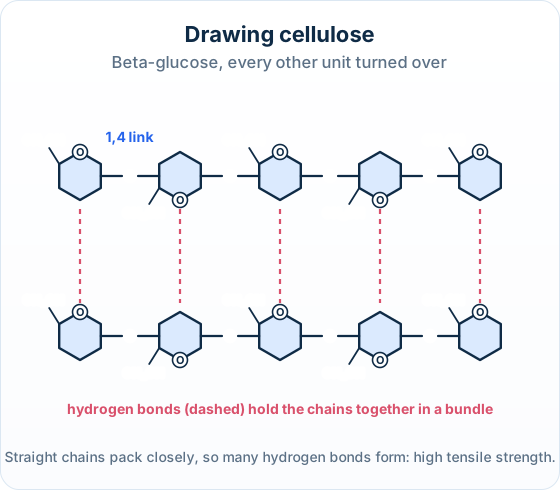
The big idea: Cellulose is made of beta-glucose. Each unit is turned over compared with its neighbour, so the chain is straight.
The points to remember
- Cellulose is a polymer of beta-glucose, joined by condensation (1,4 links).
- Each beta-glucose is turned over compared with the one before: the units alternate.
- So the chain stays straight, with no branches and no coiling.
Remember it as: Beta: flip, flip, flip, so the chain stays straight.
Real example: cotton: A cotton fibre is a single plant cell whose wall is about 90% cellulose. That is why cotton fabric is so strong.
Free preview
This is the free notes preview
You're reading the free notes. Aimnova Pro unlocks the full study experience — and you can try it with your first topic free to keep:
- FlashcardsLock in vocabulary and key terms with spaced repetition.
- Practice questionsAnswer exam-style questions and get instant AI marking.
- Mock exams & past-paper vaultSit full mocks and see exactly how examiners award marks.
- Personalised study planA daily plan built around your exam date and weak areas.
The big idea: Straight chains can lie close together and hydrogen-bond into bundles. That makes cellulose strong enough to build cell walls.
The points to remember
- Straight chains lie side by side and pack closely.
- Hydrogen bonds form between neighbouring chains, cross-linking them.
- Many chains make a bundle (a microfibril): a fibre with high tensile strength.
- In the cell wall this strength stops a plant cell bursting when water enters by osmosis.
- Humans have no enzyme to break its links, so cellulose passes through us as fibre.
Starch (a store)
- Alpha-glucose
- Coiled and branched
- Compact, glucose released easily
Cellulose (a structure)
- Beta-glucose, alternate units turned over
- Straight, unbranched chains
- Bundles held by hydrogen bonds: strong
Remember it as: Straight, side by side, hydrogen-bonded: strong.
One trap when you explain its function:
Say what the strength does: "It has a structural function" on its own is not enough. Say it gives the cell wall strength and stops the cell bursting.
Feeling unprepared for exams?
Get a clear study plan, practice with real questions, and know exactly where you stand before exam day. No more guessing.
How it is asked: Multiple-choice items on the structure or the function of cellulose, and a structure diagram with two parts: identify the monomer, then explain how the structure suits the function.
The structure of part of a cellulose molecule is shown. Identify the monomer from which cellulose is composed.
Model answer plan
See the answer broken into clear points, with guidance on how each point earns marks.
Then the three-mark part:
Explain how the structure of cellulose is related to its function.
Model answer plan
See the answer broken into clear points, with guidance on how each point earns marks.