The big idea: Lipids (fats and oils) are the body's main long-term energy store. The lipid used for storage is the triglyceride — one glycerol joined to three fatty acids.
Where fat is stored: Animals store triglycerides as fat in special storage cells called adipose tissue, often as a layer under the skin and around organs.
A triglyceride as an energy store: a glycerol joined to three long, hydrophobic fatty-acid tails packed with energy-rich C–H bonds.
Interactive diagram
Explore the labelled diagram, charts and maps for this topic in full study mode.
Two stores, two jobs: The body keeps two kinds of energy store:
Carbohydrate (glycogen in animals) = the short-term, quick-access store — used first, between meals.
Lipid (triglyceride fat) = the long-term, high-capacity store — used for sustained energy needs and saved for when food is scarce.
- Lipid
- A group of fatty, water-insoluble biological molecules that includes fats, oils and phospholipids.
- Triglyceride
- The lipid used to store energy: one glycerol molecule joined to three fatty acids.
- Adipose tissue
- Animal tissue made of fat-storage cells; it stores triglycerides and forms an insulating layer under the skin.
- Energy store
- A molecule the body builds up when energy is plentiful and breaks down later to release that energy.
Free preview
This is the free notes preview
You're reading the free notes. Aimnova Pro unlocks the full study experience — and you can try it with your first topic free to keep:
- FlashcardsLock in vocabulary and key terms with spaced repetition.
- Practice questionsAnswer exam-style questions and get instant AI marking.
- Mock exams & past-paper vaultSit full mocks and see exactly how examiners award marks.
- Personalised study planA daily plan built around your exam date and weak areas.
Triglycerides suit energy storage because of three properties, and each one comes straight from their structure.
Learn the property and the reason behind it — the exam rewards the link, not just the fact.
The three storage advantages
- More energy per gram. Triglycerides release about twice as much energy per gram as carbohydrates, because their long fatty-acid tails are packed with energy-rich C–H bonds and very little oxygen.
- Insoluble in water. Fatty-acid tails are hydrophobic (water-repelling), so fat does not dissolve in the cytoplasm and does not draw water into the cell by osmosis — it stores quietly without upsetting the cell's water balance.
- Compact and light. Because they hold so much energy and carry no extra water, fat stores the same energy for less mass — useful for animals that must move or migrate.
A triglyceride as an energy store: a glycerol joined to three long, hydrophobic fatty-acid tails packed with energy-rich C–H bonds.
Interactive diagram
Explore the labelled diagram, charts and maps for this topic in full study mode.
Insoluble is an advantage here: Being insoluble sounds like a problem, but for a store it is exactly what you want.
Because the fatty-acid tails are hydrophobic, fat does not dissolve in water and does not add dissolved particles to the cell.
No pull on water: So storing a lot of fat does not lower the cell's water potential or pull water in by osmosis — large amounts can be stored safely.
A soluble store like glucose would affect the cell's water balance.
Fat also keeps you warm and cushioned: The fat layer in adipose tissue does more than store energy:
Thermal insulation — a layer of fat under the skin slows heat loss, helping mammals (and especially animals in cold water, like whales and seals) keep a steady body temperature.
Protection — fat around organs acts as a cushion against knocks.
Fat stored in adipose tissue under the skin: droplets of triglyceride act as a long-term energy store and as a layer of thermal insulation.
Interactive diagram
Explore the labelled diagram, charts and maps for this topic in full study mode.
- Hydrophobic
- Water-repelling; a non-polar part of a molecule that does not mix with or dissolve in water.
- Osmosis
- The movement of water across a membrane from a more dilute to a more concentrated solution; a soluble store can affect it, an insoluble one cannot.
- Thermal insulation
- Reducing the loss of heat; a fat layer under the skin slows heat escaping from the body.
See how examiners mark answers
Answer exam-style questions with model answers. Learn exactly what earns marks and what doesn't.
The big idea: Fat under the skin is a heat insulator. Warm-bodied animals in cold habitats need a thicker layer.
The points to remember
- Mammals and birds keep their bodies warm, at about 37 °C or more, whatever the habitat.
- Fat conducts heat poorly, so a layer of adipose tissue under the skin slows heat loss.
- The colder the habitat, the more heat would be lost, so the thicker the fat layer.
- Water takes heat away faster than air, so animals in cold water carry the thickest fat (blubber).
- The same fat is also an energy store, used up in seasons when food is scarce.
Remember it as: Warm body, cold home, thick fat.
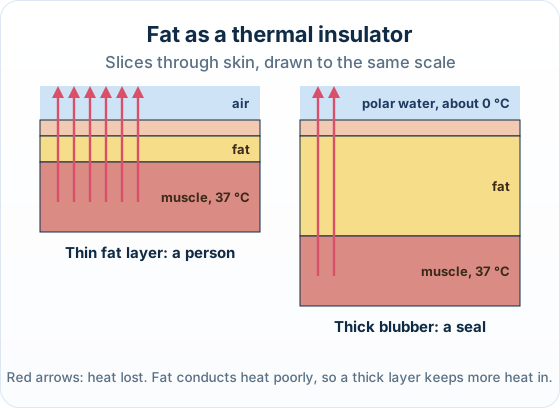
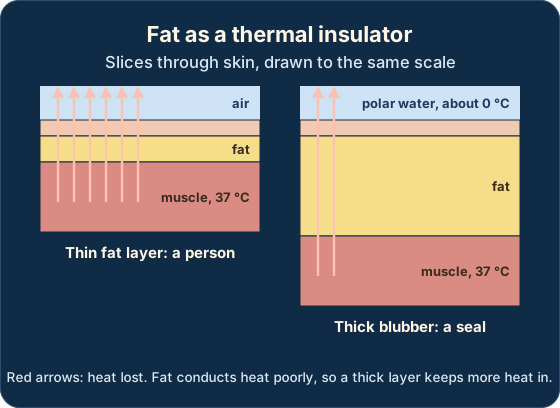
Real example: ringed seals: Ringed seals live in Arctic water near 0 °C. A thick layer of blubber under the skin keeps their body warm and stores energy.
How this is tested: On Paper 2 this is usually a 2–4 mark Describe / Outline / Explain question.
What you may be asked
- Describe the structure and properties of triglycerides as energy stores.
- Explain how triglyceride properties suit them for storage.
- Explain why oils are insoluble while glucose dissolves in water. Answer it from polarity: fatty-acid tails are hydrophobic / non-polar; glucose has many polar –OH groups.
- For full marks, always pair the property with its reason (insoluble because hydrophobic; high energy because many C–H bonds).
Exam-style question — triglyceride properties as an energy store
Explain how the properties of triglycerides make them well suited to storing energy in animals. [4]
How to score all four marks
- Pair property 1 with its reason. Triglycerides release more energy per gram than carbohydrates because their long fatty-acid tails contain many energy-rich C–H bonds.
- Pair property 2 with its reason. They are insoluble in water because the fatty-acid tails are hydrophobic — so the store does not draw water in by osmosis and does not affect the cell's water balance.
- Add the consequence. Being energy-dense and water-free, fat stores the same energy for less mass, so it is a compact, long-term store.
- Add the bonus role. Fat in adipose tissue under the skin also gives thermal insulation, reducing heat loss. (Each clearly explained point — property + reason — scores a mark, up to 4.)
Final answer
High energy per gram (many C–H bonds), insoluble because hydrophobic (no osmotic effect), so a compact long-term store; the fat layer also insulates.
Watch the verb: Describe = say WHAT the properties are (high energy density, insoluble, compact).
Explain = also say WHY (because of C–H bonds / hydrophobic tails).
The 'why insoluble' question
A 'why oils are insoluble' question is really asking about polarity.
Fatty-acid tails are non-polar / hydrophobic, so they cannot form bonds with polar water. Glucose has many polar –OH groups that can, so it dissolves.
| Property | Lipid (triglyceride / fat) | Carbohydrate (glycogen / starch) |
|---|---|---|
| Energy released per gram | About twice as much | About half as much |
| Solubility in water | Insoluble (hydrophobic) | Soluble / can affect water balance |
| Effect on the cell's water (osmosis) | None — does not draw water in | Can draw water in / raise osmotic pressure |
| Mass carried for the same energy | Lighter store for the same energy | Heavier store for the same energy |
| How quickly it is released | Slower — a long-term store | Faster — a short-term, ready store |
A two-mark Paper 2 version asks for properties linked to storage:
Explain how the properties of triglycerides make them suitable for energy storage.
Model answer plan
See the answer broken into clear points, with guidance on how each point earns marks.