The big idea: Reliable surveys from habitats all around the world show that biodiversity is falling fast: a biodiversity crisis.
The points to remember
- IPBES is the international panel of experts that reviews the evidence on biodiversity for the world's governments.
- Its 2019 global report estimated that about 1 million species of animals and plants are threatened with extinction.
- The Living Planet Index follows thousands of animal populations: on average they have fallen by about 70% since 1970.
- The evidence comes from many habitats, on land, in fresh water and in the sea.
- It must come from reliable surveys: careful methods, repeated over time.
Real example: insects in Germany: Volunteers trapped flying insects in the same nature reserves in Germany for 27 years. The mass of insects caught fell by about three quarters between 1989 and 2016.
Use the evidence the right way:
Evidence, not opinion: Say what the surveys and reports show, with a figure if you can. 'Everyone knows species are disappearing' is not evidence.
Free preview
This is the free notes preview
You're reading the free notes. Aimnova Pro unlocks the full study experience — and you can try it with your first topic free to keep:
- FlashcardsLock in vocabulary and key terms with spaced repetition.
- Practice questionsAnswer exam-style questions and get instant AI marking.
- Mock exams & past-paper vaultSit full mocks and see exactly how examiners award marks.
- Personalised study planA daily plan built around your exam date and weak areas.
Start Studying Free Full access to Aimnova Pro · cancel anytime
The big idea: Surveys must be repeated, at the same places with the same methods, to show a change in species richness and evenness.
The points to remember
- Species richness: the number of different species in an area.
- Species evenness: how equal the numbers of each species are.
- One survey shows biodiversity at one time only.
- A repeated survey, same sites and same method, shows whether richness and evenness are falling.
- Evenness can fall before any species is lost, when one species takes over.
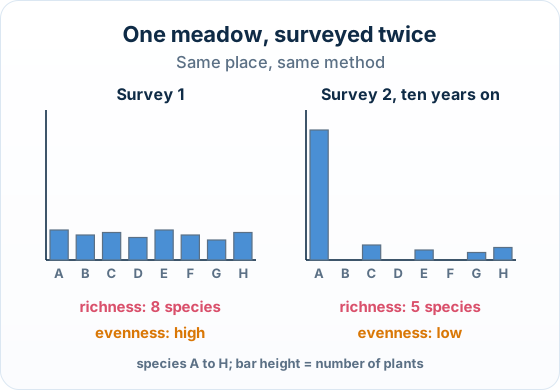
Real example: a meadow survey: A school surveys the plants of a meadow with quadrats every June, using the same method each year. Only by comparing the years can it see that a few grasses are taking over.
Read a single survey with care:
One survey shows no change: A single survey cannot be evidence of a crisis: a change needs at least two surveys to compare.
Study smarter, not longer
Most students waste 40% of study time on topics they already know. Our AI tracks your progress and optimizes every minute.
Try Smart Study FreeYour first topic is free to keep • No credit card required
The big idea: Evidence comes from expert scientists and from citizen scientists. To be trusted, it is published and peer-reviewed so that others can check the methods.
The points to remember
- Expert scientists design surveys, identify species reliably and publish their results.
- Citizen scientists are members of the public who collect data, such as counting birds or insects.
- Benefits: many observers, huge areas, many years, low cost.
- Concerns: misidentified species, different effort or methods, and more records from easy places.
- Evidence is verifiable when it is published after peer review, so others can check the method.
Remember it as: Many eyes, checked by experts.
Citizen data: benefits
- Far more data than scientists alone
- Wide areas and long time spans
- Cheap to collect
Citizen data: concerns
- Species may be misidentified
- Effort and methods vary
- Bias to easy places and species
Real example: the Big Garden Birdwatch: Every January, hundreds of thousands of people in the UK count the birds in their gardens for one hour. It has run since 1979, so trends over decades can be seen.
Weigh both sides:
Not useless, not perfect: Citizen data are not worthless and not automatically reliable. Say how methods, training and checking make them usable.
How it is tested: Paper 1B: read survey data and say what changed. Paper 2: outline why surveys are repeated, or discuss evidence from citizen scientists.
IB-style questionOutline[2 marks]
Outline why biodiversity surveys must be repeated to provide evidence of a biodiversity crisis.
Model answer plan
See the answer broken into clear points, with guidance on how each point earns marks.
Name richness and evenness: When you read survey data, say what happened to the number of species and to how equal their numbers are.