The big idea: Biodiversity — the variety of living things — is falling fast, and human activity is the main cause. When a species disappears completely it has become extinct — gone forever.
Almost every current threat traces back to five human-driven causes
- Habitat loss
- Overexploitation
- Pollution
- Invasive species
- Climate change
| Human cause | What it means | Example |
|---|---|---|
| Habitat loss | Natural homes are cleared, drained or built over | Cutting down rainforest for farmland |
| Overexploitation | Species taken from the wild faster than they breed | Overfishing a fish stock to collapse |
| Pollution | Harmful substances added to air, water or soil | Pesticides and plastic harming wildlife |
| Invasive species | A non-native species spreads and out-competes natives | Rats eating the eggs of ground-nesting birds |
| Climate change | Human-driven warming shifts conditions faster than species can adapt | Coral bleaching as the sea warms |
The five human drivers all push biodiversity down. Habitat loss is drawn largest because it destroys the most — but overexploitation, pollution, invasive species and climate change all add to the falling trend (remember them as HIPPO).
Interactive diagram
Explore the labelled diagram, charts and maps for this topic in full study mode.
Two words to keep straight: Extinction = the last member of a species dies, so the species is lost permanently.
Biodiversity loss = the overall variety of species is falling — it includes extinctions but also shrinking populations before any species is fully gone.
Free preview
This is the free notes preview
You're reading the free notes. Aimnova Pro unlocks the full study experience — and you can try it with your first topic free to keep:
- FlashcardsLock in vocabulary and key terms with spaced repetition.
- Practice questionsAnswer exam-style questions and get instant AI marking.
- Mock exams & past-paper vaultSit full mocks and see exactly how examiners award marks.
- Personalised study planA daily plan built around your exam date and weak areas.
Extinctions have happened naturally throughout Earth's history, but today the rate is far higher and is driven by people.
An easy way to remember: HIPPO: Each of these causes earns exam marks. An easy way to remember them is HIPPO: Habitat loss, Invasive species, Pollution, human Population growth and Over-exploitation, with climate change added on top.
- Biodiversity
- The variety of living organisms — the number of different species and the variety within them.
- Extinction
- The permanent loss of a species when its very last member dies.
- Habitat loss
- Destruction or fragmentation of the natural place where a species lives (e.g. deforestation, draining wetlands).
- Overexploitation
- Harvesting or hunting a species faster than it can reproduce, so its population crashes.
- Invasive species
- A non-native species, introduced by humans, that spreads and harms native species by competing with, eating or infecting them.
Habitat loss is the biggest driver: Of the five, habitat loss destroys the most biodiversity. When a forest, reef or wetland is cleared, every species that depends on it loses its home at once — not just one target species.
Invasive species are especially damaging on islands, where native species often have no defences against a brand-new predator or competitor.
Direct causes
- Overexploitation — hunting or fishing a species to collapse
- Invasive species — a new predator eating natives directly
- Fast and obvious — one species is targeted
Indirect causes
- Habitat loss — removing the place a species needs to live
- Pollution and climate change — changing the conditions
- Slower and wider — many species harmed at once
Stop wasting time on topics you know
Our AI identifies your weak areas and focuses your study time where it matters. No more overstudying easy topics.
The big idea: Today's sixth mass extinction is caused by people. Case studies show how: a giant bird on land, a seal in the sea, and one species from closer to home.
The points to remember
- North Island giant moa: a flightless bird up to about 3.6 m tall, overhunted for meat and eggs within about 150 years of people reaching New Zealand.
- Moa had never met a large predator, so they did not flee, and they bred slowly, so numbers could not recover.
- Caribbean monk seal: a marine species hunted for the oil in its blubber and for meat; the last one was seen in 1952.
- Overfishing of the reef fish it ate may also have left it short of food.
- Pick a third case study from where you live: one species lost from your own region.
- Each case shows the same thing: people killed or destroyed faster than the species could breed.
Remember it as: Hunted faster than it could breed.
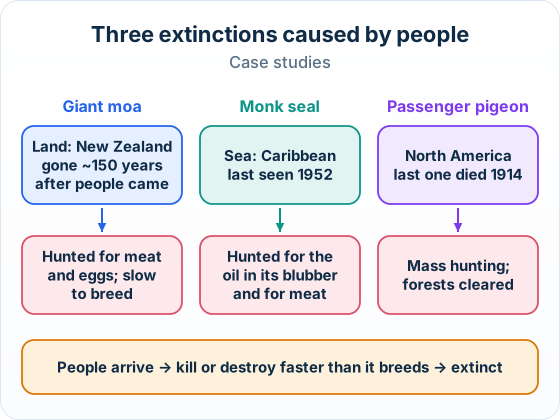
Real example: the passenger pigeon: Passenger pigeons once flew over North America in flocks of millions. Mass hunting for cheap meat, and the clearing of the forests they nested in, wiped them out: the last one died in a zoo in 1914.
Name the human cause:
Not disease or competition: The giant moa was not wiped out by new diseases, deforestation alone or competition with other animals. The evidence points to overhunting by people.
How this is tested: This topic is tested on Paper 1A and Paper 2, each in a different way.
Question types
- Paper 1A (multiple choice): you are asked to identify the human cause behind a named extinction, or to pick which listed factors cause biodiversity loss.
- Paper 2: a short List or Suggest question can ask you to name human activities that threaten a group such as pollinators.
- Paper 2: a Discuss or Explain question can ask for the impacts of an invasive species or of deforestation on a named population.
Exam-style question — an invasive cane toad
Cane toads were released into a region of Australia to control beetles, but they spread rapidly. The toads are poisonous and have no natural predators there. Discuss the likely impacts of the cane toad on the region's biodiversity. [3]
How to build a 3-mark answer
- Identify the cause. The cane toad is an invasive (non-native) species introduced by humans.
- Give a direct impact. Native predators that eat the toad are poisoned and die, so their populations fall.
- Give a knock-on impact. With no natural predators the toad's numbers explode; it competes with and preys on native species, reducing their populations — so overall biodiversity falls.
Final answer
The cane toad is an invasive species: it poisons native predators that try to eat it, and with no predators of its own it multiplies and out-competes or eats native species, lowering biodiversity.
Why this scores: A Discuss answer needs named impacts with reasoning, not just 'it is bad'. This answer identifies the cause (invasive species), gives a direct effect (poisoning predators) and a knock-on effect (population explosion → out-competing natives → lower biodiversity).