aımnova
DashboardMy LearningCrash CoursesStudy Plan

Aimnova site navigation

Stay in the loop

Get the latest study resources and updates

New features, study tips and exam insights — straight to your inbox.

IB Diploma

  • IB Past Papers
  • IB Study Notes
  • IB Question Bank
  • IB Mock Exams
  • IB Revision

IB Subjects

  • IB Math AA
  • IB Math AI
  • IB Economics
  • IB Business Management
  • IB Physics
  • IB Biology
  • View all IB subjects→

IB Past Papers

  • IB Math AA HL Past Papers
  • IB Math AA SL Past Papers
  • IB Math AI HL Past Papers
  • IB Math AI SL Past Papers
  • IB Economics HL Past Papers
  • IB Economics SL Past Papers
  • IB ESS Past Papers
  • View all past papers→

Study Resources

  • Study Notes
  • Question Bank
  • Mock Exams
  • Crash Courses
  • Flashcards
  • Revision Guide
  • Exam Skills
  • Command Terms
  • Grade Calculator
  • Exam Timetable 2027

Aimnova

  • Features
  • Pricing
  • For Teachers
  • For Schools
  • For Parents
  • About Us
  • Blog
  • Contact
aımnova

IB study, practice and feedback built around the real exam.

TermsPrivacyCookies·© 2026 Aimnova. All rights reserved.d9e1c61

Aimnova is not affiliated with or endorsed by the International Baccalaureate Organization (IB).

NotesSports, Exercise and Health ScienceTopic 10.2
Unit 10 · Stress and coping · Topic 10.2

IB Sports, Exercise and Health Science — Coping

Coping

Exam technique guidePractice questions

Key concepts in Coping

Start here: Most questions on this topic are on self-talk, often from a study's data. Show every step of a calculation, and give evidence for and against a hypothesis.

1. Coping strategies

  • A stressor causes strain, positive or negative.
  • Problem-focused: change the stressor (problem solving, seeking information).
  • Emotion-focused: calm the reaction (relaxation, emotional support, self-talk).
  • Avoidance-focused: get away from it (ignoring, quitting).

2. Self-talk and relaxation

  • Self-talk can be problem- or emotion-focused; unintentional self-talk positive or negative.
  • Mechanisms: recall good experiences, acronyms, cue words.
  • Negative self-talk narrows attention.
  • Relaxation training gives more control of heart rate.

3. Reading a study

  • Show the subtraction as well as the answer.
  • Random assignment: groups start alike, so the training explains the change.
  • Overlapping error bars: the difference may not be significant; a t-test decides.
  • A control group that also improved weakens the claim.

One stressor, three categories of coping.
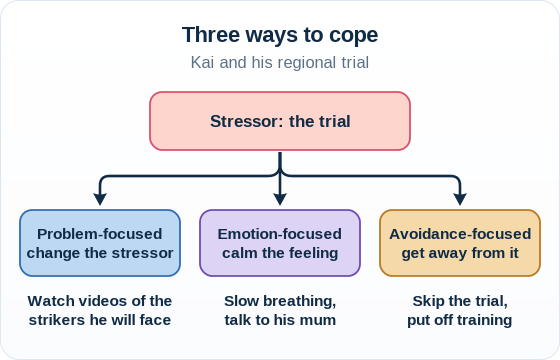
A stressor with three coping categories and examples
Recap: three ways to cope.

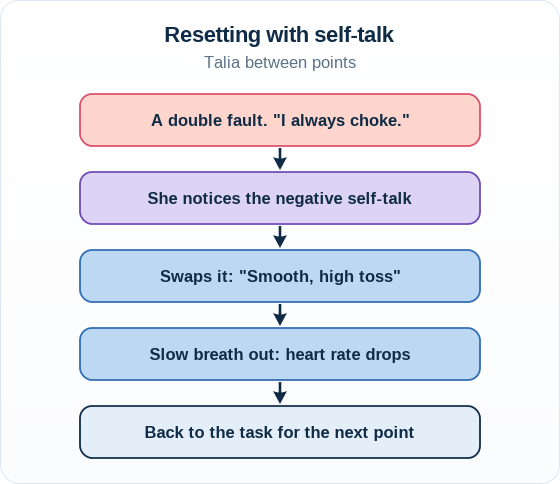
Resetting with self-talk.

Resetting with self-talk: notice, swap, breathe, refocus
Recap: the self-talk reset.

Inside My Learning

Turn these notes into practice

Try each question, reveal a clear model answer, and learn how to build your response.

  • 1.Classify *asking the coach about tactics* and *talking to a friend to calm down*. [2]
  • 2.Outline how self-talk helps a player after a mistake. [2]
  • 3.Outline why participants are randomly assigned to groups. [2]
Claim your free topic

Key terms, one line each:

TermIn one line
Stressora demand that causes strain
Problem-focused copingacting on the stressor itself
Emotion-focused copingmanaging the emotional reaction
Avoidance-focused copingmoving away from the stressor
Cue worda short word that triggers focus or calm

Inside My Learning

Turn these notes into practice

Try each question, reveal a clear model answer, and learn how to build your response.

  • 1.Seeking information: which category?
  • 2.Quitting: which category?
  • 3.Overlapping error bars mean?
Claim your free topic
IB-style questionDiscuss[4 marks]

A study finds that a self-talk group improved its free-throw score more than a control group. Discuss whether this supports the hypothesis that self-talk improves shooting.

Model answer plan

See the mark-by-mark plan — for / against / judgement, with marking guidance — in study mode.

Claim your free topic →

Exam tips

  • Show the subtraction as well as the answer.
  • Give the benefit of random assignment and why.
  • Discuss a hypothesis with evidence for and against.
  • Seeking information is problem-focused; seeking emotional support is emotion-focused.

What you'll learn in Topic 10.2

  • 10.2.1 Coping strategies
  • 10.2.2 Self-talk and relaxation
Suggested study order: Read the notes for each sub-topic below → test yourself with flashcards → attempt practice questions → review exam technique.

Study resources — 10.2 Coping

10.2.1

Coping strategies

Notes
10.2.2

Self-talk and relaxation

Notes

Ready to study Coping?

Get expert practice questions with instant AI feedback, and a study planner tailored to your IB Sports, Exercise and Health Science exam date.

Start studying free

Topic 10.2 Coping forms a core part of Unit 10: Stress and coping in IB Sports, Exercise and Health Science. Mastering these concepts will strengthen your understanding of connected topics across the syllabus and prepare you for exam questions that require analysis, evaluation, and real-world application.

Previous topic
10.1 Arousal and anxiety
Next topic
11.1 Goal setting
All Sports, Exercise and Health Science topics
Exam technique

Ready to practice?

Get AI-graded practice questions, mock exams, flashcards, and a personalised study plan — all aligned to your IB syllabus.

Start Studying Free

No credit card required · No time limit