Start here: Most questions on this topic are about anxiety and catastrophe theory, then how anxiety is measured. Separate cognitive from somatic anxiety and label both axes on any sketch.
1. Arousal theories
- Arousal: physical and psychological activation.
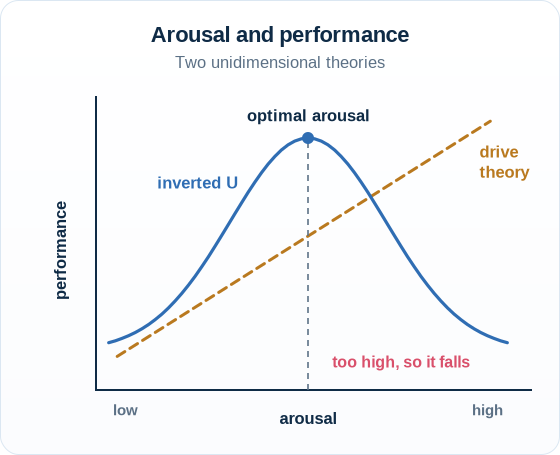
- Drive theory: performance rises with arousal; best for simple or well-learned skills.
- Inverted U: best at moderate arousal, a gradual fall either side.
- IZOF: each athlete has her own best zone.
2. Anxiety
- Cognitive (worry) and somatic (bodily signs) anxiety.
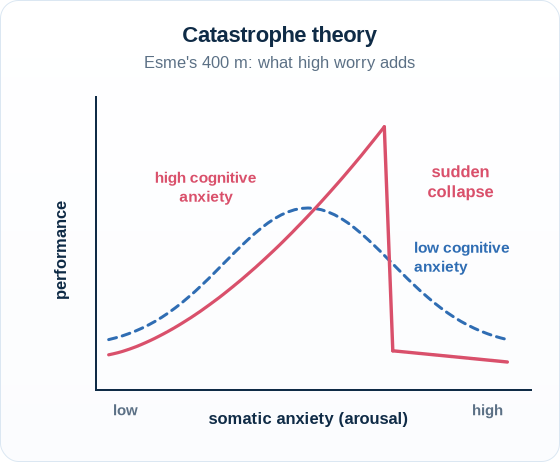
- Catastrophe theory: high cognitive anxiety plus high arousal: a sudden, sharp drop.
- Some anxiety can help: excitement rather than fear.
3. Measuring it
- Subjective: self-report questionnaires.
- Objective: heart rate, blood pressure, galvanic skin response.
- Self-report limits: bias, self-awareness, hard to use mid-competition.
Drive theory and the inverted U on one graph.
Catastrophe theory: the sudden drop.
Key terms, one line each:
| Term | In one line |
|---|---|
| Arousal | physical and psychological activation |
| Cognitive anxiety | worry and negative thoughts |
| Somatic anxiety | physical signs: heart rate, tension, sweating |
| IZOF | an athlete's individual zone of optimal functioning |
| Galvanic skin response | skin conductance, rising with sweat |
IB-style questionDiscuss[4 marks]
Discuss how anxiety could affect a swimmer in an Olympic final.
Model answer plan
See the mark-by-mark plan — for / against / judgement, with marking guidance — in study mode.
Exam tips
- Catastrophe = high cognitive anxiety and high arousal: a rapid decline.
- Inverted U: gradual rise, optimum at moderate arousal, gradual fall.
- GSR chain: anxiety, more sweating, higher skin conductance.
- In a sketch, label both axes and the optimal point.
- Self-report limits: subjective, social desirability, hard to use mid-event.